
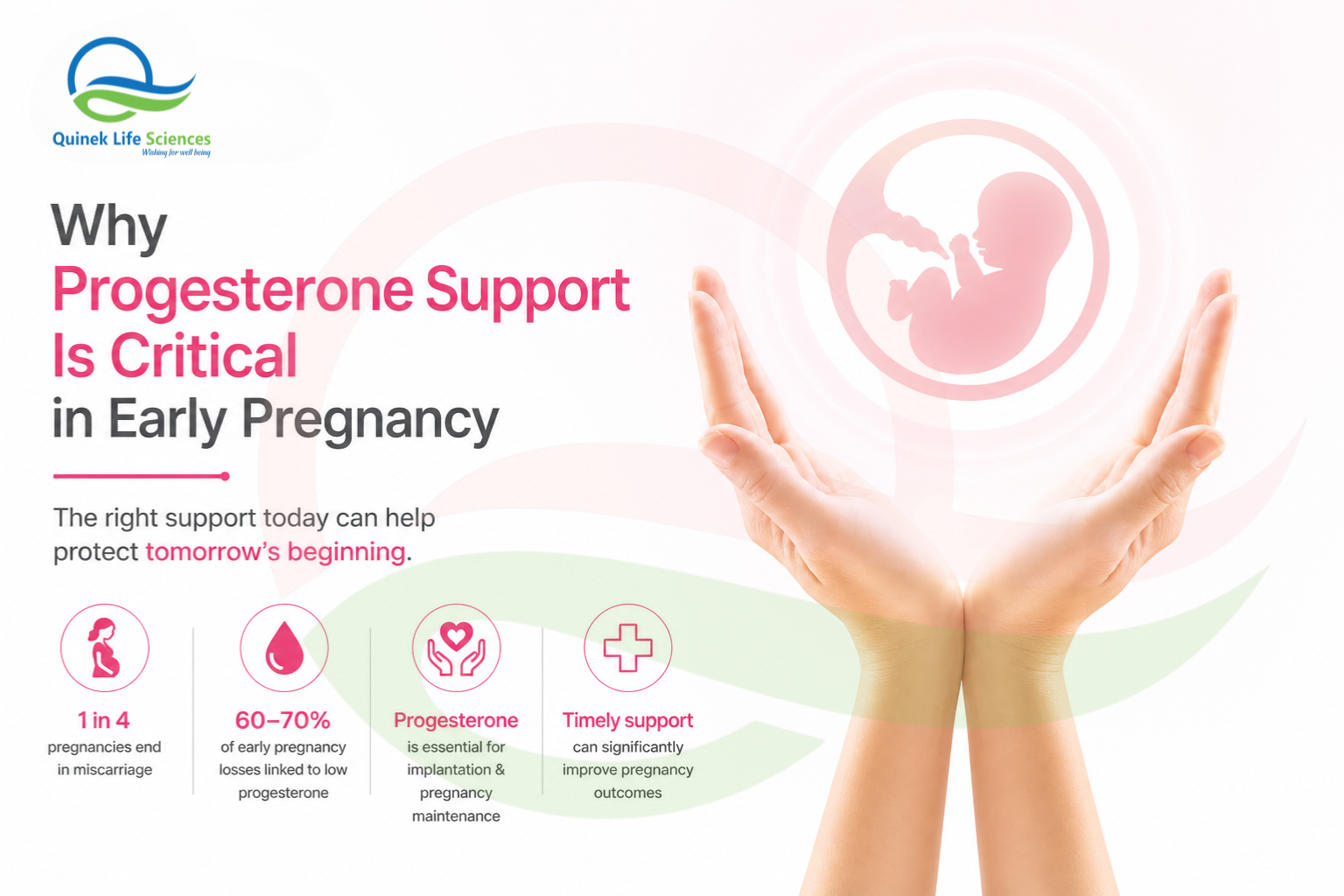
1 in 4
Pregnancies End in Miscarriage
35%
Of Recurrent Loss Linked to Luteal Deficiency
10–12 Wks
Corpus Luteum Solely Supplies Progesterone
70%
IVF Cycles Require Exogenous Progesterone
Many pregnancies are lost before a woman even knows something has gone wrong. The bleeding starts. The scan confirms the worst. And the question that follows — in almost every consultation — is: why did this happen?
In a significant proportion of first-trimester losses, the answer involves progesterone — either too little of it, too late in the luteal phase, or a corpus luteum that could not sustain production long enough for the placenta to take over. This is not a rare or exotic problem. It is one of the most clinically significant and most underdiagnosed contributors to early pregnancy failure in India.
This article is written for gynaecologists who want a thorough clinical reference, for general practitioners who are often the first to see a patient with a threatened miscarriage, and for patients and families trying to understand what is happening and why their doctor has prescribed progesterone. We have tried to make it precise, evidence-based and honest — in equal measure.
IN THIS ARTICLE
- What Is Progesterone and What Does It Do?
- What Happens When Progesterone Is Low?
- Who Is at Higher Risk of Progesterone Deficiency?
- How Is Progesterone Deficiency Diagnosed?
- How Do Doctors Manage Low Progesterone in Early Pregnancy?
- Progesterone Formulations — A Clinical Guide
- Is Progesterone Supplementation Safe?
- What About Women Who Show No Symptoms?
- Frequently Asked Questions
- How Quinek Life Sciences Supports Gynaecology Specialists
What Is Progesterone and What Does It Do?
Progesterone is a steroid hormone produced primarily by the corpus luteum — the temporary endocrine structure that forms in the ovary after ovulation. Its very name tells you its purpose: pro-gestational, literally “in favour of gestation.” It is the hormone that makes a pregnancy possible in its earliest and most vulnerable weeks.
From the moment of fertilisation, progesterone begins a series of coordinated actions that are essential for embryo survival:
Endometrial Preparation
Thickens and transforms the uterine lining into a receptive environment for embryo implantation. Without adequate progesterone, the endometrium cannot support a developing embryo.
Uterine Relaxation
Suppresses myometrial contractility — keeping the uterus relaxed and preventing expulsion of the embryo during the critical first trimester.
Immune Modulation
Suppresses the maternal immune response to prevent rejection of the embryo — which is genetically foreign to the mother. This immunotolerance mechanism is progesterone-dependent.
Placental Support
Bridges the critical luteal-placental shift — supporting the developing placenta until it is mature enough (around 10–12 weeks) to produce its own progesterone independently.
Cervical Mucus Plug
Maintains the quality and integrity of the cervical mucus plug — protecting the developing embryo and uterine cavity from ascending infection.
CLINICAL DEFINITION
Luteal phase deficiency (LPD) is defined as inadequate progesterone production by the corpus luteum following ovulation, resulting in suboptimal endometrial preparation and/or an inability to maintain early pregnancy. It is recognised as a contributing factor in both infertility and recurrent early pregnancy loss. Reference: Fertility and Sterility — Luteal Phase Deficiency, 2015
What Happens When Progesterone Is Low?
Low progesterone in early pregnancy — clinically termed luteal phase deficiency or progesterone insufficiency — disrupts every one of the mechanisms described above simultaneously. The endometrial lining may not be adequately maintained. The myometrium may become more contractile. The immunological environment may shift in a way that threatens embryo survival.
The outcome, in many cases, is miscarriage — often occurring before the woman is even aware that something is wrong. In recurrent cases, it follows a distressing and confusing pattern: a confirmed pregnancy, followed by loss, followed by no clear explanation offered to the patient.
It is important to note that low progesterone does not always present with symptoms. Many women with progesterone insufficiency feel entirely well — no spotting, no cramping, no warning signs — until a routine scan reveals the worst. This is why proactive monitoring is so important in at-risk patients.
Who Is at Higher Risk of Progesterone Deficiency?
While any pregnant woman can have suboptimal progesterone levels, certain groups face significantly elevated risk. Identifying these patients before a loss occurs — rather than after — is one of the most impactful things a clinician can do.
How Is Progesterone Deficiency Diagnosed?
Diagnosis is made through a combination of clinical history and targeted blood investigations. There is no single threshold that defines progesterone sufficiency in all clinical contexts — interpretation must always be made alongside the clinical picture and serial hCG trend.
Serum Progesterone — Interpretation in Context
A mid-luteal serum progesterone (Day 21 of a 28-day cycle) gives an indication of whether ovulation has occurred and whether post-ovulatory output is adequate. In early pregnancy, serial measurements provide more useful information than a single reading. A falling progesterone trend — even if absolute levels are within range — is often an early warning sign before any ultrasound abnormality is detectable.
CLINICAL POINT
A single progesterone reading must never be interpreted in isolation. Always correlate with gestational age, hCG doubling time and transvaginal ultrasound findings. Reference: NCBI — Serum Progesterone in Early Pregnancy and Pregnancy Outcomes
Additional Investigations
In patients with recurrent pregnancy loss, a broader workup is warranted alongside progesterone levels — including thyroid function (TSH, free T4), antiphospholipid antibodies, karyotyping of both partners, uterine cavity assessment (hysteroscopy or 3D ultrasound) and thrombophilia screen. Progesterone deficiency rarely exists in isolation.
How Do Doctors Manage Low Progesterone in Early Pregnancy?
The goal of progesterone supplementation is to bridge the gap between what the corpus luteum can produce and what the developing pregnancy requires — until the placenta is mature enough to take over. This is a supportive intervention, not a cure. The decision to supplement, the formulation chosen and the duration of therapy are all individualised based on clinical context.
When to Start
In IVF cycles, progesterone supplementation begins on the day of egg retrieval — the corpus luteum has been functionally ablated and exogenous progesterone is the only source. In spontaneous conceptions with a history of recurrent loss, supplementation is often started prophylactically in the luteal phase — before pregnancy is even confirmed — and continued through the first trimester. In cases of threatened miscarriage with confirmed cardiac activity, the evidence for supplementation is strongest in women with a prior history of loss.
EVIDENCE BASE
The PRISM trial (NEJM, 2019) — the largest randomised controlled trial of vaginal progesterone in women with first-trimester bleeding — found a significant improvement in live birth rates among women with a history of one or more prior miscarriages. The PROMISE trial (Lancet, 2015) evaluated progesterone in women with unexplained recurrent miscarriage and provided foundational evidence supporting supplementation in this population.
Progesterone Formulations — A Clinical Guide
Progesterone is not a single drug — it is available in multiple formulations with meaningfully different pharmacokinetic profiles, delivery routes and clinical indications. Choosing the right formulation for the right patient is not a minor detail. It directly affects serum levels, local uterine concentrations and patient adherence.
At Quinek Life Sciences, our gynaecology range includes progesterone and related hormonal formulations manufactured at WHO-GMP, GLP and ISO certified facilities — ensuring that every formulation delivers consistent bioavailability and the quality assurance that clinical outcomes depend on.
Micronised Progesterone — Oral and Vaginal
Micronised progesterone is natural progesterone processed into fine particles to improve absorption. Administered vaginally, it achieves high local uterine concentrations through the first-uterine-pass effect — making it particularly effective for endometrial support and luteal phase maintenance. Oral micronised progesterone undergoes significant first-pass hepatic metabolism, producing sedating neurosteroid metabolites (hence the recommendation to take it at night), but remains an effective option for luteal support.
QUINEK FORMULATION
QGESS-200 — Progesterone 200mg SR (Sustained Release)
Luteal phase support · Threatened miscarriage · First-trimester progesterone supplementation
WHO-GMP certified · Consistent bioavailability · SR formulation for sustained release profile
Progesterone Gel — Vaginal Route
Vaginal progesterone gel delivers the hormone directly to the uterine environment. The first-uterine-pass effect means that local endometrial progesterone concentrations are significantly higher than systemic serum levels would suggest — a phenomenon that makes vaginal gel particularly effective for endometrial support in IVF cycles and threatened miscarriage management.
QUINEK FORMULATION
Momtime Gel — Progesterone Gel 8.0% w/w
IVF luteal phase support · Endometrial preparation · Threatened miscarriage
Direct uterine delivery · First-uterine-pass effect · WHO-GMP certified
Dydrogesterone — Oral Retroprogesterone
Dydrogesterone is a retroprogesterone — a stereoisomer of progesterone with high oral bioavailability, strong progestogenic activity at the endometrial level and an excellent safety profile. Unlike natural progesterone, it does not produce the sedating neurosteroid metabolites of oral micronised progesterone and does not suppress the woman’s own progesterone production. Multiple randomised controlled trials support its use in threatened miscarriage and luteal phase deficiency, and it is a first-choice oral option for many gynaecologists.
QUINEK FORMULATION
QUINEK Dydrogesterone 10mg
Threatened miscarriage · Luteal phase deficiency · Recurrent pregnancy loss · Habitual abortion
High oral bioavailability · Does not suppress endogenous progesterone · WHO-GMP certified
Injectable Progesterone
Intramuscular progesterone in oil is used when very high serum progesterone levels are needed — primarily in IVF cycles using GnRH agonist protocols, or in cases where vaginal delivery is not feasible. It achieves the highest systemic levels but is associated with local injection site reactions, pain and occasional sterile abscesses with prolonged use.
QUINEK FORMULATION
Ezi-Trone INJ — Medroxyprogesterone Acetate 150mg/ml
Injectable progesterone support · IVF protocols · Cases requiring high systemic levels
WHO-GMP certified · Sterile manufacturing
FORMULATION SELECTION GUIDE — CLINICAL CONTEXT
IVF Luteal Support
Vaginal gel (Momtime) · Oral SR (QGESS-200) · Injectable (Ezi-Trone)
Threatened Miscarriage
Dydrogesterone 10mg (QUINEK) · Vaginal gel (Momtime) · Oral SR (QGESS-200)
Recurrent Pregnancy Loss
Dydrogesterone 10mg (QUINEK) · Oral SR (QGESS-200) — started from luteal phase
Post-Ovulation Induction
Oral SR (QGESS-200) · Dydrogesterone 10mg (QUINEK) — based on individual response
Is Progesterone Supplementation Safe?
Yes — when prescribed and monitored by a qualified clinician. Micronised progesterone and dydrogesterone, in particular, carry extensive safety data spanning decades of clinical use across multiple countries. They do not carry the androgenic or virilising risks associated with older synthetic progestogens.
The PRISM trial — which enrolled over 4,000 women — found no increase in adverse pregnancy outcomes, congenital abnormalities or neonatal complications with vaginal progesterone supplementation. Dydrogesterone has been studied extensively in threatened miscarriage, with multiple RCTs confirming safety and efficacy. Reference: Cochrane Database — Progestogens for Preventing Miscarriage.
IMPORTANT NOTE ON DURATION
In most clinical protocols, progesterone supplementation is continued until 10–12 weeks of gestation — the point at which the placenta has established sufficient steroidogenic capacity. In high-risk cases, specialist guidance may extend this to 16–20 weeks. Abrupt discontinuation before this point carries risk of progesterone withdrawal. Always taper under medical supervision.
What About Women Who Show No Symptoms?
This is where proactive clinical thinking matters most. Many women with progesterone insufficiency feel completely well — no spotting, no pain, nothing to prompt a consultation. The pregnancy feels normal. And then, on a routine scan, it does not.
The case for prophylactic progesterone support is strongest in women who are clinically asymptomatic but carry established risk factors. In these patients, waiting for symptoms before supplementing is equivalent to waiting for a problem that could have been prevented:
Two or More Unexplained Miscarriages
Start progesterone supplementation as soon as pregnancy is confirmed — or even in the luteal phase prior to confirmation.
IVF / ART Conception
Progesterone support is mandatory — begin from the day of egg retrieval and continue per protocol through the first trimester.
Ovulation Induction Cycles
Luteal phase support is recommended after ovulation induction. Serum progesterone monitoring guides the decision to supplement.
PCOS / Hormonal Imbalance
Baseline hormonal irregularity makes luteal insufficiency more likely. Proactive monitoring and supplementation should be considered at conception.
Frequently Asked Questions
Q. Can low progesterone be the only reason for miscarriage?
Not always. Chromosomal abnormalities are the most common cause of first-trimester loss overall. However, in recurrent miscarriage — where chromosomal causes are less likely to repeat — luteal phase deficiency becomes a more clinically significant contributing factor and warrants specific investigation and management.
Q. Is dydrogesterone better than natural progesterone for threatened miscarriage?
Both have established evidence. Dydrogesterone offers the advantages of high oral bioavailability, no sedating side effects, and the ability to be taken without food restrictions. Multiple RCTs — including a Cochrane systematic review — support its efficacy in threatened and habitual miscarriage. The choice between dydrogesterone and micronised progesterone depends on clinical context, route preference and individual patient factors.
Q. Can I take progesterone without a prescription?
No. All progesterone formulations are prescription medicines. The dose, route and duration must be individualised by a qualified gynaecologist based on clinical history and blood investigations. Self-medication in pregnancy carries risk and is strongly discouraged.
Q. Does stopping progesterone suddenly cause miscarriage?
Abrupt discontinuation before the placenta is functionally established — generally before 10–12 weeks — can be clinically significant and potentially harmful. Your doctor will typically taper the dose gradually or continue until a confirmed safe stage. Never stop or reduce the dose without explicit medical guidance.
Q. What is a normal progesterone level in early pregnancy?
First-trimester serum progesterone levels above 25 ng/mL are generally considered reassuring. Levels below 10 ng/mL raise significant concern. However, absolute values must always be interpreted alongside gestational age, hCG trend and ultrasound findings. No single number tells the complete story.
Q. Are there natural ways to increase progesterone?
Managing stress, maintaining a healthy weight, treating underlying thyroid dysfunction and supporting ovulation can all positively influence hormonal balance. However, in clinical progesterone deficiency during pregnancy, pharmaceutical supplementation is necessary and cannot be replaced by dietary changes or over-the-counter supplements alone.
How Quinek Life Sciences Supports Gynaecology Specialists
Quinek Life Sciences is a WHO-GMP, GLP and ISO certified specialty pharmaceutical company with a comprehensive gynaecology and IVF range — covering progesterone supplementation, hormonal therapy, ovulation induction support, antifungal management, nutritional supplementation and more.
In early pregnancy management, the quality of the progesterone formulation prescribed is not a secondary consideration. A patient who achieves stability on a well-manufactured progesterone formulation can experience a setback if switched to a substandard generic with inconsistent bioavailability. The brand matters. The facility it was made in matters. The quality standards it was manufactured under matter.
Our gynaecology product range — including QGESS-200, Momtime Gel, QUINEK Dydrogesterone and Ezi-Trone — is designed to give gynaecologists and IVF specialists in India the confidence that every formulation delivers exactly what it promises, every time. If you are looking to partner with a quality-first gynaecology pharmaceutical company in India — get in touch with our team today.
“Most early pregnancy losses are not inevitable. With the right progesterone support, at the right time, many can be prevented.”
Quinek Life Sciences — WHO-GMP Certified Gynaecology & IVF Pharmaceutical Company, India
References & Further Reading
- PRISM Trial — Vaginal Progesterone in Women with First-Trimester Bleeding, NEJM 2019
- PROMISE Trial — Progesterone in Recurrent Miscarriage, The Lancet 2015
- Cochrane Database — Progestogens for Preventing Miscarriage
- Fertility and Sterility — Luteal Phase Deficiency: Current Perspectives
- NCBI — Serum Progesterone in Early Pregnancy and Pregnancy Outcomes
- World Health Organization — Maternal Health and Pregnancy Loss Data
- Quinek Life Sciences — Gynaecology & IVF Pharmaceutical Segment
This article is for educational purposes and clinical reference only. It does not constitute medical advice for individual patients. Always consult a qualified gynaecologist for diagnosis and treatment decisions. Do not stop, start or change any medication during pregnancy without medical supervision.