
Nephrology
Phosphate Is Destroying the Hearts, Bones and Blood Vessels of CKD Patients in India. VELA Q Stops It — Without Adding Calcium.
In chronic kidney disease, phosphate accumulates in the blood because the kidneys can no longer excrete it. Left uncontrolled, this excess phosphate causes progressive bone disease, arterial calcification and a dramatically increased risk of cardiovascular death. Sevelamer Carbonate — the active ingredient in VELA Q 400 and VELA Q 800 — is the most studied non-calcium phosphate binder available, with published evidence from Indian CKD patients confirming its efficacy and safety in this population.
Why High Phosphate Is One of the Most Dangerous Complications of CKD
When kidneys function normally, they filter and excrete phosphate continuously — maintaining blood phosphate within a narrow physiological range. As CKD progresses and GFR falls, this excretory capacity is progressively lost. Phosphate absorbed from food accumulates in the blood. Initially, the body compensates — PTH rises to increase urinary phosphate excretion, FGF-23 increases, Vitamin D activation is suppressed. But as CKD advances, particularly beyond Stage 3b, these compensatory mechanisms are overwhelmed and serum phosphate rises above normal.
Elevated serum phosphate — hyperphosphatemia — is not simply an electrolyte abnormality. It is a systemic toxin in the context of CKD. Excess phosphate combines with calcium in the blood and in vessel walls, forming calcium-phosphate crystals that deposit in arteries, heart valves, skin and soft tissue — a process called vascular and extra-skeletal calcification. This calcification is irreversible, progressive and lethal. Dialysis patients with uncontrolled hyperphosphatemia have mortality rates significantly higher than those with controlled phosphate — driven primarily by cardiovascular events.
At the same time, high phosphate suppresses active Vitamin D production, causing secondary hyperparathyroidism — elevated PTH that pulls calcium from bones, causing renal osteodystrophy. This bone disease reduces quality of life, increases fracture risk and further accelerates cardiovascular calcification as calcium is released into the circulation. Controlling phosphate is not peripheral to CKD management — it is central to it.
“An Indian clinical study of Sevelamer Carbonate in CKD patients on haemodialysis confirmed significant reductions in serum phosphorus, PTH and LDL cholesterol — with no significant changes in serum calcium. Sevelamer Carbonate was well tolerated and effective in controlling hyperphosphatemia in Indian ESRD patients.”
— Indian Journal of Nephrology — Sevelamer Carbonate Experience in Indian ESRD Patients
What Is Sevelamer Carbonate — and How Does VELA Q Work?
Sevelamer Carbonate is a non-absorbed, non-calcium, metal-free polymeric phosphate binder. It is taken with every meal and works entirely within the gastrointestinal tract — it is never absorbed into the bloodstream. When swallowed with food, the positively charged polymer network of Sevelamer binds negatively charged phosphate ions released from food during digestion, trapping them in an insoluble complex in the intestinal lumen.
Because Sevelamer itself is not absorbed and the phosphate it binds cannot pass through the intestinal wall, the phosphate is excreted in the faeces rather than being absorbed into the bloodstream. The result is a meaningful reduction in the amount of dietary phosphate entering the circulation — reducing the phosphate burden on kidneys that can no longer excrete it.
Why Sevelamer Carbonate — Not Sevelamer Hydrochloride
Both Sevelamer Carbonate and Sevelamer Hydrochloride bind phosphate through the same polymer mechanism. The difference lies in the anion — carbonate versus chloride — and this difference has a clinically meaningful consequence in CKD patients who are already prone to metabolic acidosis.
Sevelamer Hydrochloride — The Problem
When Sevelamer Hydrochloride releases chloride ions as part of its phosphate-binding action, it contributes to a mild but cumulative acid load in the body — worsening the metabolic acidosis that is already a common and serious complication of CKD. In a patient population already battling acidosis, adding an acidogenic medicine is a pharmacological disadvantage.
Sevelamer Carbonate (VELA Q) — The Advantage
Sevelamer Carbonate releases bicarbonate — an alkalising agent — as it binds phosphate. This provides a mild but beneficial buffering effect that partially counteracts metabolic acidosis in CKD patients rather than worsening it. This is why Sevelamer Carbonate is the preferred formulation in current nephrology practice — same phosphate-binding efficacy, better acid-base profile for the CKD patient.
Why Non-Calcium Matters — The Problem With Calcium-Based Phosphate Binders
Calcium Carbonate and Calcium Acetate were the first widely used phosphate binders and remain in use due to their low cost. However, calcium-based binders carry a significant clinical liability that is particularly relevant in CKD patients: they add calcium to the body with every dose.
A dialysis patient may take calcium-based binders three times daily with three meals. Over weeks and months, this additional calcium load contributes to hypercalcaemia, suppresses PTH below normal (adynamic bone disease) and — most critically — provides the calcium substrate for vascular calcification. Phosphate binds calcium in vessel walls; if serum calcium is elevated by binder-derived calcium, this calcification process accelerates.
VELA Q 400 vs VELA Q 800 — Choosing the Right Strength
Dosing VELA Q — Starting Dose Based on Serum Phosphate
Dose adjustments should be made at 2-week intervals in increments of one tablet per meal, based on serum phosphate. Target serum phosphate: 3.5–5.5 mg/dL per KDOQI guidelines. VELA Q must always be taken with meals — taking it without food significantly reduces phosphate-binding efficacy. Do not crush or chew tablets.
Beyond Phosphate — The Additional Clinical Benefits of Sevelamer
LDL Cholesterol Reduction
Sevelamer binds negatively charged bile acids in the intestine as a secondary mechanism — reducing bile acid reabsorption and stimulating the liver to convert more cholesterol to bile acids, thereby lowering LDL cholesterol. The Indian clinical study and multiple international studies have confirmed modest but consistent LDL reductions with Sevelamer Carbonate — a clinically meaningful secondary benefit in a population with high cardiovascular risk.
Reduced Vascular Calcification
Multiple studies including the RIND and DCOR trials have demonstrated that dialysis patients on Sevelamer show significantly less coronary artery calcification progression than those on calcium-based binders. This structural protection of blood vessel integrity translates to the lower cardiovascular mortality seen in Sevelamer-treated patients over the long term.
Reduction of Inflammatory Markers
Emerging evidence suggests Sevelamer reduces circulating levels of CRP and other pro-inflammatory cytokines in CKD patients — potentially through reduction of advanced glycation end products (AGEs) absorbed from food. This anti-inflammatory effect adds another dimension to its cardiovascular-protective profile beyond phosphate control alone.
Improved PTH Control
By reducing serum phosphate — the primary stimulus for PTH secretion in CKD — VELA Q indirectly helps to reduce secondary hyperparathyroidism. Lower PTH means less parathyroid-mediated bone resorption, better bone mineral density maintenance and reduced calcium mobilisation from the skeleton into blood vessels.
What Dialysis Patients on VELA Q Must Understand
Always take VELA Q with meals — not before, not after. Sevelamer works by binding phosphate in food as it is digested. If taken without food, it has nothing to bind and provides no benefit. Taking it with every meal, including snacks containing significant protein, is essential.
Do not crush or chew VELA Q tablets. The polymer structure must remain intact for effective phosphate binding. Crushing or chewing alters the release characteristics and reduces efficacy.
Diet matters alongside medicine. VELA Q controls phosphate absorbed from meals, but dietary phosphate restriction remains essential. Reducing consumption of high-phosphate foods — processed foods with phosphate additives, cola drinks, dairy in large amounts and organ meats — works synergistically with VELA Q to achieve target phosphate levels.
Attend phosphate monitoring appointments. Serum phosphate should be checked regularly — every 1–3 months in stable dialysis patients. Dose adjustment based on phosphate results is how the full protective benefit of VELA Q is maintained over time.
Quinek Life Sciences — Nephrology Segment
VELA Q 400 & VELA Q 800 — Sevelamer Carbonate From a WHO-GMP Certified Nephrology Specialist
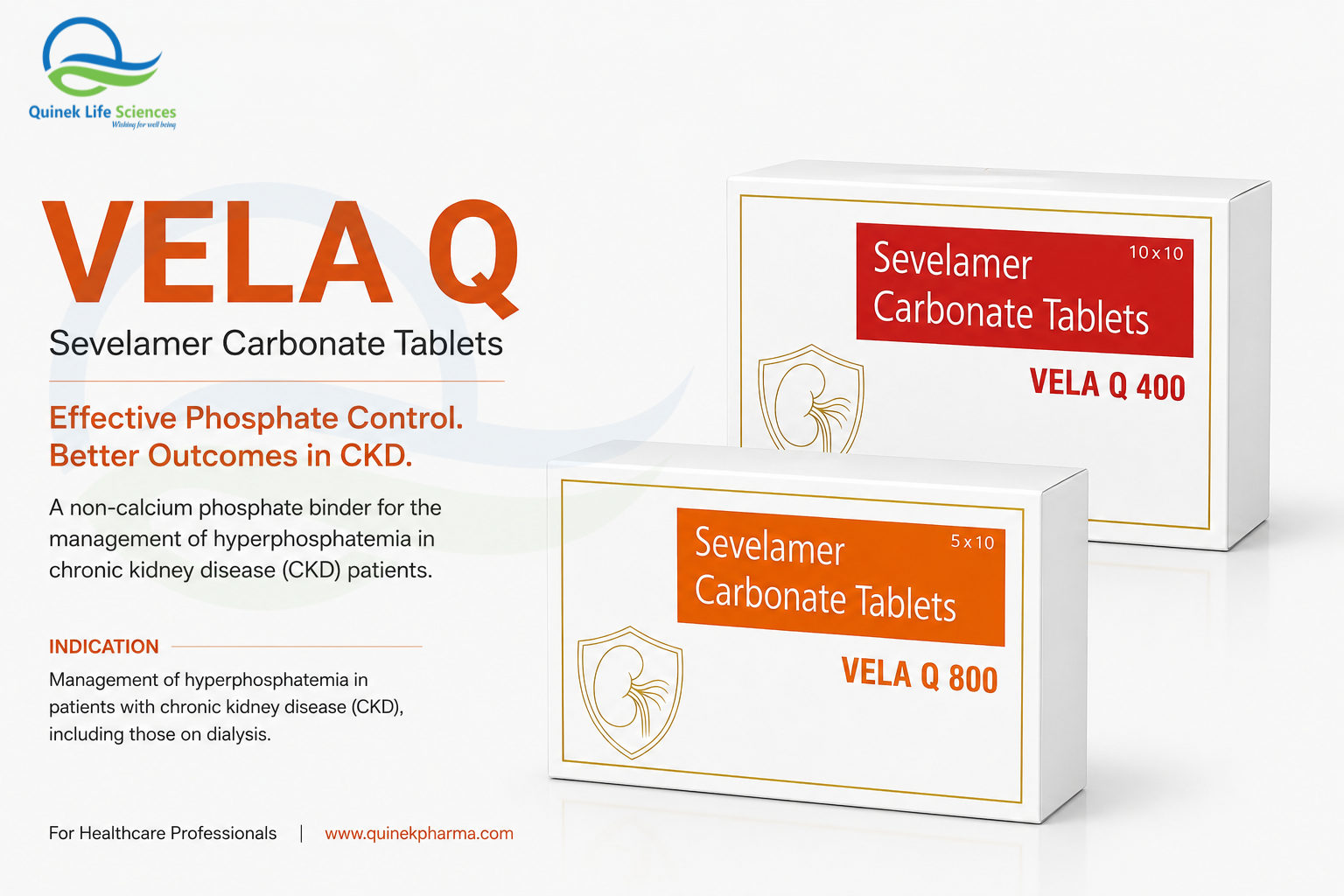
VELA Q 400 and VELA Q 800 are Quinek Life Sciences’ Sevelamer Carbonate formulations — available in both strengths to support the full clinical range of hyperphosphatemia management, from initiation and titration with VELA Q 400 to standard maintenance dosing with VELA Q 800. Manufactured at our WHO-GMP, GLP and ISO certified facilities with the batch-to-batch consistency that nephrology patients require from a medicine taken three times daily for life.
Quinek Life Sciences’ nephrology segment spans CKD management from early-stage renoprotection through dialysis care — and VELA Q sits at the heart of our dialysis pharmaceutical portfolio, addressing one of the most prevalent and most dangerous complications of end-stage renal disease in India.
If you are a nephrologist, a dialysis centre or a pharmaceutical distributor serving the nephrology space — we would like to speak with you about how VELA Q and our broader nephrology range can support your patients.
Every Meal Is a Phosphate Load. VELA Q Is What Intercepts It.
Dialysis removes a significant amount of phosphate from the blood during each session — but it is not enough. Three sessions a week cannot compensate for three meals a day, seven days a week, each delivering phosphate that the kidneys can no longer excrete. The gap between what dialysis removes and what food delivers must be bridged by a phosphate binder taken with every meal, consistently and correctly.
VELA Q does that without adding calcium to a system already at risk of calcification. Without raising the serum calcium that accelerates arterial disease. And with the additional benefit of mildly improving acidosis, reducing LDL and protecting cardiovascular health over the long term.
VELA Q 400 and VELA Q 800 — Sevelamer Carbonate from Quinek Life Sciences. Taken with food. Every meal. Because controlling phosphate is not a periodic intervention — it is a daily commitment to protecting what remains of a patient’s vascular and skeletal health.
Medical Disclaimer: This article is for educational purposes and healthcare professional reference only. Sevelamer Carbonate must be prescribed and monitored by a qualified nephrologist. All dosing decisions must be based on individual serum phosphate levels and clinical assessment.
Sources: Indian Journal of Nephrology — Sevelamer Carbonate in Indian ESRD Patients · NCBI — Sevelamer Carbonate vs Lanthanum Carbonate Study · Nefrología — Sevelamer Beyond Phosphorus Control · KDOQI CKD-MBD Guidelines · Steris Healthcare Clinical Reference · Quinek Life Sciences Nephrology Segment