
Nephrology ·
Tacrolimus After a Kidney Transplant — What Every Patient and Specialist Needs to Know About QLIME
A kidney transplant gives a patient their life back. Tacrolimus is what keeps that kidney safe. It is the most important medicine in the post-transplant protocol — and getting it right, at the right dose, from a quality manufacturer, is non-negotiable.
Why Kidney Transplant Patients Need Immunosuppression — For Life
When a kidney is transplanted from a donor to a recipient, the recipient’s immune system does not recognise the new organ as self. Left unchecked, it will attack and destroy the transplanted kidney in a process called rejection. This is not a malfunction — it is the immune system doing exactly what it is designed to do. Preventing it requires deliberately and carefully suppressing the immune system — for as long as the transplanted kidney is in the body.
Tacrolimus is the cornerstone immunosuppressant in modern kidney transplant medicine. It is the single most important post-transplant medicine in the majority of protocols used globally and in India — and the quality of the tacrolimus preparation, the consistency of its blood levels, and the patient’s adherence to the regimen determine, more than almost anything else, whether a transplanted kidney survives for one year or for twenty.
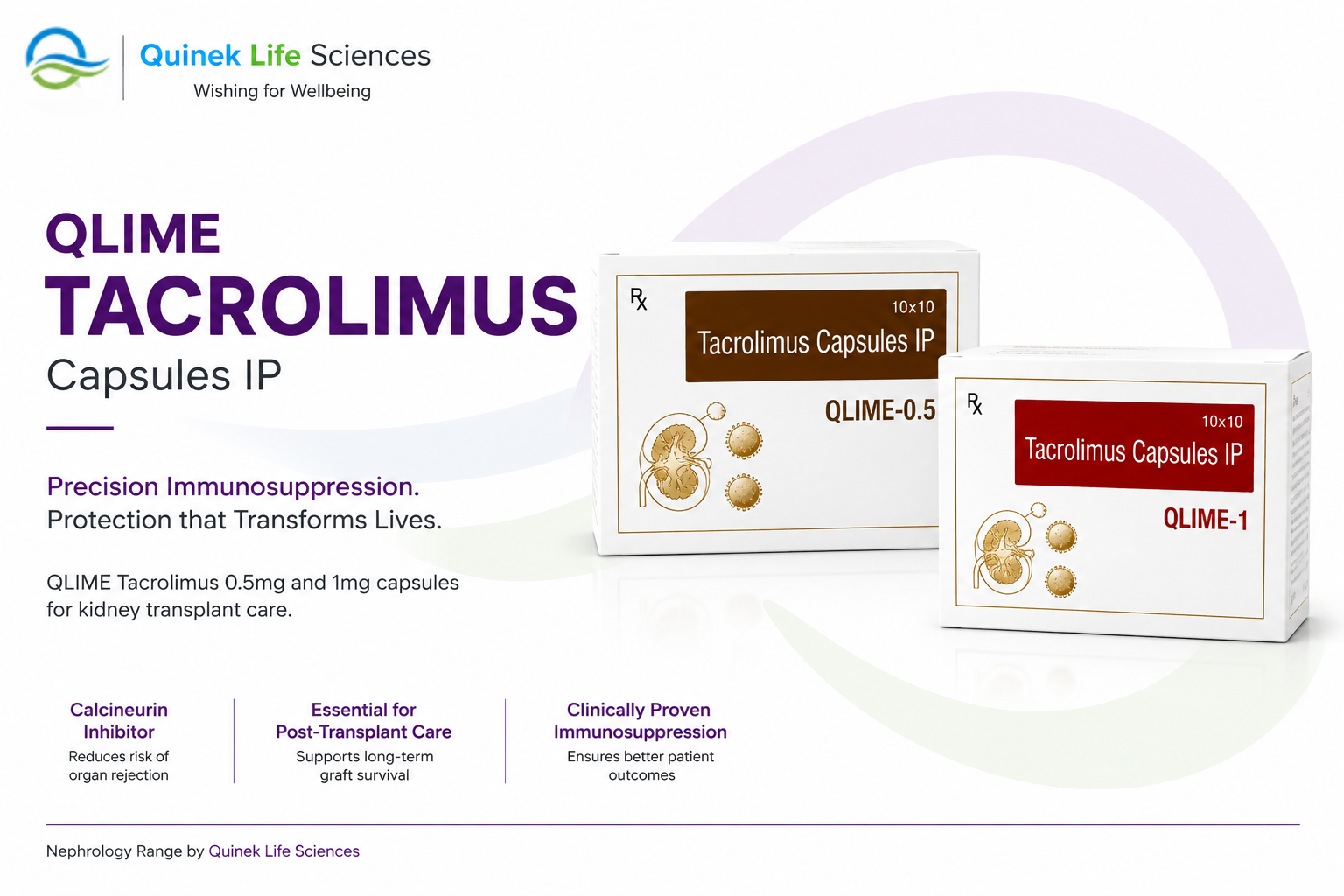
QLIME, Quinek Life Sciences’ Tacrolimus capsule formulation — available in 0.5mg and 1mg strengths — is manufactured to provide nephrologists and transplant teams across India with a quality-assured, consistently bioavailable tacrolimus option for post-transplant care.
“Tacrolimus has transformed transplant medicine. Before its introduction, long-term kidney graft survival rates were significantly lower. Today, it forms the backbone of virtually every kidney transplant immunosuppression protocol in the world.”
What Is Tacrolimus and How Does It Work?
Tacrolimus is a macrolide immunosuppressant derived from the soil bacterium Streptomyces tsukubaensis. It works by binding to an intracellular protein called FKBP-12, forming a complex that inhibits calcineurin — a phosphatase enzyme that is essential for activating T-lymphocytes, the immune cells responsible for recognising and rejecting foreign tissue.
By blocking calcineurin, Tacrolimus prevents the production of key immune signalling molecules — including Interleukin-2 and Interferon-gamma — that would otherwise trigger the immune cascade leading to graft rejection. The result is a selective but powerful suppression of the cell-mediated immune response, targeted precisely at the mechanism responsible for organ rejection.
Tacrolimus is available as oral capsules (the standard route for maintenance therapy) and as an intravenous solution for patients who cannot take oral medication in the immediate post-operative period. QLIME provides the oral capsule formulation in 0.5mg and 1mg strengths — the two doses most used in dose titration and maintenance protocols in Indian transplant practice.
Why QLIME Comes in 0.5mg and 1mg — The Importance of Dose Flexibility
Tacrolimus dosing is highly individualised. Every patient metabolises it differently — influenced by body weight, genetics (CYP3A5 polymorphisms are particularly relevant in the Indian population), concomitant medications, organ function and time post-transplant. This means the therapeutic dose for one patient may be very different from another — and the dose required in the first weeks after transplant will be quite different from what is needed as maintenance therapy years later.
QLIME 0.5mg Capsule
The 0.5mg strength is essential for fine dose titration — particularly during the maintenance phase when the required dose is lower and precision adjustments of 0.5mg have meaningful clinical impact on trough levels. It is also the preferred strength for paediatric dosing calculations and for patients who have been stable on low-dose tacrolimus for extended periods.
QLIME 1mg Capsule
The 1mg strength is the workhorse of the post-transplant protocol — used in both the early higher-dose phase (typically 0.1–0.15mg/kg/day in two divided doses) and the long-term maintenance phase. It provides the dose flexibility to prescribe common daily doses of 2mg, 3mg, 4mg and 5mg with simple capsule combinations — reducing the risk of dosing errors.
Dosing Protocol and Therapeutic Drug Monitoring
Tacrolimus is one of the few medicines in clinical use where therapeutic drug monitoring (TDM) is not optional — it is mandatory. The therapeutic window is narrow. Too little tacrolimus means rejection risk. Too much means toxicity — nephrotoxicity, neurotoxicity, diabetes and infection. Getting the trough level right is the central clinical task in post-transplant management.
Side Effects — What to Monitor and Why
Tacrolimus is a powerful medicine with a meaningful side effect profile. All of its significant adverse effects are dose-related and trough-level-dependent — which is precisely why rigorous monitoring is essential.
Nephrotoxicity
Tacrolimus can cause kidney damage — particularly when trough levels are consistently above the therapeutic range. Serum creatinine and GFR must be monitored regularly. If nephrotoxicity is suspected, dose reduction is required and alternative immunosuppressants may need to be considered.
New-Onset Diabetes After Transplant (NODAT)
Tacrolimus impairs insulin secretion, and a significant proportion of transplant patients develop diabetes as a result. Blood glucose monitoring is mandatory post-transplant. Dose reduction or a switch to a lower diabetogenic immunosuppressant may be considered in affected patients.
Neurotoxicity
Tremor, headache, insomnia, and in severe cases, posterior reversible encephalopathy syndrome (PRES) — all associated with high tacrolimus levels. Neurological symptoms in a post-transplant patient on tacrolimus should always prompt a trough level check immediately.
Infection Risk
By suppressing the immune system, tacrolimus increases vulnerability to bacterial, viral (particularly CMV) and fungal infections. Prophylactic antimicrobials are routinely co-prescribed in the early post-transplant period. Patients should be educated on infection warning signs.
Key Drug Interactions — For Prescribers and Pharmacists
Tacrolimus is metabolised by the CYP3A4 and CYP3A5 enzyme system. Any medicine that inhibits or induces these enzymes will significantly alter tacrolimus blood levels. This includes: Antifungals (Fluconazole, Voriconazole — increase levels), Antibiotics (Erythromycin, Clarithromycin — increase levels), Anticonvulsants (Phenytoin, Carbamazepine — decrease levels) and Rifampicin (dramatically decreases levels).
Grapefruit juice inhibits CYP3A4 and should be avoided completely by patients on tacrolimus. Even a single glass can raise tacrolimus levels significantly.
Tacrolimus should not be used with Sirolimus in kidney transplant patients — this combination is associated with increased thrombotic risk and nephrotoxicity.
What Every Kidney Transplant Patient on QLIME Should Know
Take QLIME at the same time every day — morning and evening doses must be 12 hours apart. Consistency in timing directly affects trough level stability.
Take it on an empty stomach or consistently with food — but never change your pattern. Food affects absorption and changing from fasted to fed can alter your blood levels.
Never miss a dose and never stop without your nephrologist’s guidance. Stopping tacrolimus — even briefly — puts your kidney at serious risk of rejection.
Keep all your blood monitoring appointments. Trough levels must be checked regularly, especially when any other medicine is started or stopped.
Do not switch brands without your nephrologist’s approval. Even small differences in bioavailability between tacrolimus preparations can result in clinically significant changes in trough levels.
Quinek Life Sciences — Nephrology Segment
QLIME — Tacrolimus 0.5mg & 1mg — Precision Immunosuppression from a WHO-GMP Certified Manufacturer
QLIME is Quinek Life Sciences’ dedicated Tacrolimus formulation — manufactured at our WHO-GMP, GLP and ISO certified facilities to the highest standards of pharmaceutical quality. In a medicine where batch-to-batch consistency and bioavailability precision directly impact patient outcomes, manufacturing quality is not a marketing claim — it is a clinical requirement.
Available in both 0.5mg and 1mg capsules, QLIME gives nephrologists and transplant teams the dose flexibility needed across the entire post-transplant journey — from the early high-dose induction phase through to years of low-dose maintenance therapy. Our nephrology range extends beyond immunosuppression to cover the full spectrum of post-transplant and CKD pharmaceutical needs.
If you are a nephrologist, a transplant centre or a pharmaceutical distributor serving the nephrology space — we would like to discuss how Quinek Life Sciences can support your pharmaceutical supply needs.
A Transplant Is a Second Chance — QLIME Is What Protects It
For a patient who has spent years on dialysis, a kidney transplant is not a procedure — it is a transformation. It is the difference between spending four hours, three times a week, connected to a machine, and living freely again. Protecting that transplant — keeping it functioning for decades — depends more on tacrolimus than on almost any other single variable in post-transplant care.
QLIME — Tacrolimus 0.5mg and 1mg from Quinek Life Sciences — is manufactured with the understanding that what goes into this capsule is not just an active ingredient. It is someone’s second chance. And that demands nothing less than the highest standard of pharmaceutical quality we can deliver.
Medical Disclaimer: This article is for healthcare professional and educational reference only. Tacrolimus therapy must be initiated and monitored by a qualified nephrologist or transplant physician. All dosing decisions must be based on individual patient assessment, trough level monitoring and clinical judgement.
Sources: CDSCO Prescribing Information — Tacrolimus · KDIGO Transplant Guidelines · Indian Society of Nephrology · GoodRx Clinical Reference · Quinek Life Sciences Nephrology Segment