
Neuropsychiatry
Depression, Anxiety, OCD, Panic Disorder, PTSD — One SSRI That Addresses All of Them. Introducing QOXY PR by Quinek Life Sciences.
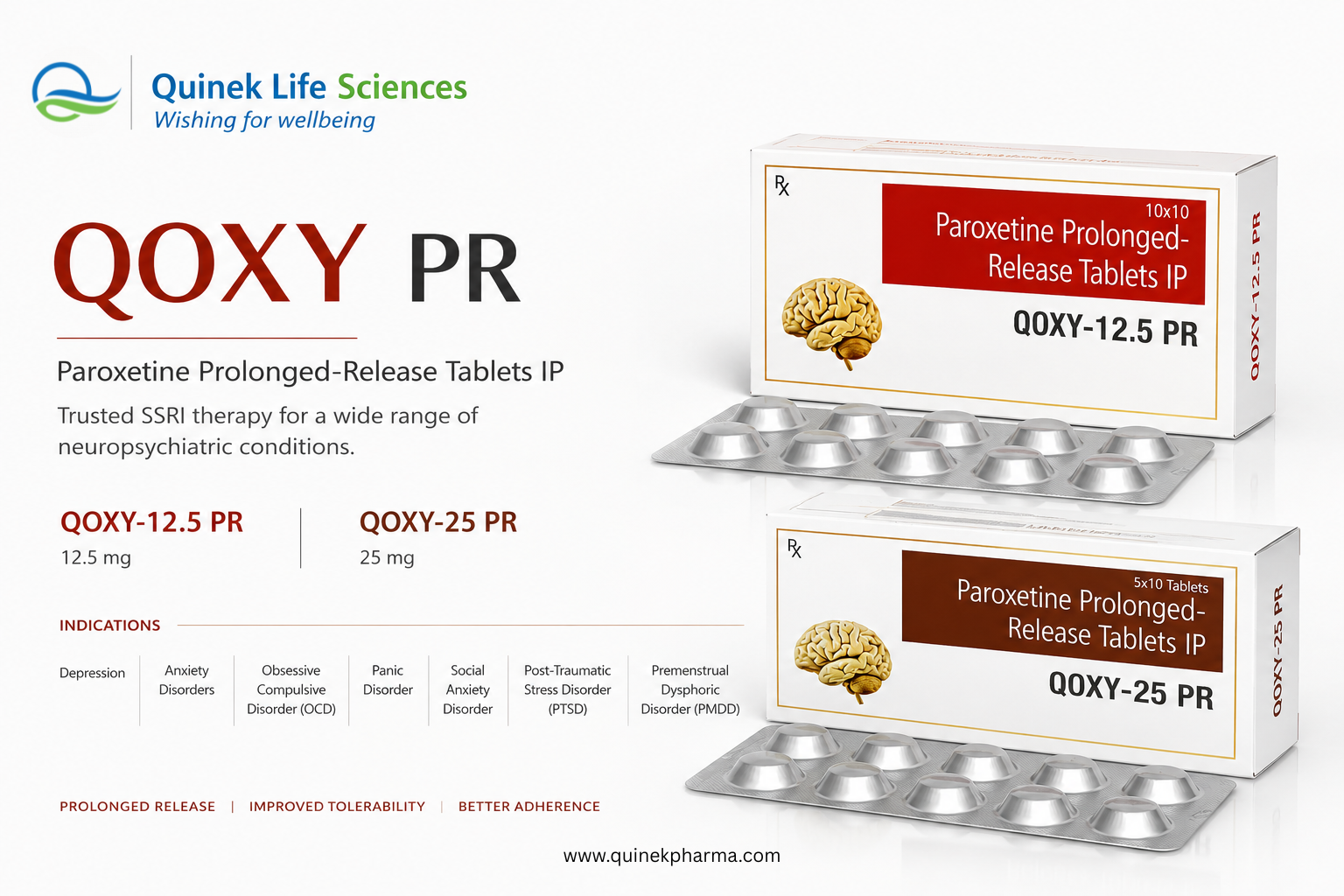
Paroxetine is one of the most comprehensively studied SSRIs in the world — with proven efficacy across the widest range of mood and anxiety disorders of any antidepressant. QOXY 12.5 PR and QOXY-25 PR deliver Paroxetine in a prolonged-release formulation designed for steadier drug levels, fewer side effects and better daily tolerability.
Why Paroxetine Stands Apart From Other SSRIs
There are several SSRIs available in India today — Escitalopram, Sertraline, Fluoxetine and Fluvoxamine among them. Each has its strengths, its preferred indications and its clinical personality. Paroxetine is unique in the group for one important reason: it has the broadest approved indication range of any SSRI, covering not just depression and anxiety but also OCD, panic disorder, social anxiety disorder, PTSD and PMDD — all with strong clinical evidence behind every indication.
It is also the most potent serotonin reuptake inhibitor among the commonly used SSRIs — which gives it a meaningful advantage in conditions where robust serotonergic action is required, such as OCD and severe anxiety. And unlike some SSRIs, Paroxetine also has meaningful anticholinergic and noradrenergic activity — contributing additional therapeutic benefits in specific patient profiles, particularly those with anxiety disorders combined with sleep difficulties.
The prolonged-release (PR) formulation — the one used in QOXY 12.5 PR and QOXY-25 PR — was specifically developed to address the tolerability challenges that have historically been associated with Paroxetine, particularly nausea and dizziness in the early weeks of treatment. By releasing the drug gradually over several hours rather than all at once, the PR formulation reduces the peak plasma concentration that is responsible for these side effects — making the medicine easier to start and easier to stay on.
“Paroxetine is one of the most potent SSRIs available — and the prolonged-release formulation addresses its main historical limitation. The result is a medicine with the widest indication profile in its class, now significantly better tolerated at initiation.”
How Paroxetine Works — The Mechanism
Paroxetine is a Selective Serotonin Reuptake Inhibitor (SSRI). Its primary action is to block the Serotonin Reuptake Transporter (SERT) — the protein responsible for removing serotonin from the synapse and returning it to the presynaptic neuron. By blocking this transporter, Paroxetine increases the concentration of serotonin in the synaptic cleft, prolonging its effect on postsynaptic receptors.
Serotonin Reuptake Inhibition (SERT)
Primary mechanism — increases synaptic serotonin across mood, anxiety and behavioural circuits. Paroxetine’s SERT affinity is among the highest of any SSRI, producing robust serotonergic effects that contribute to its efficacy in severe anxiety and OCD.
Norepinephrine Reuptake Inhibition (NET)
Paroxetine also has moderate norepinephrine reuptake inhibiting activity — adding an NRI component that contributes to its efficacy in anxiety and depression. This dual mechanism makes it similar to an SNRI in clinical effect, particularly useful in patients with fatigue and cognitive symptoms.
Muscarinic Receptor Blockade
Paroxetine has the strongest anticholinergic activity of any SSRI. While this contributes to some side effects (dry mouth, constipation), it also produces anxiolytic and sedating effects that can be clinically useful in patients with severe anxiety or insomnia as a comorbidity — particularly at initiation.
Why Prolonged Release — QOXY PR vs Standard Paroxetine
The Problem With Immediate-Release Paroxetine
Standard Paroxetine tablets are absorbed rapidly, producing a sharp peak in plasma concentration shortly after each dose. This peak is responsible for the nausea, dizziness and GI discomfort that are the most commonly cited reasons patients discontinue Paroxetine in the early weeks of treatment — before it has had the chance to produce its full therapeutic effect. Early discontinuation means treatment failure before it begins.
How QOXY PR Solves This
QOXY PR’s prolonged-release matrix releases Paroxetine gradually over an extended period — flattening the absorption curve and significantly reducing peak plasma concentration. Clinical studies of Paroxetine CR/PR have shown meaningful reductions in nausea and dizziness compared to immediate-release — improving early tolerability, increasing the likelihood of treatment continuation and therefore improving therapeutic outcomes.
7 Conditions QOXY PR Treats — Complete Indication Guide
Major Depressive Disorder (MDD)
The most common indication for QOXY PR. Paroxetine is indicated for major depressive disorder including reactive depression, severe depression and depression accompanied by anxiety — a profile that covers the majority of depression presentations seen in Indian clinical practice. It reduces core depressive symptoms, improves sleep quality, reduces anxiety and restores motivation. The prolonged-release formulation is particularly valuable here because MDD requires sustained treatment — and tolerability in the early weeks determines whether patients stay on treatment long enough to benefit.
Generalised Anxiety Disorder (GAD)
Paroxetine is indicated for GAD — chronic, persistent worry and anxiety lasting more than 6 months. Efficacy has been demonstrated in clinical trials for up to 24 weeks of continuous treatment. QOXY PR is an appropriate first-line choice for patients with GAD, especially those with comorbid depressive symptoms — where the dual serotonergic and noradrenergic action of Paroxetine provides meaningful benefit across both presentations simultaneously.
Obsessive Compulsive Disorder (OCD)
Paroxetine is one of the most extensively studied medicines for OCD, with clinical trials demonstrating efficacy for at least one year of continuous treatment and prevention of OCD relapse. Its high SERT affinity — stronger than most other SSRIs — is particularly important in OCD, where robust serotonergic action is required for meaningful symptom reduction. The target dose for OCD is higher than for depression (up to 60mg/day), which is why the 25mg PR formulation of QOXY-25 PR is often essential in this indication.
Panic Disorder (PD)
Paroxetine is indicated for panic disorder with and without agoraphobia. It reduces both the frequency and severity of panic attacks and is considered a first-line pharmacological treatment. Starting at the 12.5mg dose with QOXY 12.5 PR is particularly important in panic disorder — as patients with PD are often highly sensitive to somatic symptoms, and the low starting dose allows the body to adjust before titrating upward.
Social Anxiety Disorder (SAD)
Social anxiety disorder — intense, debilitating fear of social situations — is significantly underdiagnosed in India despite being highly prevalent. Paroxetine is one of the most evidence-backed pharmacological options for SAD, reducing both anticipatory anxiety and avoidance behaviour. It is often used in combination with cognitive behavioural therapy for this indication for the best outcomes.
Post-Traumatic Stress Disorder (PTSD)
Paroxetine is one of the two SSRIs with the strongest evidence base for PTSD treatment (the other being Sertraline). Efficacy has been demonstrated for up to 12 weeks, and continuation beyond this period is recommended in responding patients given PTSD’s chronically relapsing nature. QOXY PR addresses the hyperarousal, intrusive symptoms and mood disturbances that characterise PTSD — often managing multiple symptom clusters simultaneously.
Premenstrual Dysphoric Disorder (PMDD)
PMDD — a severe form of premenstrual syndrome with significant mood, anxiety and behavioural symptoms in the luteal phase of the menstrual cycle — is one of the most underdiagnosed conditions in Indian women. Paroxetine is an approved treatment for PMDD and can be used either continuously or intermittently (only during the luteal phase). The low starting dose of QOXY 12.5 PR makes it particularly well suited for intermittent PMDD dosing protocols.
Dosing QOXY PR — Starting Doses and Titration by Indication
Critical Prescribing Information — For Clinicians
Never stop abruptly. Paroxetine has the highest risk of discontinuation syndrome of any SSRI — due to its short half-life and strong SERT affinity. Abrupt stopping causes flu-like symptoms, dizziness, sensory disturbances and rebound anxiety. Always taper gradually over a minimum of 4 weeks, and more slowly in patients on higher doses or long-term treatment.
Strong CYP2D6 inhibitor. Paroxetine significantly inhibits CYP2D6 — which metabolises many medicines including Tamoxifen, Codeine and several antipsychotics. Review the full medication list before prescribing. Co-administration with Tamoxifen is generally contraindicated.
Not for use in pregnancy or breastfeeding without specialist assessment. Paroxetine carries a Category D pregnancy classification — discuss risks carefully with women of childbearing potential.
Full effect takes 2–4 weeks. Patients must be counselled that QOXY PR will not produce immediate mood improvement. The serotonergic adaptation that produces therapeutic benefit takes 2–6 weeks to develop. Stopping early because of perceived lack of effect is one of the most common reasons for treatment failure.
Quinek Life Sciences — Neuropsychiatry Segment
QOXY 12.5 PR & QOXY-25 PR — Paroxetine Prolonged Release, Manufactured to WHO-GMP Standards
QOXY 12.5 PR and QOXY-25 PR are Quinek Life Sciences’ Paroxetine Prolonged Release formulations — offering psychiatrists, neurologists and general physicians a complete, flexible prescribing option across the widest indication range of any SSRI. Both strengths are manufactured at our WHO-GMP, GLP and ISO certified facilities with the formulation precision that prolonged-release technology demands.
The 12.5mg strength allows low-dose initiation and sensitive patient management. The 25mg strength covers standard therapeutic dosing across the majority of indications. Together, they give prescribers complete dose flexibility across the full Paroxetine therapeutic range — from the first cautious dose in a first-time patient to the optimised maintenance dose in long-term treatment.
The Most Versatile SSRI in Neuropsychiatry — Now Better Tolerated Than Ever
Paroxetine’s clinical legacy is built on evidence across more indications than any other SSRI. Its potency, its breadth of application and its well-understood profile make it a valuable tool in the hands of any psychiatrist or neurologist managing the full spectrum of mood and anxiety disorders.
QOXY 12.5 PR and QOXY-25 PR from Quinek Life Sciences deliver that clinical legacy in a prolonged-release formulation that makes Paroxetine more accessible, more tolerable and more likely to be continued — because a medicine that patients stop taking is a medicine that cannot help them.
Medical Disclaimer: This article is for educational purposes and healthcare professional reference only. Paroxetine must be prescribed and monitored by a qualified psychiatrist or licensed physician. Never start, change or stop psychiatric medication without medical supervision. If you are in mental health crisis, contact iCall (9152987821) or Vandrevala Foundation (1860-2662-345).
Sources: NCBI StatPearls — Paroxetine · Drugs.com Prescribing Information · Mayo Clinic · Indian Psychiatric Society · Quinek Life Sciences Neuropsychiatry Segment