
Gynaecology
When Hormones Drive Acne, Excess Hair and Irregular Periods — QNYL-35 Addresses the Cause, Not Just the Symptoms
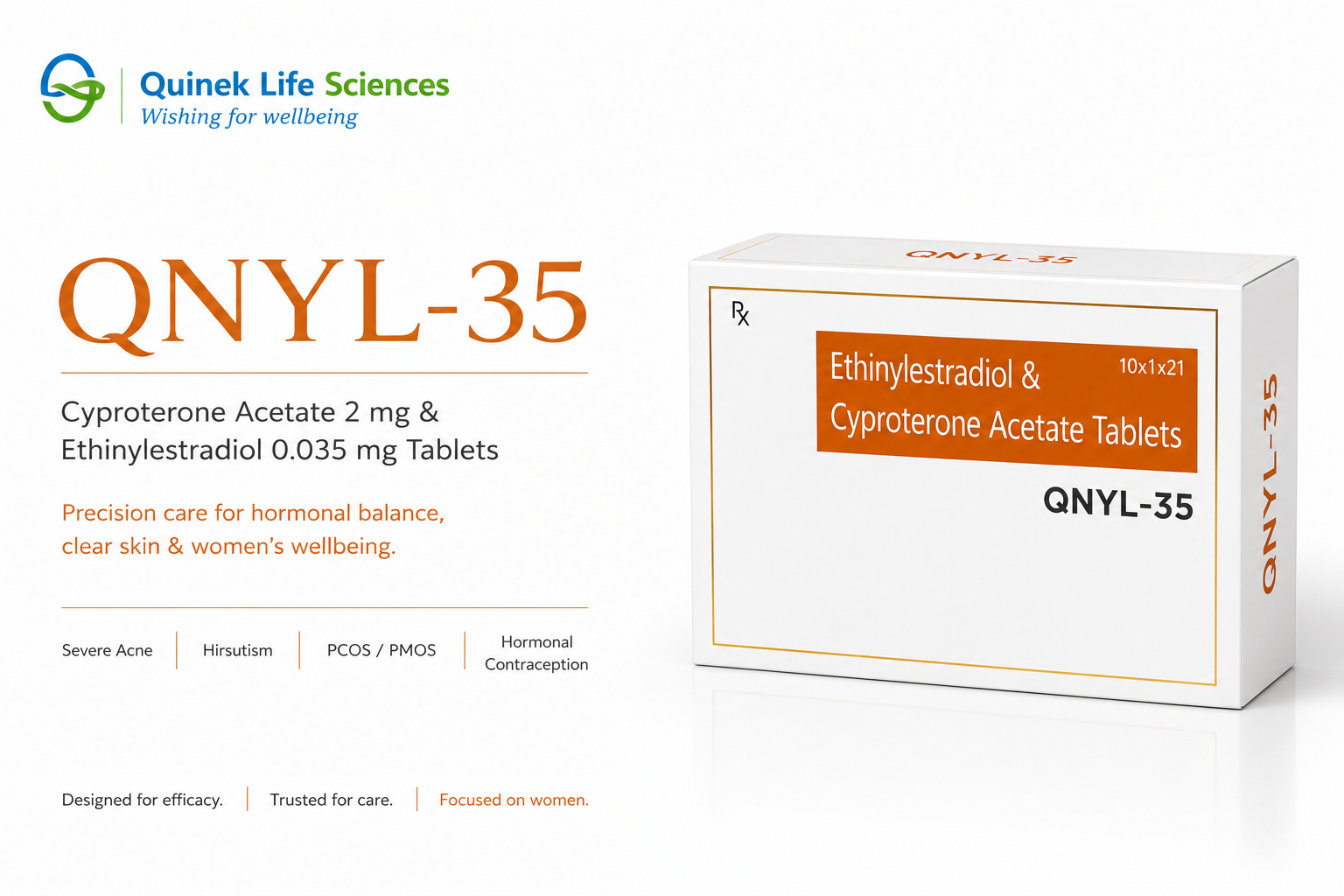
For millions of women in India, acne is not a skincare problem. It is a hormonal one. Excess androgens drive persistent facial and body acne, unwanted hair growth and irregular cycles — and treating the skin alone never fully works. QNYL-35, Quinek Life Sciences’ Cyproterone Acetate 2mg and Ethinylestradiol 0.035mg formulation, targets the hormonal root cause directly.
Understanding Hyperandrogenism — Why Hormones Are Behind So Many Skin and Hair Problems in Women
Androgens — often called male hormones — are present in all women, but at much lower levels than in men. They play a role in libido, bone density and hair growth. When androgen levels rise above the normal female range, a predictable cluster of symptoms emerges: acne on the face, chest and back, excessive facial or body hair (hirsutism), oily skin (seborrhoea), scalp hair thinning and, frequently, irregular or absent menstrual periods.
This condition — hyperandrogenism — is most commonly associated with PMOS (formerly known as PCOS), but it can also arise from idiopathic causes, adrenal disorders or other endocrine conditions. Regardless of the underlying cause, the symptoms share a common driver: excess circulating androgens stimulating androgen-sensitive skin structures — the sebaceous glands, hair follicles and sweat glands.
Treating hyperandrogenic symptoms with topical acne creams or cosmetic hair removal treats the result, not the cause. Women who have been through years of antibiotics for acne, laser sessions for hirsutism and period irregularities without resolution often arrive at the gynaecologist’s office having never had their androgen levels properly assessed. QNYL-35 is the treatment that addresses the hormonal driver directly — producing comprehensive improvement across all androgen-mediated symptoms simultaneously.
“In a clinical study of 66 women with PCOS treated with Cyproterone Acetate 2mg and Ethinylestradiol 0.035mg for 36 cycles, acne disappeared in 100% of cases, seborrhoea improved in 76.4% and hirsutism reduced in 75%. LH/FSH ratio and androgen levels fell significantly, while SHBG rose.”
— Falsetti et al., Contraception Journal, 1990 — Long-term CPA/EE Treatment in PCOS
What Is QNYL-35 — How Do the Two Ingredients Work Together?
QNYL-35 combines two hormonally active compounds — Cyproterone Acetate and Ethinylestradiol — whose mechanisms of action complement and reinforce each other in addressing androgen excess.
Ingredient 1
Cyproterone Acetate 2mg
Cyproterone Acetate is a potent anti-androgen and a progestogen. As an anti-androgen, it works by competitively blocking androgen receptors — preventing testosterone and dihydrotestosterone (DHT) from binding to and activating the androgen-sensitive structures in the skin and hair follicles. The result is a progressive reduction in sebaceous gland activity (less oil, less acne), reduced terminal hair growth in androgen-sensitive areas (hirsutism), and reduced scalp hair loss. As a progestogen, it also contributes to the contraceptive action of the combination by suppressing ovulation.
Ingredient 2
Ethinylestradiol 0.035mg
Ethinylestradiol is a synthetic oestrogen that amplifies the anti-androgenic effect of Cyproterone in two ways. First, it significantly increases the liver’s production of Sex Hormone Binding Globulin (SHBG) — a protein that binds to free testosterone in the bloodstream and makes it biologically inactive. Less free testosterone means less androgen available to drive acne and hair growth. Second, it suppresses LH release from the pituitary — reducing ovarian androgen production at the source. Together, Ethinylestradiol and Cyproterone produce a comprehensive reduction in androgen activity across multiple pathways simultaneously.
What Conditions Is QNYL-35 Prescribed For?
QNYL-35 is indicated for use in women of reproductive age only, for the following conditions:
Severe Acne Refractory to Oral Antibiotics
QNYL-35 is indicated specifically for severe acne in women where prolonged oral antibiotic therapy has failed or is no longer appropriate. This distinction is important — it is not a first-line acne treatment but a specialist intervention for hormonally driven acne that has not responded to standard dermatological management. Clinical evidence consistently shows that androgenic acne — particularly the deep, nodular, inflammatory type concentrated on the jaw, chin and lower face — responds far better to anti-androgen therapy than to antibiotics, because antibiotics address bacterial colonisation but not the hormonal stimulus driving sebaceous overactivity.
Moderately Severe Hirsutism
Hirsutism — unwanted terminal hair growth in androgen-sensitive areas including the upper lip, chin, chest, abdomen and thighs — is one of the most distressing symptoms of hyperandrogenism for women. QNYL-35 reduces hirsutism by blocking androgen receptors in the hair follicle and reducing circulating androgens. The response is gradual — hair growth slows progressively over 3–6 months, with meaningful improvement typically visible at 6 months and maximal benefit at 12–18 months of continuous treatment. Women should be counselled that QNYL-35 prevents new terminal hair growth but does not remove existing hair, which must be managed by conventional cosmetic methods during treatment.
PMOS / PCOS — Androgenic Symptom Management
In women with PMOS (Polyendocrine Metabolic Ovarian Syndrome — formerly PCOS) who are not seeking fertility, QNYL-35 addresses the androgenic symptoms of the condition — acne, hirsutism and seborrhoea — while simultaneously regulating the menstrual cycle and providing contraceptive cover. The combination’s suppression of LH reduces the ovarian androgen production that is a central feature of PMOS. The significant increase in SHBG produced by the Ethinylestradiol component further reduces bioavailable testosterone. This makes QNYL-35 one of the most comprehensively effective options for symptomatic PMOS management in women not currently trying to conceive.
Seborrhoea (Oily Skin) and Androgenic Alopecia
Seborrhoea — excessive oiliness of the scalp and face driven by androgen-stimulated sebaceous gland activity — often coexists with acne and hirsutism as part of the hyperandrogenic syndrome. Androgenic alopecia in women — scalp hair thinning in androgen-sensitive distribution patterns — is similarly driven. QNYL-35’s anti-androgen activity reduces sebaceous gland output and slows the androgen-dependent conversion of terminal scalp hairs to vellus hairs, helping to stabilise and improve both seborrhoea and androgenic hair loss over time.
Contraception — When Anti-Androgenic Effect Is Also Required
QNYL-35 provides effective hormonal contraception through the same mechanisms — suppression of ovulation by the combined oestrogenic and progestogenic action, cervical mucus thickening and endometrial changes that prevent implantation. It is particularly appropriate for women who require both contraception and hormonal management of androgenic symptoms, making it a single-tablet solution to two clinical needs. Women using QNYL-35 solely for therapeutic indications (acne or hirsutism) without requiring contraception should be made aware of its contraceptive action and advised accordingly.
How to Take QNYL-35 — Dosing and Cycle Protocol
Critical Prescribing Warnings — For Clinicians
Venous Thromboembolism (VTE): Cyproterone-containing combined oral contraceptives are associated with a higher VTE risk than levonorgestrel-containing pills. QNYL-35 is contraindicated in women with a personal or family history of VTE, prolonged immobilisation, known thrombophilic disorders, or significant cardiovascular risk factors. The risk-benefit assessment must be documented before prescribing.
Not for use in pregnancy or breastfeeding. If pregnancy is suspected during treatment, stop immediately and seek medical advice.
Not indicated for women seeking fertility. QNYL-35 suppresses ovulation and must not be prescribed to women actively trying to conceive. Fertility typically returns within 1–3 cycles of stopping.
Liver function monitoring is recommended before starting and periodically during treatment, particularly in women with a history of liver disease. QNYL-35 is contraindicated in active liver disease.
What Patients Ask Most About QNYL-35
How long before I see results? Acne usually shows meaningful improvement within 3 cycles. Seborrhoea often responds within the first cycle. Hirsutism takes longer — visible reduction in new hair growth typically takes 6 months, with maximum benefit at 12–18 months. Existing hair must be removed by conventional methods during this period.
Will my symptoms come back when I stop? In women with PMOS or idiopathic hyperandrogenism, symptoms are likely to recur gradually after stopping — because the underlying hormonal tendency remains. Some women cycle on and off treatment; others continue long-term under periodic medical review. This decision should always be made with the prescribing gynaecologist.
Can I use QNYL-35 just for acne without needing contraception? Yes — QNYL-35 can be prescribed therapeutically for acne or hirsutism regardless of contraceptive need. However, its contraceptive action will be active during use, which should be understood and documented.
Quinek Life Sciences — Gynaecology Segment
QNYL-35 — Anti-Androgenic Gynaecology From a WHO-GMP Certified Specialist
QNYL-35 is part of Quinek Life Sciences’ dedicated gynaecology range — formulated for gynaecologists and dermatologists who manage the hormonal root causes of acne, hirsutism and PMOS-related androgenic symptoms in women. Manufactured at our WHO-GMP, GLP and ISO certified facilities, QNYL-35 meets the pharmaceutical standards that specialist prescribers require from a hormonal medicine.
Our gynaecology range spans IVF, hormonal therapy, reproductive health and women’s wellbeing — and QNYL-35 represents our commitment to addressing the full hormonal spectrum of women’s health conditions, not just the visible symptoms.
Treating Acne and Hirsutism at the Source — Not Just the Surface
For too many women, years pass between the first appearance of hormonal acne and the first prescription of an anti-androgen. In the meantime, there are antibiotics, topical treatments, laser sessions and a great deal of emotional cost. Androgenic acne and hirsutism are not dermatological problems that need dermatological solutions. They are endocrine problems that need hormonal ones.
QNYL-35 from Quinek Life Sciences — Cyproterone Acetate 2mg and Ethinylestradiol 0.035mg — is manufactured for gynaecologists who understand this. A well-formulated, evidence-backed medicine that addresses the cause — and the result follows.
Medical Disclaimer: This article is for educational purposes and healthcare professional reference only. QNYL-35 must be prescribed by a qualified gynaecologist following a thorough clinical assessment including cardiovascular risk screening. It is not suitable for all women and should not be self-prescribed.
Sources: Falsetti et al., Contraception Journal 1990 · Human Reproduction — Oxford Academic 2008 · JCAD — Hirsutism in PCOS 2020 · HPRA Prescribing Information — CPA/EE · Quinek Life Sciences Gynaecology Segment