
Urology
Gout Is a Uric Acid Problem. Q-STAT Febuxostat Stops Uric Acid at the Source — Before the Next Attack Happens.
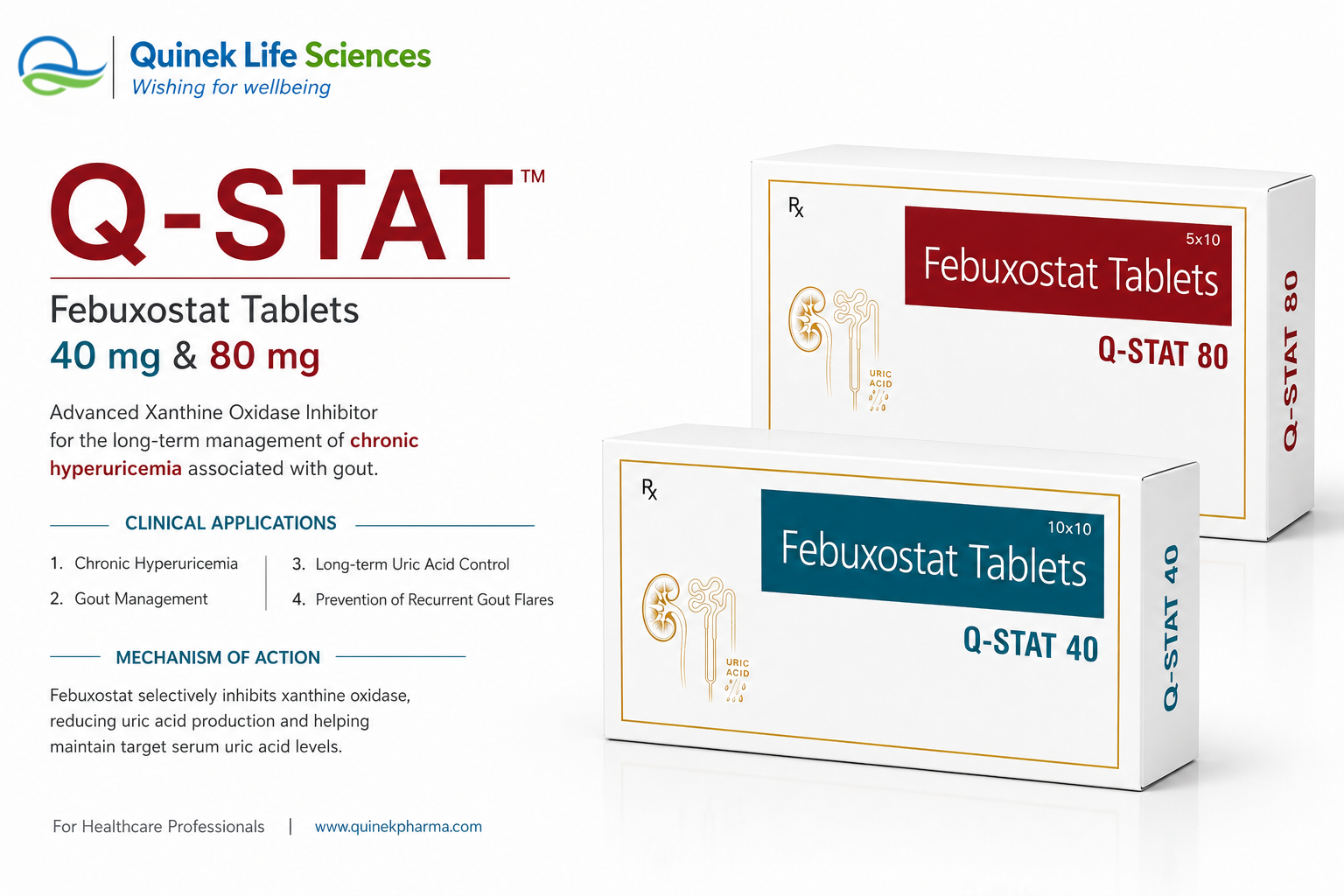
Gout is the most common inflammatory arthritis in India — and unlike most joint conditions, it is entirely preventable with the right medicine. Q-STAT 40 and Q-STAT 80 — Quinek Life Sciences’ Febuxostat 40mg and 80mg formulations — reduce uric acid production at the enzymatic level, consistently lowering serum urate to below the crystal-formation threshold and protecting joints, kidneys and soft tissue from the long-term damage of chronic hyperuricemia.
What Is Gout — and Why Is It So Common in India?
Gout is a form of inflammatory arthritis caused by the deposition of monosodium urate crystals in joints and surrounding tissues. It develops when uric acid — the end product of purine metabolism — accumulates in the blood at levels high enough to supersaturate body fluids, causing crystals to form and deposit preferentially in the cooler peripheral joints, most commonly the big toe, ankles, knees and wrists.
An acute gout attack is one of the most acutely painful conditions in medicine — the sudden onset of severe, hot, red, exquisitely tender joint swelling typically occurring at night and lasting 3–10 days. Most people who experience their first attack assume it will not recur. It will. Without treatment to lower uric acid, attacks become more frequent, more severe and begin affecting more joints. Over years, tophi (urate crystal deposits) form under the skin and in joint structures, causing progressive joint damage and deformity.
India has seen a dramatic rise in gout prevalence driven by dietary changes — particularly increased consumption of red meat, organ meats, seafood, fructose-sweetened beverages and alcohol. Comorbidities including metabolic syndrome, hypertension, CKD and diabetes all independently raise uric acid levels or reduce renal urate excretion, creating a perfect environment for crystal deposition. An estimated 20 million or more Indians now live with hyperuricemia or gout, making effective urate-lowering therapy one of the most important areas of pharmaceutical need in Indian urology and rheumatology.
“Febuxostat is a potent, non-purine, selective xanthine oxidase inhibitor that achieves a 40–55% reduction in serum uric acid at doses of 40–80mg daily. It inhibits both the oxidised and reduced forms of xanthine oxidase — which gives it more consistent urate-lowering than allopurinol, which inhibits only the oxidised form.”
— StatPearls, NCBI Bookshelf — Febuxostat
How Febuxostat Works — Stopping Uric Acid at the Enzyme
Uric acid is produced in the body through the metabolism of purines — compounds found in many foods and also generated from normal cellular turnover. The final two steps of this metabolic pathway are both catalysed by a single enzyme: Xanthine Oxidase. Hypoxanthine is converted to xanthine, and xanthine is then converted to uric acid — both reactions driven by Xanthine Oxidase.
The Purine-to-Uric Acid Pathway
→
Hypoxanthine
→ Xanthine Oxidase →
Xanthine
→ Xanthine Oxidase →
Uric Acid
Febuxostat forms a stable inhibitory complex with both the oxidised and reduced forms of Xanthine Oxidase — blocking both conversions simultaneously and comprehensively. This is why Febuxostat produces more consistent and potent urate lowering than Allopurinol, which only inhibits the oxidised (active) form. At therapeutic doses, Febuxostat does not inhibit any other enzymes involved in purine or pyrimidine metabolism — making its urate-lowering action highly selective.
Q-STAT Febuxostat vs Allopurinol — When to Choose Which
Allopurinol has been the standard urate-lowering therapy for decades. Febuxostat was introduced as an alternative for patients where Allopurinol is not appropriate or has been inadequate. Understanding when each is preferred allows urologists and rheumatologists to make the right choice for each patient.
When Q-STAT Febuxostat Is Preferred
Patients who have failed to achieve target serum urate below 6 mg/dL on Allopurinol at maximum tolerated doses. Patients who are intolerant of Allopurinol — particularly those who have developed hypersensitivity reactions (Allopurinol Hypersensitivity Syndrome is rare but can be severe). Patients with mild-to-moderate renal impairment (CrCl 30–89 mL/min) where Febuxostat requires no dose adjustment, while Allopurinol doses must be reduced. Patients who prefer the convenience of a fixed daily dose without the need for dose escalation based on CrCl calculations.
When Allopurinol Remains Appropriate
Well-tolerated patients who have achieved target urate on Allopurinol with no side effects — no reason to switch. Patients with severe renal impairment (CrCl below 30 mL/min) — here Febuxostat must be limited to 40mg/day, and the clinical advantage may be less clear. Patients on Azathioprine or 6-Mercaptopurine — Febuxostat is contraindicated with these medicines as it dramatically increases their plasma levels.
Q-STAT 40 vs Q-STAT 80 — Clinical Dosing Protocol
Important: Q-STAT should be started only after an acute gout attack has fully subsided. Starting Febuxostat during an acute attack does not treat the current attack and may provoke a flare due to rapid urate mobilisation. Co-prescribe a prophylactic NSAID or low-dose Colchicine for the first 3–6 months of therapy to reduce the risk of mobilisation flares.
What Q-STAT Treats — Indications for Febuxostat
Chronic Hyperuricemia With Gout
The primary indication. Any patient with confirmed gout who requires long-term urate-lowering therapy — to prevent recurrent attacks, resolve existing tophi and prevent joint damage. Q-STAT 40 initiates treatment; Q-STAT 80 escalates if the target serum urate below 6 mg/dL is not achieved at 2 weeks.
Gout With CKD (Mild-Moderate)
The American College of Rheumatology guidelines specifically recommend Febuxostat for patients with gout and moderate-to-severe CKD. No dose adjustment is required for CrCl 30–89 mL/min — a significant advantage over Allopurinol, which requires careful dose reduction in renal impairment. At CrCl below 30 mL/min, Q-STAT 40 (40mg/day) is used and not escalated.
Tophaceous Gout
Patients with established tophi — urate crystal deposits in subcutaneous tissue and joint structures — require sustained and aggressive urate lowering to dissolve these deposits over time. The target serum urate for tophaceous gout is even lower — below 5 mg/dL — which often requires Q-STAT 80 to achieve. Tophi typically begin to reduce in size after 6–12 months of sustained urate control below the target.
Allopurinol-Intolerant Patients
A meaningful proportion of patients cannot tolerate Allopurinol — due to skin rash, GI intolerance, or the rare but severe Allopurinol Hypersensitivity Syndrome. For these patients, Q-STAT Febuxostat provides an effective, non-purine alternative with a different mechanism and a generally better-tolerated profile in Allopurinol-intolerant individuals.
Side Effects and Monitoring — What Prescribers Need to Know
Liver Function
Liver function abnormalities are the most common adverse effect leading to discontinuation — occurring in approximately 1.2–1.8% of patients on Febuxostat 40–80mg. Baseline LFTs should be checked before starting Q-STAT and rechecked periodically, particularly in patients with pre-existing liver conditions or those on hepatotoxic medicines.
Early Gout Flares During Initiation
When uric acid levels fall rapidly at the start of treatment, mobilisation of existing urate crystals from joints and tissue can trigger acute gout flares — paradoxically worsening symptoms initially. This does not mean the medicine is failing — it is a known pharmacological phenomenon. Prophylactic Colchicine or NSAIDs for the first 3–6 months significantly reduce this risk. Patients must be counselled about this before starting.
Cardiovascular Caution
The CARES trial raised a concern about a possible increase in cardiovascular mortality with Febuxostat compared to Allopurinol in patients with established cardiovascular disease. The FDA subsequently added a warning — Febuxostat should be used with caution in patients with known major cardiovascular disease. The benefit-risk balance should be carefully assessed in such patients, and Allopurinol should be considered first if tolerated.
Drug Interactions
Febuxostat is contraindicated with Azathioprine and 6-Mercaptopurine — it inhibits xanthine oxidase which is the primary metabolising enzyme for these drugs, dramatically increasing their plasma levels and toxicity risk. Also review for interactions with Theophylline. No dose adjustment needed for mild-to-moderate renal or hepatic impairment beyond the CrCl caveat described above.
What Patients on Q-STAT Need to Understand
Q-STAT does not treat an acute gout attack. It is a preventive medicine. During an acute attack, use prescribed anti-inflammatories (Colchicine, NSAIDs or Prednisolone). Start or continue Q-STAT once the attack resolves.
Take Q-STAT every day, regardless of whether you feel well. Uric acid levels do not produce symptoms until they precipitate as crystals. Stopping treatment during symptom-free periods allows urate to rise again — and the next attack may be more severe.
Dietary changes support the medicine, not replace it. Reducing purine-rich foods (red meat, organ meats, shellfish), limiting alcohol (especially beer), staying well-hydrated and avoiding fructose-heavy drinks all help lower uric acid — but diet alone is rarely sufficient to reach the target below 6 mg/dL in chronic gout. Q-STAT is required.
Attend your follow-up appointments. Serum uric acid should be checked at 2 weeks (to decide between Q-STAT 40 and Q-STAT 80) and then periodically. Liver function should also be monitored as recommended.
Quinek Life Sciences — Urology Segment
Q-STAT 40 & Q-STAT 80 — Febuxostat From a WHO-GMP Certified Manufacturer
Q-STAT 40 and Q-STAT 80 are Quinek Life Sciences’ Febuxostat formulations — manufactured at our WHO-GMP, GLP and ISO certified facilities with the potency, purity and batch consistency that urologists and rheumatologists require from a urate-lowering medicine. The availability of both strengths allows a clean two-step protocol: initiate with Q-STAT 40, escalate to Q-STAT 80 if needed — all from a single trusted manufacturer.
Quinek Life Sciences’ urology segment addresses the full spectrum of urological pharmaceutical needs in India — from BPH management to metabolic urology. If you are a urologist, rheumatologist or distributor serving the urology and metabolic medicine space — we would like to speak with you.
Gout Is Preventable — If You Take the Right Medicine Consistently
Most patients who have experienced a gout attack live in fear of the next one. Some change their diet. Some take painkillers during attacks and wait. Very few start the long-term urate-lowering medicine that would prevent future attacks entirely — because no one has explained that gout is not a dietary condition. It is a metabolic condition that requires pharmaceutical management.
Q-STAT 40 and Q-STAT 80 from Quinek Life Sciences — Febuxostat 40mg and 80mg — give urologists and rheumatologists a potent, well-tolerated, once-daily urate-lowering option. Take it consistently. Monitor appropriately. And watch gout become a condition of the past rather than a recurring disruption to a patient’s life.
Medical Disclaimer: This article is for educational purposes and healthcare professional reference only. Febuxostat must be prescribed by a qualified physician. All treatment decisions must be based on individual patient assessment including renal function, cardiovascular history and concurrent medications.
Sources: NCBI StatPearls — Febuxostat · Drugs.com — Febuxostat · Care Hospitals Clinical Reference · NCBI — Febuxostat 40mg vs 80mg Comparative Study · American College of Rheumatology Gout Guidelines · Quinek Life Sciences Urology Segment