
Urology
UTIs Are Among the Most Common Bacterial Infections in India. ORA-Q Treats Them at the Source — With Sustained Release Nitrofurantoin That Works Exactly Where It Is Needed.
Nitrofurantoin is one of the most effective, most evidence-backed antibiotics for urinary tract infection — and for good reason. It concentrates directly in the urine, acts against the bacteria causing the infection, and largely spares the systemic microbiome. ORA-Q from Quinek Life Sciences delivers it in sustained release form — steadier urinary concentrations, better tolerability and one less dose per day.
UTIs in India — A Very Common, Often Undertreated Problem
A urinary tract infection (UTI) is a bacterial infection of any part of the urinary system — the kidneys, ureters, bladder or urethra. The large majority of UTIs are lower tract infections — cystitis — affecting the bladder and urethra and causing the symptoms most patients recognise: burning during urination, frequent urges to urinate, pain in the lower abdomen, cloudy or strong-smelling urine and sometimes blood in the urine.
UTIs are extraordinarily common. Women are significantly more susceptible than men due to anatomical factors — the shorter urethra allows bacteria to reach the bladder more easily. Post-menopausal women and sexually active women are at even higher risk. In India, UTIs are among the most common reasons for antibiotic prescription — yet they are also one of the most mismanaged infection categories, with widespread prescription of inappropriate antibiotics, inadequate duration of therapy and significant rates of antibiotic resistance.
The most common causative organism — Escherichia coli — accounts for 80–85% of uncomplicated UTIs. Klebsiella, Enterococcus, Staphylococcus saprophyticus and Enterobacter account for most of the remainder. Nitrofurantoin remains highly effective against the majority of these organisms in India — with 86% sensitivity rates for common uncomplicated cystitis pathogens — making it one of the most reliably effective first-line agents for uncomplicated lower UTI.
“Nitrofurantoin is effective against most gram-positive and gram-negative bacteria that cause urinary tract infections. In Germany, 86% of pathogens causing uncomplicated cystitis are sensitive to Nitrofurantoin. The sustained-release formulation delays absorption, prevents toxic plasma concentrations and allows longer dosing intervals.”
— Urology-Textbook.com — Nitrofurantoin Clinical Reference
How Nitrofurantoin Works — A Multi-Target Antibiotic
Nitrofurantoin is a nitrofuran-class antibiotic with a uniquely multi-target mechanism of action that distinguishes it from most other antibiotics — and is central to why it retains high efficacy and low resistance rates even after decades of clinical use.
Within bacterial cells, Nitrofurantoin is reduced by bacterial flavoproteins to highly reactive intermediates — reactive oxygen species and other cytotoxic compounds. These reactive intermediates simultaneously attack multiple critical bacterial targets:
DNA Damage
Reactive intermediates disrupt bacterial DNA synthesis and damage existing DNA strands — inhibiting the bacterium’s ability to replicate and repair its genetic material. This is one of the primary bactericidal mechanisms.
Cell Wall Synthesis Inhibition
Nitrofurantoin interferes with bacterial cell wall synthesis by inhibiting enzymes involved in peptidoglycan assembly — the structural component of the bacterial outer wall. Without intact cell walls, bacteria cannot maintain structural integrity and lyse.
Ribosomal Protein Synthesis Inhibition
The reactive intermediates also impair ribosomal function — disrupting bacterial protein synthesis. This triple attack on DNA, cell wall and ribosomes simultaneously is why resistance to Nitrofurantoin develops so much more slowly than with single-target antibiotics.
Concentrated in Urine — Targeted Action
Nitrofurantoin is almost exclusively excreted via the kidneys into the urine — where it reaches concentrations far above the minimum inhibitory concentration for susceptible urinary pathogens. It does not achieve significant tissue or systemic concentrations, which is why it works for lower UTIs but is not effective for upper tract or systemic infections.
Why Sustained Release — ORA-Q vs Standard Nitrofurantoin
Standard Nitrofurantoin — The Problem
Immediate-release Nitrofurantoin is rapidly absorbed and produces a sharp peak in plasma concentration shortly after each dose. This peak is responsible for the nausea, vomiting and GI discomfort that are the most commonly reported reasons patients discontinue Nitrofurantoin before completing their course. Standard Nitrofurantoin also requires four-times-daily dosing — which significantly reduces adherence and course completion rates.
ORA-Q Sustained Release — The Advantage
ORA-Q’s sustained-release formulation releases Nitrofurantoin gradually — flattening the plasma concentration curve and significantly reducing the peak concentration responsible for GI side effects. The macrocrystalline-SR technology also delays absorption, allowing twice-daily dosing rather than four times daily. The result: better tolerability, simplified dosing schedule, improved adherence and maintained or improved therapeutic efficacy in the urine where it matters.
What ORA-Q Treats — Clinical Indications
Uncomplicated Acute Cystitis
The primary indication for ORA-Q. Uncomplicated cystitis — bladder infection in an otherwise healthy, non-pregnant woman without structural urinary tract abnormalities — is the most common UTI presentation in clinical practice. ORA-Q is prescribed as 100mg twice daily for 5–7 days. It is effective against E. coli, Staphylococcus saprophyticus, Klebsiella and Enterococcus — covering the vast majority of uncomplicated lower UTI pathogens. Nitrofurantoin SR is recommended in NICE guidelines as first-line therapy for uncomplicated UTI in women.
Recurrent UTI Prophylaxis
Women who experience three or more UTIs per year are classified as having recurrent UTI — a condition that significantly affects quality of life and is often managed with long-term low-dose antibiotic prophylaxis. ORA-Q 100mg taken once nightly at bedtime for up to 6 months is an evidence-supported prophylactic regimen that significantly reduces the frequency of UTI recurrence. The sustained-release formulation taken at night maintains adequate urinary Nitrofurantoin concentrations during the overnight period — when urinary flow is reduced and bacterial colonisation risk is highest.
Complicated UTI (Short-Term Catheter-Associated)
In patients with complicated UTIs — including those with urinary bladder emptying disorders or catheter use — ORA-Q 100mg twice daily (or once nightly) for up to 14 days may be prescribed as part of a managed antibiotic protocol. However, for complicated UTIs involving the upper urinary tract (pyelonephritis), systemic infection or unusual pathogens, Nitrofurantoin is not appropriate and a systemic antibiotic is required. This distinction is clinically critical.
Dosing ORA-Q — Protocol by Indication
Always take ORA-Q with food or milk — this significantly improves absorption and reduces nausea. Urine may turn brown or yellow — this is a harmless and expected effect of Nitrofurantoin excretion. Drink adequate water throughout treatment to maintain urinary flow.
Important Contraindications and Warnings
Renal Impairment — Contraindicated
ORA-Q is contraindicated in patients with significant renal impairment (GFR below 30 mL/min). Nitrofurantoin depends on renal excretion to reach therapeutic concentrations in the urine — reduced GFR produces inadequate urinary levels (treatment failure) while allowing potentially toxic plasma levels to accumulate. Always check renal function before prescribing.
Not for Upper Tract Infections
ORA-Q is specifically for lower urinary tract infections only. It does not achieve adequate tissue concentrations for kidney infections (pyelonephritis) or systemic infections. Patients with fever, rigors, flank pain or signs of upper tract involvement require a different antibiotic regimen entirely.
Pulmonary Reactions — Long-Term Use
Rare but serious pulmonary reactions (acute or chronic) have been reported with long-term Nitrofurantoin use — particularly in prophylaxis regimens beyond 6 months. Patients on long-term ORA-Q should be monitored for new respiratory symptoms — cough, breathlessness — and pulmonary function assessed if symptoms develop.
Pregnancy — Caution
Nitrofurantoin may be used with caution in the second and third trimesters of pregnancy for treating UTI when the benefits outweigh the risks. It is contraindicated at term (38–42 weeks) due to the risk of haemolytic anaemia in the newborn. Always consult obstetric guidance before prescribing in pregnancy.
What Patients on ORA-Q Should Know
Always complete the full course. Even if symptoms improve within 2–3 days, stopping ORA-Q early allows surviving bacteria to multiply and may cause recurrence or resistance development.
Take with food or milk at every dose. This is not optional — food significantly improves Nitrofurantoin absorption and reduces the nausea that is the main tolerability concern.
Drink plenty of water. Adequate hydration maintains urinary flow, helps flush bacteria from the bladder and supports the concentration of ORA-Q in the urine where it is needed.
Brown or dark yellow urine is normal. This discolouration is harmless and is simply the colour of Nitrofurantoin being excreted — it is not a sign of blood or kidney damage.
Quinek Life Sciences — Urology Segment
ORA-Q — Nitrofurantoin SR 100mg, Manufactured to WHO-GMP Standards
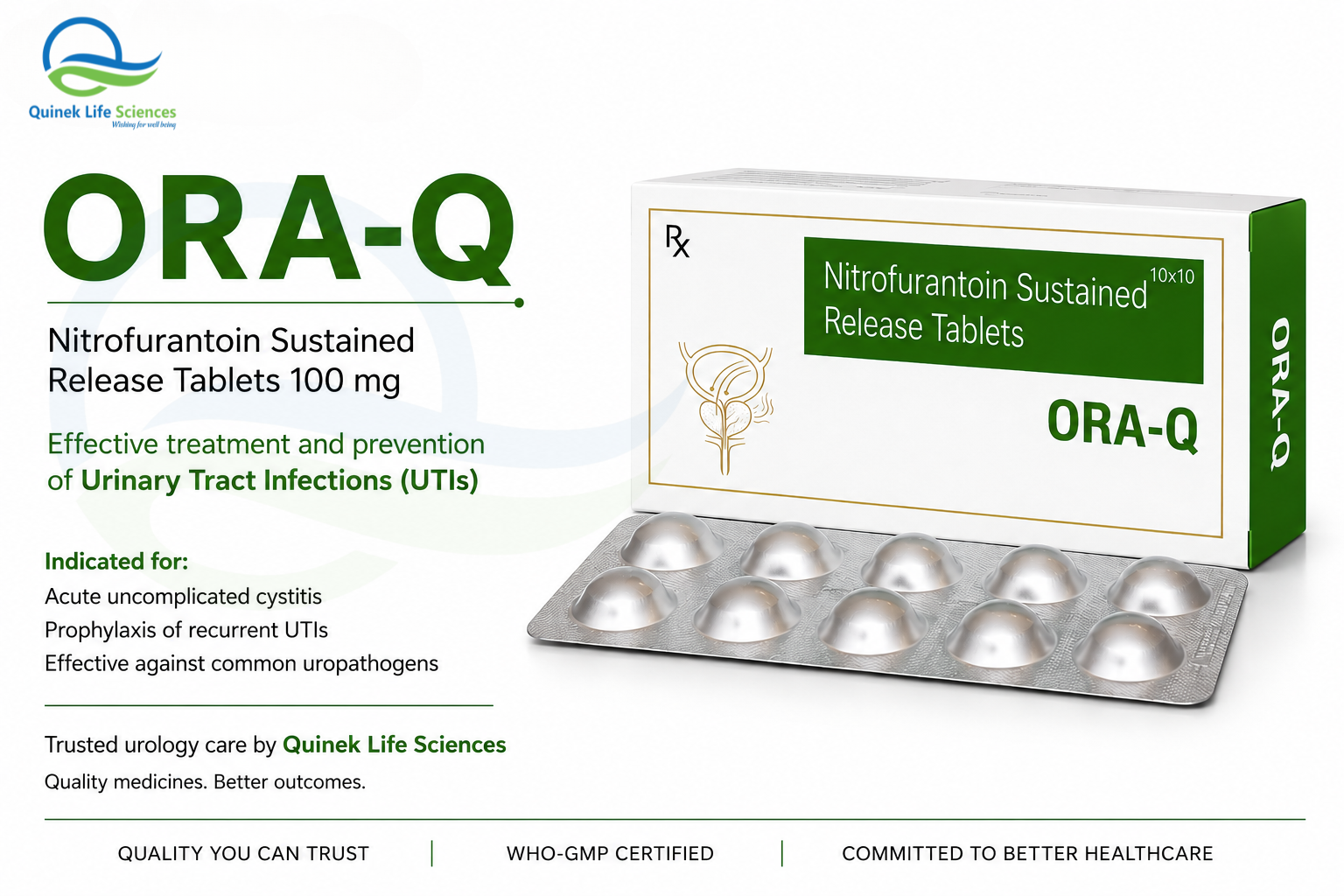
ORA-Q is Quinek Life Sciences’ Nitrofurantoin Sustained Release 100mg formulation — delivering the clinical efficacy of Nitrofurantoin with the improved tolerability and simplified twice-daily dosing of the sustained-release formulation. Manufactured at our WHO-GMP, GLP and ISO certified facilities with the quality consistency that urologists and general practitioners rely on for one of India’s most prescribed antibiotic indications.
Our urology segment serves the full spectrum of urological pharmaceutical needs across India — from BPH and gout to UTI management. If you are a urologist, a general physician or a pharmaceutical distributor serving the urology or women’s health segment, Quinek Life Sciences and ORA-Q are ready to support your practice.
The Right Antibiotic, at the Right Concentration, Right Where the Infection Is
What makes Nitrofurantoin exceptional for UTI is its targeting precision — it concentrates in the urine, acts directly on the bacteria causing the infection and largely avoids the systemic microbiome disruption that broad-spectrum antibiotics cause. In an era of rising antibiotic resistance, that precision matters enormously.
ORA-Q — Nitrofurantoin Sustained Release 100mg from Quinek Life Sciences — delivers that precision with the added benefit of sustained release: better tolerability, twice-daily dosing and consistent urinary concentrations that support both acute treatment and long-term prophylaxis where needed.
Medical Disclaimer: This article is for educational purposes and healthcare professional reference only. ORA-Q must be prescribed by a qualified physician following clinical assessment including renal function evaluation. It is not appropriate for upper urinary tract infections or in patients with significant renal impairment.
Sources: Urology-Textbook.com — Nitrofurantoin Clinical Reference · Medcentral.com — Nitrofurantoin Uses · Medicoverhospitals.in · NICE UTI Guidelines · Sterisonline.com SR Clinical Guide · Quinek Life Sciences Urology Segment