
Nephrology & Urology
Acid Is Destroying Kidneys Silently Across India. ODIE Q — USP Grade Sodium Bicarbonate — Is What Corrects It.
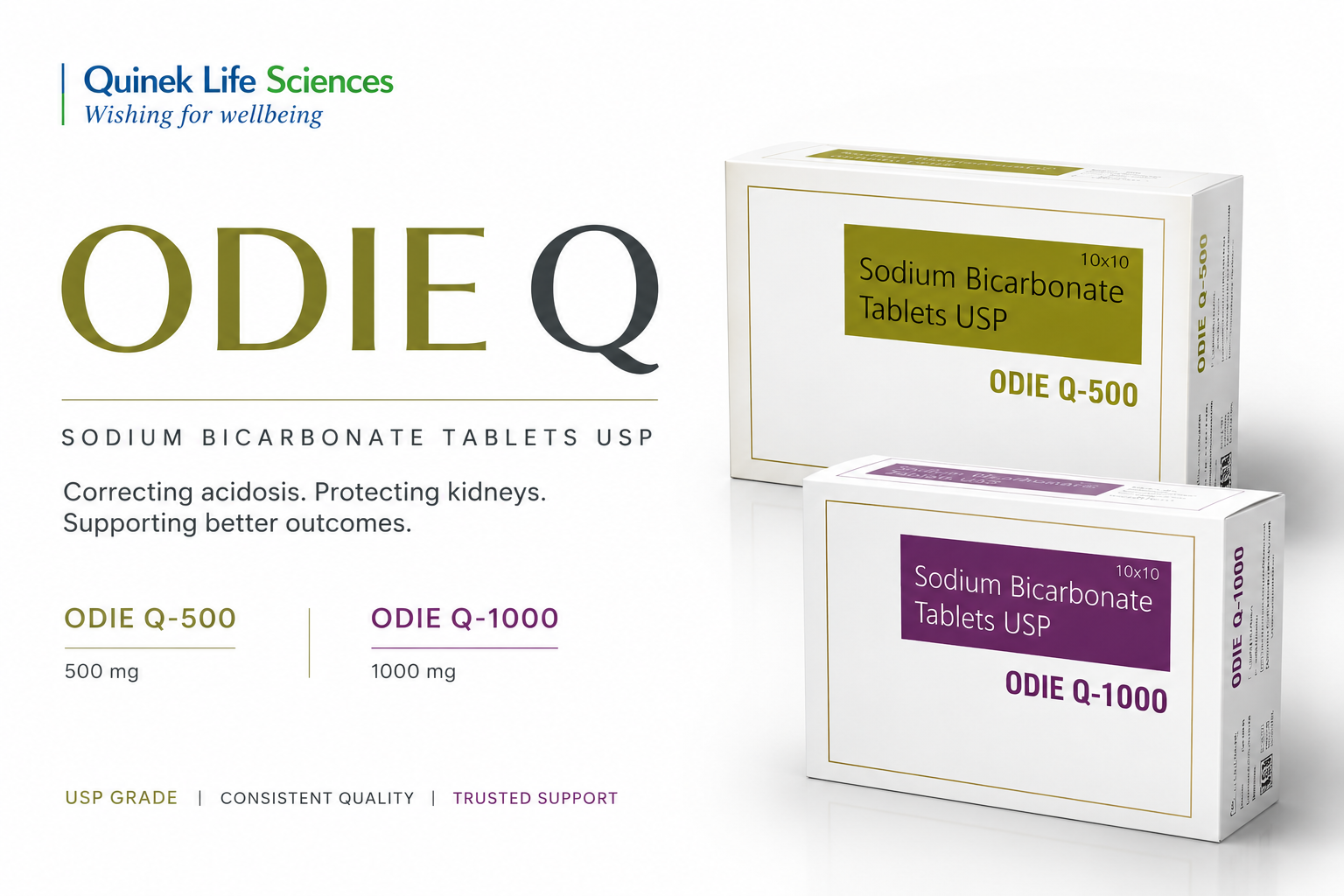
Metabolic acidosis — excess acid in the blood caused by failing kidneys — accelerates CKD progression, destroys bone, drives protein catabolism and increases mortality. Correcting it with sodium bicarbonate is one of the most evidence-backed, cost-effective and underutilised interventions in nephrology. ODIE Q 500 and ODIE Q 1000 bring USP grade sodium bicarbonate to nephrologists and urologists across India in pharmaceutical tablet form.
What Is Metabolic Acidosis — and Why Does It Matter So Much in CKD?
Healthy kidneys perform a critical function that is easy to overlook: they regulate the body’s acid-base balance. Every day, the metabolic processes of the body generate acid — through protein metabolism, cellular respiration and various biochemical reactions. The kidneys neutralise this acid by excreting hydrogen ions and regenerating bicarbonate — the blood’s primary buffer against acidosis.
As kidney function declines in CKD, this acid-clearing capacity is progressively lost. The kidneys can no longer excrete enough hydrogen ions or generate enough bicarbonate to maintain pH balance. The result is metabolic acidosis — a chronic state of excess acid in the blood that affects virtually every organ system and accelerates the very kidney damage that caused it.
The consequences of untreated metabolic acidosis in CKD are serious and well documented. It activates the renin-angiotensin system, increasing intra-glomerular pressure and fibrosis. It stimulates protein catabolism — breaking down muscle and albumin to generate bicarbonate through amino acid metabolism. It accelerates bone demineralisation as the skeleton is used as a bicarbonate buffer. And it increases all-cause mortality in CKD patients. Yet despite this, metabolic acidosis remains dramatically undertreated in Indian nephrology practice.
“Sodium bicarbonate is one of the most evidence-backed, cost-effective interventions in CKD management. Studies show it reduces CKD progression rate from 5.93 mL/min to 1.88 mL/min per 1.73m²/year — a meaningful slowing of the inevitable march toward dialysis.”
— Dr Rajesh Goel, Kidney Care Centre, Delhi
What Is Sodium Bicarbonate — and How Does It Work?
Sodium Bicarbonate (NaHCO₃) is one of the most fundamental medicines in clinical use. It is both an alkalising agent and a buffer — working through two complementary mechanisms depending on where it acts.
Systemic Alkalisation — Correcting Blood pH
When absorbed into the bloodstream, Sodium Bicarbonate directly raises serum bicarbonate levels — replenishing the buffer that the kidneys can no longer produce in adequate quantities. This corrects blood pH toward the normal range, reducing the acid load that is damaging kidney tissue, bone and muscle. Regular serum bicarbonate monitoring allows dose adjustment to maintain levels at or above the KDOQI target of 22 mEq/L.
Urinary Alkalisation — Protection in the Kidney Tubules
Sodium Bicarbonate also alkalises the urine — raising urinary pH. This is critical for preventing the precipitation of uric acid and calcium oxalate crystals in the kidney tubules and collecting system, reducing the formation of kidney stones and protecting tubular function. Alkaline urine also provides symptomatic relief in cystitis and urinary tract infections where acidic urine worsens burning symptoms.
Clinical Indications for ODIE Q
Metabolic Acidosis in Chronic Kidney Disease (CKD)
The primary indication for ODIE Q. KDOQI guidelines recommend maintaining serum bicarbonate at or above 22 mEq/L in all CKD patients. ODIE Q 1000 is typically prescribed at 1000mg three times daily (3g/day — approximately 0.5 mEq/kg of body weight) in patients with CKD Stage 3–5 and confirmed metabolic acidosis. Doses are adjusted based on regular serum bicarbonate monitoring. Evidence from multiple clinical studies demonstrates that bicarbonate supplementation at this dose significantly slows CKD progression and reduces the rate of GFR decline — one of the most meaningful disease-modifying interventions available in CKD management.
Renal Tubular Acidosis (RTA)
Renal Tubular Acidosis is a condition where the kidney tubules fail to acidify urine normally — leading to metabolic acidosis despite preserved or near-normal GFR. Unlike CKD-related acidosis, RTA often affects younger patients and responds very well to sodium bicarbonate supplementation. ODIE Q 500 is useful in RTA patients who require lower total daily doses — particularly in distal (Type 1) RTA where maintenance supplementation at 1–3 mEq/kg/day is the standard treatment.
Uric Acid Kidney Stone Prevention
Uric acid stones form in acidic urine — when urinary pH falls below 5.5, uric acid crystallises and precipitates in the kidney tubules. Sodium bicarbonate alkalises the urine to pH 6.0–6.5, preventing uric acid crystallisation and dissolving existing uric acid stones over time. This is a standard urological indication for ODIE Q, particularly in patients with gout, hyperuricosuria or recurrent uric acid stone disease. ODIE Q 500 allows flexible twice or thrice daily dosing for urinary alkalisation without the higher sodium load of the 1000mg formulation.
Cystinuria and Mixed Kidney Stone Management
Cystine stones — caused by an inherited defect in amino acid transport — form most readily in acidic urine. Urinary alkalisation with sodium bicarbonate to pH 7.0–7.5 significantly reduces cystine crystallisation. ODIE Q is also used in mixed stone disease where uric acid is a component, and in patients on uricosuric agents where urinary alkalisation protects against uric acid crystal formation triggered by increased urinary uric acid excretion.
Acute Metabolic Acidosis — Emergency and ICU Use
While IV sodium bicarbonate is preferred in acute severe acidosis (pH <7.1), oral sodium bicarbonate is used in less acute situations and as a step-down from IV therapy in hospitalised patients with acute kidney injury and metabolic acidosis once oral intake is possible. ODIE Q 1000 provides a convenient high-dose oral formulation for the transition from parenteral to enteral alkalisation therapy in recovering patients.
ODIE Q 500 vs ODIE Q 1000 — Clinical Selection Guide
Why USP Grade Matters — ODIE Q’s Quality Commitment
Sodium Bicarbonate is available in many forms — food grade, industrial grade and pharmaceutical grade. In a pharmaceutical tablet intended for human consumption in patients with kidney disease, only pharmaceutical grade material is acceptable. ODIE Q uses USP (United States Pharmacopeia) grade Sodium Bicarbonate — the highest pharmaceutical purity standard available.
USP grade certification means the raw material meets strict specifications for identity, purity, potency and the absence of heavy metals, microbial contamination and other impurities. In nephrology patients — whose kidneys cannot adequately clear impurities — pharmaceutical grade purity is not a marketing distinction. It is a clinical requirement.
ODIE Q is manufactured at Quinek Life Sciences’ WHO-GMP, GLP and ISO certified facilities — ensuring that the USP grade raw material is processed and tableted under conditions that maintain its purity, potency and consistency in every batch.
Monitoring and Important Clinical Cautions
Monitor Serum Bicarbonate Regularly
Target serum bicarbonate is ≥22 mEq/L per KDOQI guidelines. Over-correction (pushing bicarbonate above 26 mEq/L) can cause metabolic alkalosis — which carries its own risks. Check blood gas or serum electrolytes at initiation and every 4–8 weeks during dose adjustment, and every 3–6 months once stable.
Sodium Load Consideration
Each gram of Sodium Bicarbonate contains approximately 12 mEq of sodium. In CKD patients who are also hypertensive, oedematous or in heart failure, this sodium load requires consideration. Blood pressure and fluid balance should be monitored, and sodium intake from diet should be reviewed alongside ODIE Q therapy. In sodium-restricted patients, ODIE Q 500 allows lower total sodium delivery at equivalent alkalising effect.
Timing With Other Medicines
Sodium Bicarbonate can alter the absorption of several medicines by changing gastric and urinary pH. It should be taken separately from Phosphate Binders (which require acidic pH for optimal action), from Iron supplements (bicarbonate may reduce iron absorption), and from Fluoroquinolone antibiotics. A gap of at least 2 hours is recommended between ODIE Q and these medicines.
Urinary pH Monitoring for Stone Prevention
For uric acid stone prevention, target urinary pH is 6.0–6.5. For cystinuria, target is 7.0–7.5. Urinary pH strips allow patient self-monitoring at home — an important component of managing stone-forming disease. Alkalising the urine above pH 7.5 can paradoxically increase the risk of calcium phosphate stone formation.
Quinek Life Sciences — Nephrology & Urology Segment
ODIE Q 500 & ODIE Q 1000 — USP Grade Sodium Bicarbonate, Manufactured to WHO-GMP Standards
ODIE Q 500 and ODIE Q 1000 are Quinek Life Sciences’ USP grade Sodium Bicarbonate tablets — formulated specifically for the nephrology and urology pharmaceutical market in India. Both strengths are manufactured at our WHO-GMP, GLP and ISO certified facilities using USP grade raw material, ensuring the pharmaceutical purity, potency and batch consistency that nephrologists and their patients require.
The availability of both 500mg and 1000mg strengths provides prescribers with complete dose flexibility — from conservative initiation in sodium-sensitive patients to the standard 3g/day CKD metabolic acidosis protocol. ODIE Q is part of Quinek Life Sciences’ comprehensive nephrology and urology portfolio, designed to support specialists across India with quality-assured medicines at every stage of kidney disease management.
If you are a nephrologist, urologist or pharmaceutical distributor serving the nephrology or urology space — Quinek Life Sciences and ODIE Q are ready to support your practice.
Correcting the pH Saves the Kidney — ODIE Q Makes It Simple
In the context of CKD, where treatment options are often complex, expensive and demanding, sodium bicarbonate stands out: it is simple, inexpensive, well-tolerated and backed by strong evidence that it meaningfully slows the progression of kidney disease. Yet it is one of the most commonly omitted medicines in the CKD protocol.
For every nephrologist who routinely checks and corrects serum bicarbonate — and for every patient who takes their ODIE Q consistently — there is meaningful potential to delay the progression toward dialysis, preserve quality of life and protect the bones, muscles and cardiovascular system from the silent damage of chronic acidosis.
ODIE Q 500 and ODIE Q 1000 — USP grade Sodium Bicarbonate from Quinek Life Sciences. A simple medicine. A powerful intervention. The quality it deserves.
Medical Disclaimer: This article is for educational purposes and healthcare professional reference only. Sodium Bicarbonate therapy must be prescribed and monitored by a qualified nephrologist or physician. Serum bicarbonate, blood pressure and renal function must be regularly assessed during treatment.
Sources: ScienceDirect — Bicarbonate Therapy in CKD · NCBI — Effect of NaHCO3 on Intrarenal RAS in CKD · KDOQI Guidelines · Dr Rajesh Goel, Kidney Care Centre Delhi · Indian Society of Nephrology · Quinek Life Sciences Nephrology & Urology Segment