
Nephrology ·
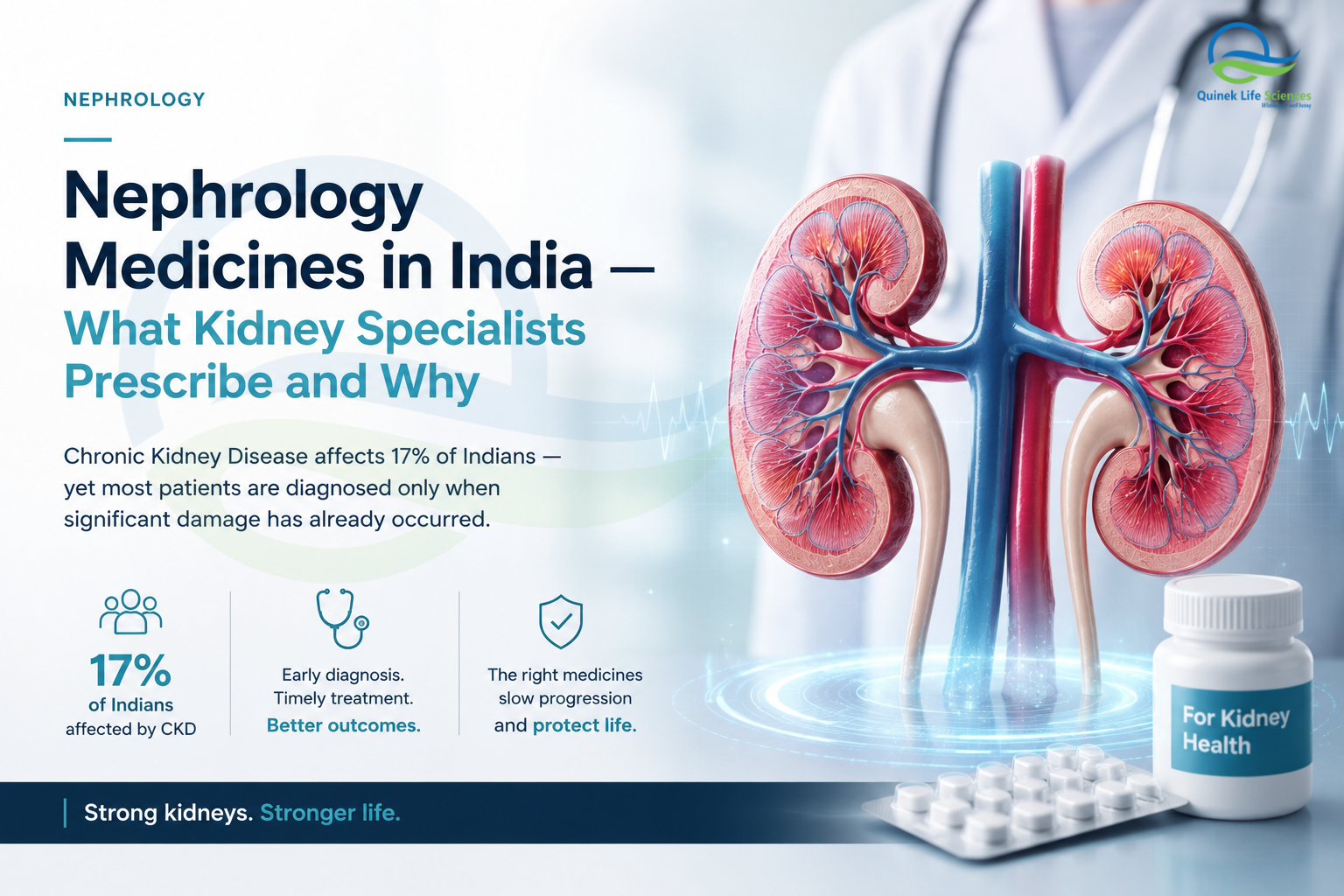
Nephrology Medicines in India — What Kidney Specialists Prescribe and Why
Chronic Kidney Disease affects 17% of Indians — yet most patients are diagnosed only when significant damage has already occurred. The right medicines, prescribed at the right stage, are what slow the progression and protect what remains.
India’s Silent Kidney Disease Crisis
The kidneys are among the hardest-working organs in the human body — filtering over 150 litres of blood every single day, regulating blood pressure, balancing electrolytes, producing hormones and removing waste. When they begin to fail, virtually every other system in the body is affected.
India is in the middle of a quiet but accelerating kidney disease epidemic. Chronic Kidney Disease affects an estimated 17% of the population — driven primarily by the twin epidemics of uncontrolled diabetes and hypertension. Yet because CKD produces almost no symptoms in its early stages, the vast majority of patients are not diagnosed until their kidney function has already fallen below 30% of normal.
By the time most Indian patients see a nephrologist, the window for early intervention has often already closed. This is why nephrology medicines — and getting access to quality nephrology pharmaceutical care — matter enormously.
“Nephrology is not just about managing kidney disease. It is about protecting every organ that depends on the kidneys — the heart, the bones, the blood and the brain.”
Understanding CKD — The Five Stages
Chronic Kidney Disease is classified into five stages based on GFR (Glomerular Filtration Rate) — a measure of how well the kidneys are filtering blood. The medicines prescribed at each stage differ significantly.
G3
Moderate CKD — GFR 30–59
Mild to moderate reduction in kidney function. Complications begin — anaemia, early bone disease, and fluid retention. Medicines for anaemia (ESAs, Iron supplements), phosphate binders and diuretics are added to the protocol.
G4
Severe CKD — GFR 15–29
Significant kidney damage. Preparation for renal replacement therapy begins. Comprehensive medication management across anaemia, bone-mineral disease, metabolic acidosis and cardiovascular protection.
G5
Kidney Failure — GFR below 15
End-stage renal disease. Dialysis or transplant required. Dialysis-related medicines, immunosuppressants (post-transplant) and comprehensive supportive care medicines are prescribed.
Key Categories of Nephrology Medicines
Nephrology is one of the most medication-intensive specialties in medicine. A patient with moderate-to-advanced CKD is typically on 6–10 different medicines simultaneously — each addressing a specific complication of declining kidney function.
Renoprotective Medicines — Slowing CKD Progression
ACE Inhibitors & ARBs
The first-line medicines for CKD associated with diabetes or hypertension. They reduce proteinuria (protein in urine), lower blood pressure and slow the progression of kidney damage. Consistently prescribed from early-stage CKD onwards.
SGLT2 Inhibitors
Originally developed for Type 2 diabetes, SGLT2 inhibitors have transformed CKD management. They reduce intra-glomerular pressure and have proven kidney-protective effects independent of their glucose-lowering action. Now recommended across multiple CKD guidelines globally.
Antioxidant Renal Support
Combinations of antioxidants — including Alpha Lipoic Acid, NAC and Vitamin E — are prescribed to reduce oxidative stress in kidney tissue. Oxidative damage is a key driver of CKD progression and is particularly significant in diabetic nephropathy.
Anaemia Management in CKD
Anaemia develops in the majority of CKD patients because the damaged kidneys cannot produce adequate amounts of erythropoietin — the hormone that signals the bone marrow to make red blood cells. Untreated anaemia in CKD causes fatigue, reduced quality of life and accelerates cardiovascular decline.
ESAs — Erythropoiesis Stimulating Agents
Injectable medicines (Erythropoietin alpha/beta, Darbepoetin) that stimulate red blood cell production. Given subcutaneously or intravenously, typically weekly or bi-weekly in dialysis patients and less frequently in non-dialysis CKD.
IV & Oral Iron Supplements
Iron deficiency is almost universal in CKD anaemia. Intravenous iron (Iron Sucrose, Ferric Carboxymaltose) is preferred in dialysis patients for faster correction. Oral iron supplements are used in earlier stages, though absorption may be impaired.
Bone and Mineral Disease in CKD
The kidneys play a central role in Vitamin D activation and phosphate balance. As kidney function declines, patients develop secondary hyperparathyroidism, Vitamin D deficiency and dangerous elevations in blood phosphate — collectively called CKD-MBD (Mineral Bone Disease).
Active Vitamin D Analogues
Calcitriol and Alfacalcidol are the active forms of Vitamin D prescribed in CKD — unlike standard Vitamin D supplements, which require kidney activation and are therefore ineffective. These medicines suppress PTH, improve calcium absorption and reduce bone loss.
Phosphate Binders
Calcium-based binders (Calcium Carbonate, Calcium Acetate) and non-calcium binders (Sevelamer, Lanthanum Carbonate) are taken with food to prevent phosphate absorption from the gut. High phosphate levels accelerate CKD progression and increase cardiovascular risk.
Cinacalcet
A calcimimetic agent that directly suppresses PTH secretion by increasing the sensitivity of parathyroid cells to calcium. Used in secondary hyperparathyroidism in dialysis patients where Vitamin D analogues alone are insufficient.
Metabolic Acidosis and Urinary Alkalizers
Sodium Bicarbonate
As kidneys lose the ability to excrete acid, metabolic acidosis develops. Sodium Bicarbonate supplementation corrects blood pH, reduces protein catabolism, slows CKD progression and protects bone mineral density.
Urinary Alkalizers
Potassium Citrate and Sodium Citrate formulations are prescribed to alkalise urine, prevent uric acid and calcium oxalate stone formation, and manage renal tubular acidosis — a common complication in CKD patients with recurrent stone disease.
The Access Gap in Indian Nephrology
India adds over 2.2 lakh new dialysis patients every year. Yet access to dialysis infrastructure, specialist nephrology care and quality medicines remains severely limited outside major cities. In Tier 2 and Tier 3 cities, nephrologists frequently struggle to source consistent, quality-assured nephrology medicines from reliable pharmaceutical partners.
The gap is not in medical knowledge — India’s nephrologists are among the best trained in the world. The gap is in pharmaceutical supply — quality medicines, consistently available, at every level of the healthcare system.
Quinek Life Sciences — Nephrology Segment
13 Products. 7 Categories. A Dedicated Nephrology Range Built for Indian Specialists.
At Quinek Life Sciences, nephrology is a dedicated specialty segment — not a product line added as an afterthought. Our nephrology range spans 13 products across 7 clinical categories, covering antioxidant renal support, alkalizers, anaemia management, bone-mineral disease, dialysis care and immunosuppressant support.
Every product is manufactured at our WHO-GMP, GLP and ISO certified facilities — meeting the same international quality standards that hospitals and specialist clinics across India demand. Our distribution network is expanding rapidly across states, bringing our nephrology range closer to specialists in cities and towns that have historically had limited access to quality pharmaceutical supply.
If you are a nephrologist, a kidney care clinic or a distributor looking for a trusted nephrology pharmaceutical partner — we would like to speak with you.
Kidney Disease Is Manageable — If You Have the Right Medicines
CKD cannot be reversed, but its progression can absolutely be slowed — sometimes dramatically — with the right combination of medicines, prescribed at the right time and taken consistently. The difference between a patient who reaches dialysis in three years and one who maintains adequate kidney function for fifteen years often comes down to the quality and consistency of their pharmaceutical care.
For nephrologists — the medicines you prescribe are only as good as the company that makes them. For patients — understanding why each medicine has been prescribed helps you take it seriously. And for the healthcare system — ensuring that quality nephrology medicines reach every corner of India is not a commercial opportunity. It is an obligation.
Medical Disclaimer: This article is for educational and informational purposes only. All nephrology treatment decisions must be made by a qualified nephrologist based on individual patient assessment.
Sources: KDIGO CKD Guidelines · Indian Society of Nephrology · ICMR · Quinek Life Sciences Nephrology Segment