
Pain Management & Neurology
A Migraine Is Not Just a Headache. NAPRIDOM Treats the Pain and the Nausea Together — Because Managing One Without the Other Is Not Enough.
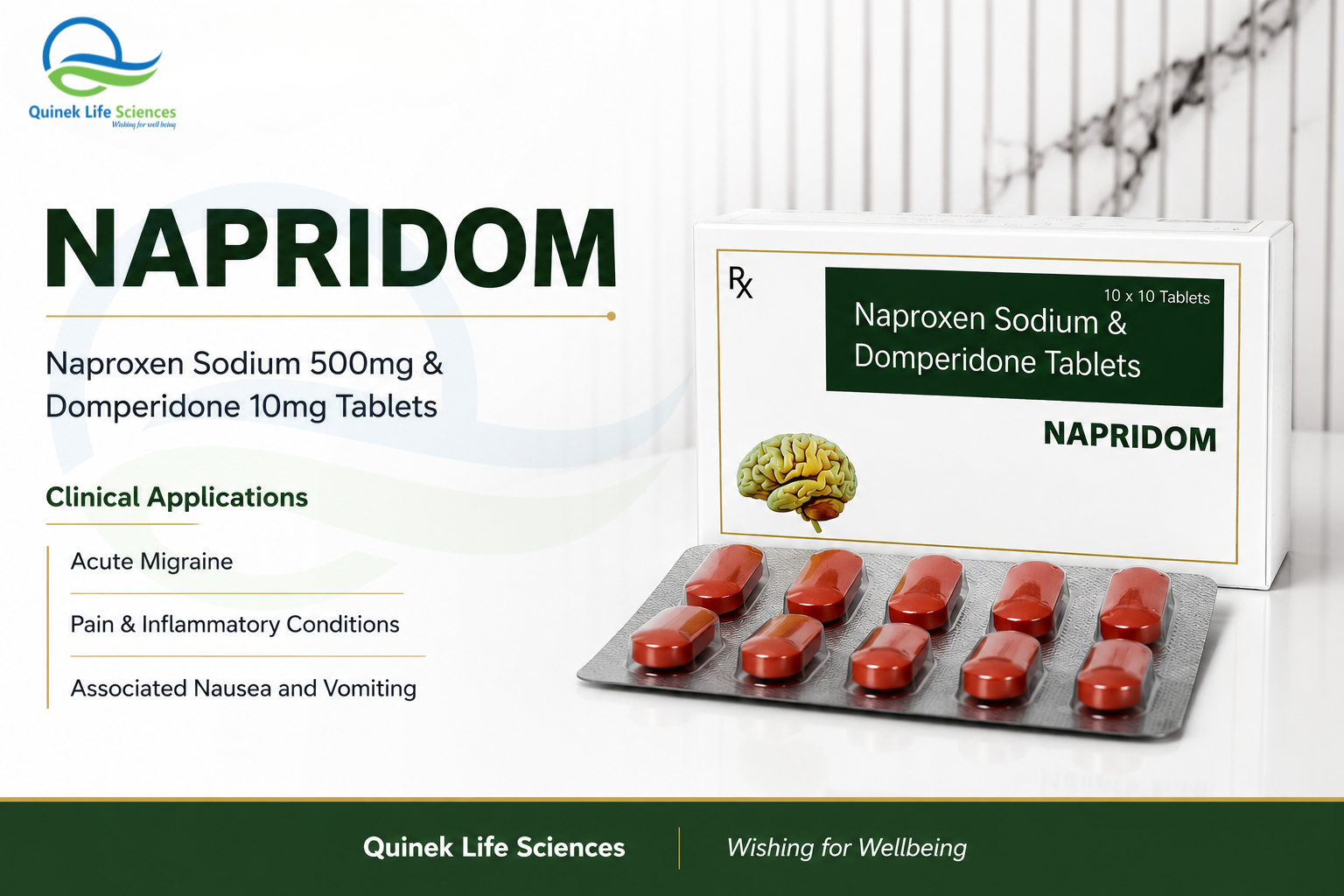
Migraine attacks arrive with more than pain. Nausea, vomiting and gastric stasis compound the headache and make oral medicines harder to absorb and work with. NAPRIDOM — Naproxen 500mg combined with Domperidone 10mg — addresses both simultaneously. The NSAID controls pain and inflammation. The antiemetic controls nausea, reduces vomiting and restores gastric motility so the medicine itself is absorbed properly. Two mechanisms. One tablet. From Quinek Life Sciences.
Why Migraine Needs More Than Just a Painkiller
Migraine is the third most prevalent neurological condition in the world and one of the leading causes of disability in India. It is not simply a bad headache. A migraine attack is a complex neurological event — involving a cascade of inflammatory and vascular changes in the brain that produce severe, often one-sided, pulsating head pain that typically lasts between 4 and 72 hours. It is accompanied by heightened sensitivity to light, sound and smell, and in the majority of patients, by nausea — and frequently by vomiting.
This nausea is not a side effect of the pain. It is a direct consequence of the neurological changes occurring during the migraine attack itself. During a migraine, gastric motility slows dramatically — a process called gastric stasis. Food and liquid stop moving normally through the stomach and upper digestive tract. This matters clinically for a very specific reason: oral pain medicines taken during a migraine attack are absorbed from the small intestine, not the stomach. If gastric motility is reduced, the medicine sits in the stomach rather than passing through to be absorbed — producing delayed, reduced or erratic pain relief even when the right NSAID has been prescribed.
This is the clinical problem that NAPRIDOM is designed to solve. By combining Naproxen — a long-acting, dual COX-inhibiting NSAID — with Domperidone — a prokinetic antiemetic that restores gastric motility and controls nausea — NAPRIDOM addresses the full clinical picture of a migraine attack in a single tablet, taken at the earliest sign of an attack for the best possible outcome.
“When a migraine attack begins, the body releases prostaglandins that cause blood vessels in the brain to dilate and become inflamed. Naproxen blocks the enzymes responsible for this prostaglandin production. Domperidone simultaneously restores gastric motility — ensuring Naproxen reaches the small intestine to be absorbed at the right time, when it is needed most.”
What Is NAPRIDOM?
NAPRIDOM is a fixed-dose combination tablet containing Naproxen 500mg — a non-steroidal anti-inflammatory drug (NSAID) — and Domperidone 10mg — a dopamine antagonist with antiemetic and prokinetic properties. It is primarily indicated for the acute management of migraine attacks in adults, where both the headache pain and the gastrointestinal symptoms of nausea and vomiting need to be addressed at the same time.
The combination is also used in other painful inflammatory conditions where nausea is a complicating factor, including menstrual pain (dysmenorrhoea) with nausea, and post-operative or procedure-related pain with gastric discomfort. Each tablet contains a full therapeutic dose of both agents — 500mg of Naproxen for meaningful analgesic and anti-inflammatory effect, and 10mg of Domperidone for prokinetic and antiemetic coverage.
How the Two Ingredients Work — and Why This Combination Makes Clinical Sense
01
Naproxen 500mg
COX-1 & COX-2 Inhibitor · Long-Acting · Anti-Inflammatory · Analgesic · Antipyretic
Naproxen is a propionic acid-class NSAID that works by inhibiting both Cyclooxygenase-1 (COX-1) and Cyclooxygenase-2 (COX-2) enzymes — the enzymes responsible for converting arachidonic acid into prostaglandins. Prostaglandins are the primary chemical mediators of pain, inflammation, fever and vascular changes. In migraine specifically, prostaglandins cause intracranial blood vessel dilation and neurogenic inflammation — producing the characteristic throbbing, pulsating pain of a migraine attack.
By blocking both COX enzymes, Naproxen reduces prostaglandin synthesis throughout the body — producing analgesic, anti-inflammatory and antipyretic effects. Its key clinical advantage over shorter-acting NSAIDs like Ibuprofen is its long half-life of 12–17 hours, providing sustained pain relief from a single dose — ideal for migraine attacks that can last for hours to days. At 500mg, NAPRIDOM provides the full therapeutic dose validated in migraine treatment guidelines.
02
Domperidone 10mg
Dopamine D2 Antagonist · Antiemetic · Prokinetic · Gastric Motility Restoration
Domperidone is a dopamine D2 receptor antagonist — but unlike Metoclopramide (another dopamine antagonist commonly used as an antiemetic), Domperidone acts primarily at the peripheral dopamine receptors of the gastrointestinal tract and at the chemoreceptor trigger zone (CTZ) in the brain — without significantly crossing the blood-brain barrier. This gives Domperidone its antiemetic and prokinetic effects with a significantly lower risk of the central nervous system side effects (extrapyramidal reactions, sedation) associated with centrally-acting dopamine antagonists.
In the context of migraine treatment, Domperidone’s role is dual and critically important. By blocking D2 receptors in the CTZ, it prevents the nausea and vomiting signal from reaching the vomiting centre — directly suppressing migraine-associated nausea. Simultaneously, by blocking peripheral D2 receptors in the gut wall, it restores normal gastric motility — reversing the gastric stasis of migraine and ensuring that Naproxen is propelled from the stomach into the small intestine where it can be properly absorbed. This prokinetic action effectively converts the oral Naproxen from a poorly-absorbed migraine treatment into one that reaches the bloodstream at the right concentration, at the right time.
What Conditions NAPRIDOM Is Used For
01
Acute Migraine With Nausea or Vomiting
The primary and most important indication for NAPRIDOM. Migraine attacks accompanied by nausea — which describes the majority of moderate-to-severe migraine episodes — are precisely the clinical situation this combination addresses. NAPRIDOM should be taken at the earliest sign of an attack — ideally at the very onset of headache, before the pain becomes severe and before gastric stasis is fully established. Earlier administration consistently produces better outcomes because Naproxen is absorbed before the gastric stasis reaches its maximum, and Domperidone prevents the nausea from becoming established.
02
Menstrual Migraine and Hormonal Migraine
Menstrual migraine — migraine attacks triggered by the cyclical drop in oestrogen around the menstrual period — is one of the most common and most severe migraine presentations in Indian women. These attacks are typically longer, more intense and more resistant to standard treatment than non-menstrual migraines. Naproxen’s long half-life (12–17 hours) gives it a particular advantage in menstrual migraine — sustained anti-prostaglandin effect across the duration of the attack — and its anti-inflammatory action also addresses the uterine prostaglandin excess that drives menstrual cramping simultaneously.
03
Dysmenorrhoea (Menstrual Cramps)
Primary dysmenorrhoea — painful menstrual cramps caused by excessive uterine prostaglandin production driving sustained, painful uterine contractions — is one of the most common reasons women seek over-the-counter and prescription pain relief in India. Naproxen’s dual COX inhibition reduces uterine prostaglandin synthesis directly, relieving cramping and reducing menstrual blood flow. Domperidone addresses the nausea that frequently accompanies severe dysmenorrhoea, completing a comprehensive single-tablet approach to period pain management.
04
Inflammatory Joint Pain — Rheumatoid Arthritis and Osteoarthritis
As a potent dual COX inhibitor, Naproxen is indicated for rheumatoid arthritis, osteoarthritis, ankylosing spondylitis and acute gout flares — providing meaningful analgesic and anti-inflammatory relief. In patients with these conditions who also experience NSAID-related nausea or gastric discomfort, the Domperidone component of NAPRIDOM adds prokinetic support that reduces GI symptoms and improves medication tolerability. This makes NAPRIDOM particularly appropriate for older patients with inflammatory joint disease who are prone to NSAID-related gastric complaints.
05
Post-Operative and Acute Musculoskeletal Pain With Nausea
In acute musculoskeletal pain conditions — tendinitis, bursitis, acute back pain, sports injuries — where nausea is present as a consequence of pain severity or co-prescribed medications, NAPRIDOM provides dual-action relief. The Domperidone component addresses nausea without sedation, while Naproxen’s sustained 12–17 hour action reduces the need for frequent redosing during acute pain episodes.
Why the Combination Works Better Than Naproxen Alone
The Absorption Problem During Migraine
When a patient takes Naproxen alone during a migraine attack, they are taking an oral medicine into a stomach that is not moving its contents normally. Gastric stasis means Naproxen may spend 30–60 minutes or longer in the stomach before reaching the small intestine. During that time, pain continues to escalate, nausea may worsen and the patient may vomit — expelling the medicine before it can be absorbed at all. Domperidone in NAPRIDOM prevents this entire failure cascade.
Domperidone’s Role as an Absorption Enhancer
By restoring gastric motility through D2 receptor blockade, Domperidone in NAPRIDOM accelerates gastric emptying — propelling Naproxen through the stomach and into the small intestine faster than would occur without it. The result is a faster onset of Naproxen’s analgesic action, a higher peak plasma concentration and more consistent pain relief — making NAPRIDOM clinically more effective than Naproxen alone for migraine in the majority of patients.
Side Effects and Important Clinical Warnings
GI Risk — Take With Food
As a dual COX inhibitor, Naproxen reduces prostaglandin-mediated gastric mucosal protection — increasing the risk of gastric irritation, peptic ulcer and GI bleeding, particularly with prolonged use or in patients with a history of GI disease. Always prescribe with food. In high-risk patients, add a PPI. Avoid prolonged use without clinical indication.
Cardiovascular Caution
Like all NSAIDs, Naproxen should be used with caution in patients with cardiovascular disease, hypertension or heart failure. Use the lowest effective dose for the shortest duration. NAPRIDOM is not appropriate for long-term daily use in cardiovascular-risk patients without specialist review.
Domperidone Cardiac Warning
Domperidone is associated with a small but documented risk of QT interval prolongation and serious cardiac arrhythmia, particularly at higher doses and in patients with pre-existing cardiac conditions. At the 10mg dose in NAPRIDOM — used for the shortest necessary duration — the risk is minimal in otherwise healthy patients. However, NAPRIDOM is contraindicated in patients with known prolonged QT, hypokalaemia or on other QT-prolonging medicines.
Renal and Hepatic Caution
NAPRIDOM is contraindicated in patients with significant renal or hepatic impairment. Naproxen reduces prostaglandin-mediated renal blood flow regulation and may worsen renal function. Monitor renal function in patients on chronic NSAID therapy. Avoid in patients with CKD beyond Stage 2.
Important Warning — Medication Overuse Headache
Taking any acute pain medicine — including NAPRIDOM — for headache on more than 10–15 days per month can paradoxically cause Medication Overuse Headache (MOH) — a chronic daily headache driven by analgesic withdrawal rather than the original migraine. This is one of the most common causes of chronic daily headache in India.
Patients who experience migraines frequently enough to require acute treatment more than twice per week should be assessed for preventive migraine therapy — which reduces attack frequency and removes the dependence on acute medications. NAPRIDOM is an acute treatment. It is not a preventive. Prescribers should monitor frequency of use and initiate preventive therapy when indicated.
What Patients Should Know About NAPRIDOM
Take it at the very first sign of a migraine attack. The earlier you take NAPRIDOM after an attack starts, the more effective it will be. Waiting until the headache is severe and vomiting has started significantly reduces its effectiveness — because gastric stasis is then fully established and Naproxen absorption is severely impaired.
Always take with food or a glass of milk. This protects the stomach lining from Naproxen’s COX-1 inhibitory effect on gastric mucosal prostaglandins. Never take NAPRIDOM on an empty stomach.
Do not exceed two tablets in 24 hours and do not use NAPRIDOM on more than 10 days in any calendar month. If your migraine frequency is increasing, speak to your neurologist about preventive therapy.
Do not combine with other NSAIDs, aspirin or blood thinners without medical guidance. The combination significantly increases the risk of GI bleeding.
Quinek Life Sciences — Specialty Pharma
NAPRIDOM — Dual-Action Migraine and Pain Relief From a WHO-GMP Certified Manufacturer
NAPRIDOM is part of Quinek Life Sciences’ specialty pharmaceutical range — formulated for neurologists, gynaecologists, general physicians and pain specialists who need a reliable, dual-action acute pain and antiemetic combination. Manufactured at our WHO-GMP, GLP and ISO certified facilities, NAPRIDOM delivers consistent potency and pharmaceutical quality in every tablet.
At Quinek Life Sciences, our portfolio spans five specialty segments — IVF and fertility, gynaecology, nephrology, urology and neuropsychiatry — and NAPRIDOM reflects our commitment to formulations that address the complete clinical picture rather than treating one symptom while ignoring another. If you are a prescriber or distributor looking for a trusted pharmaceutical partner across specialty segments, we would like to speak with you.
Migraine Is a Full-Body Event. NAPRIDOM Is a Full-Picture Response.
For too long, migraine has been managed with a single painkiller taken during a full attack — often too late, often vomited back up, often providing partial relief at best. The clinical insight behind NAPRIDOM is straightforward: a migraine is not just a headache, so the medicine should not be just a painkiller. It should address the pain, the nausea and the absorption problem that gastric stasis creates — all at once, at the earliest possible moment in the attack.
NAPRIDOM — Naproxen 500mg and Domperidone 10mg from Quinek Life Sciences. Taken at the first sign. Working on the right targets. Giving migraine patients a real chance of getting through an attack without losing the rest of their day.
Medical Disclaimer: This article is for educational purposes and healthcare professional reference only. NAPRIDOM must be prescribed by a qualified physician. It is not appropriate for patients with cardiovascular disease, renal impairment, GI ulcer history, prolonged QT or pregnancy without specialist assessment. Do not self-medicate with this combination.
Sources: PlatinumRx — Naproxen Domperidone Combination Clinical Reference · Metropolis India — Naxdom 500 Uses · Bionova — Naproxen Domperidone Tablets · Truemeds — Naproxen Domperidone Drug Salts Reference · Quinek Life Sciences Specialty Pharma