
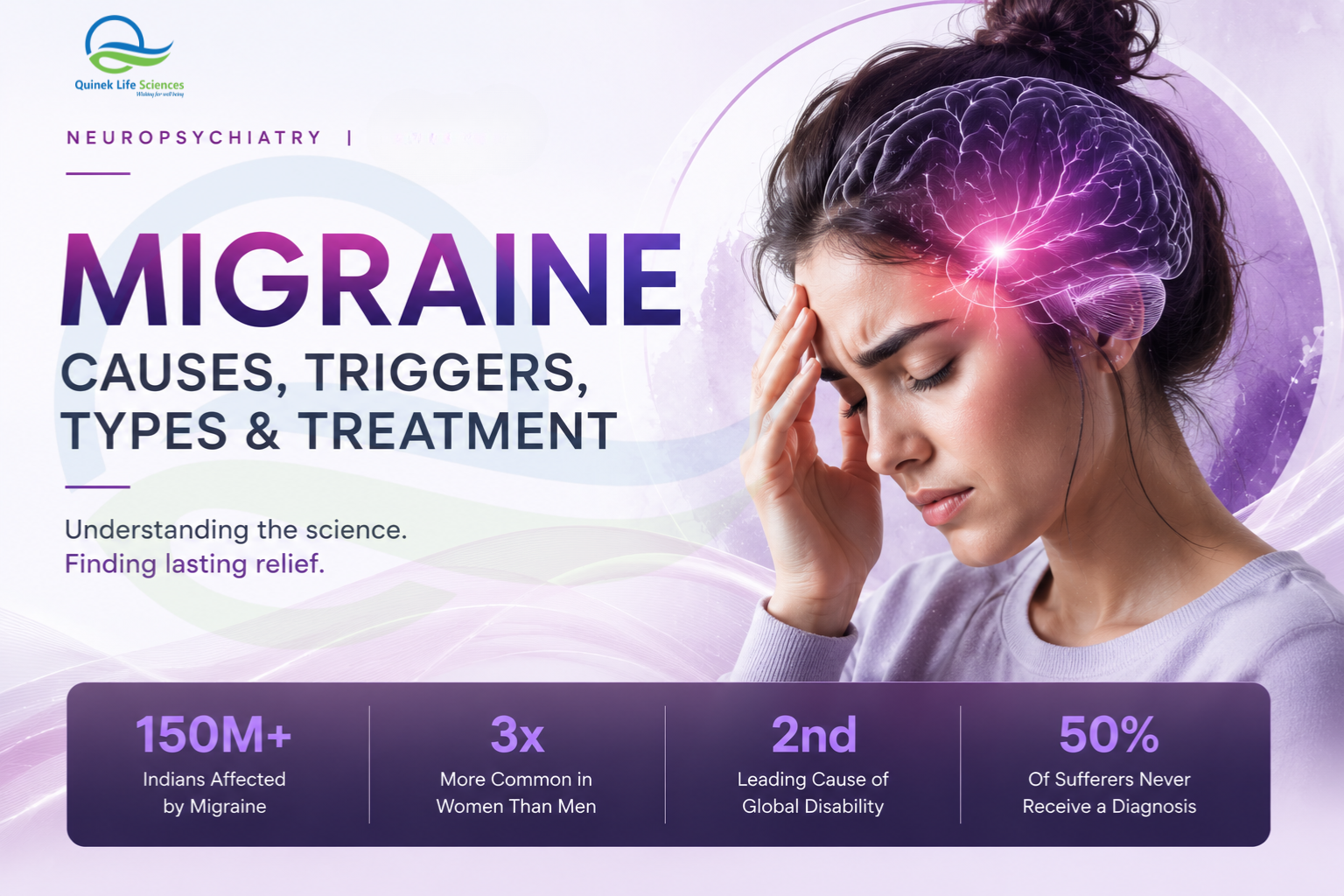
Migraine is the most misunderstood neurological condition in India. Ask most people what a migraine is and they will say “a really bad headache.” Ask someone who has one and they will describe something altogether different — a disabling, hours-long or days-long neurological event involving throbbing head pain, profound nausea, extreme sensitivity to light and sound, and sometimes visual disturbances that appear before the headache even starts.
Migraine is not a severe headache. It is a complex neurological disorder with a distinct pathophysiology, clear diagnostic criteria, known trigger patterns and — critically — effective treatment options that most sufferers in India never access. An estimated 150 million Indians are affected by migraine. The majority manage it with over-the-counter painkillers, rest in a dark room, and the quiet hope that the next attack will be milder. Many have never been formally diagnosed. Fewer still have been offered preventive treatment.
This article changes that. It explains what migraine actually is, what causes it, how it is diagnosed and — most importantly — what can be done to treat and prevent it effectively.
IN THIS ARTICLE
- What Is Migraine — And What Makes It Different?
- Types of Migraine
- The Four Phases of a Migraine Attack
- What Causes Migraine — The Neuroscience
- Common Migraine Triggers
- How Migraine Is Diagnosed
- Acute Treatment — Stopping an Attack
- Preventive Treatment — Reducing Attack Frequency
- Frequently Asked Questions
- Quinek Life Sciences — Neuropsychiatry Support
What Is Migraine — And What Makes It Different?
Migraine is a primary headache disorder — a neurological condition in its own right, not a symptom of another disease. It is characterised by recurrent attacks of moderate to severe headache, typically unilateral and pulsating in quality, lasting 4 to 72 hours and associated with nausea, vomiting, photophobia (sensitivity to light) and phonophobia (sensitivity to sound). Physical activity worsens the headache. Rest in a dark, quiet room is the instinctive response — and for good reason.
ICHD-3 DIAGNOSTIC CRITERIA FOR MIGRAINE WITHOUT AURA
At least 5 attacks fulfilling the following criteria:
Lasting 4–72 hours (untreated or unsuccessfully treated)
At least 2 of 4: unilateral · pulsating · moderate-severe pain · aggravated by routine physical activity
At least 1 of 2: nausea and/or vomiting · photophobia and phonophobia
Not better accounted for by another diagnosis
Reference: International Classification of Headache Disorders, 3rd Edition (ICHD-3)
Types of Migraine
Migraine Without Aura
The most common type. Attacks of moderate-severe headache with nausea, photo and phonophobia — without preceding neurological symptoms. Accounts for approximately 75% of all migraine.
Migraine With Aura
Preceded by reversible focal neurological symptoms (aura) — most commonly visual (zigzag lines, blind spots, flashing lights), but also sensory (tingling), speech or motor disturbances. Aura typically lasts 20–60 minutes before the headache phase begins.
Chronic Migraine
Defined as headache on 15 or more days per month for more than 3 months, with migraine features on at least 8 of those days. A significant cause of disability and productivity loss — and a strong indication for preventive pharmacotherapy.
Menstrual Migraine
Attacks occurring exclusively or predominantly around menstruation — triggered by the oestrogen withdrawal that occurs before the period. Often more severe, longer-lasting and less responsive to treatment than non-menstrual attacks.
Vestibular Migraine
Migraine with prominent vestibular symptoms — vertigo, dizziness and balance disturbance — which may occur with or without headache. Frequently misdiagnosed as labyrinthitis or BPPV. One of the most common causes of recurrent vertigo in adults.
The Four Phases of a Migraine Attack
A full migraine attack can unfold across four distinct phases — though not every patient experiences all four with every attack. Understanding the phases helps patients recognise early warning signs and take acute treatment at the most effective time window.
What Causes Migraine — The Neuroscience
Migraine is a disorder of the central nervous system — specifically involving abnormal excitability of the trigeminal pain pathways and dysregulation of pain modulation circuits in the brain. The exact pathophysiology has evolved significantly in understanding over the past three decades.
The current evidence points to cortical spreading depression (CSD) as the likely neurological basis of aura — a wave of neuronal and glial depolarisation that spreads across the cortex, producing the transient neurological symptoms of aura. This triggers the trigeminal nucleus caudalis, releasing inflammatory neuropeptides — particularly calcitonin gene-related peptide (CGRP) — that cause vasodilation of meningeal vessels and the characteristic throbbing, pulsating head pain of the headache phase.
THE CGRP BREAKTHROUGH
The discovery of CGRP’s central role in migraine pathophysiology led to the development of a new class of targeted migraine treatments — CGRP monoclonal antibodies (erenumab, fremanezumab, galcanezumab) and CGRP receptor antagonists (gepants). These have transformed preventive migraine treatment globally and represent the first migraine-specific prevention class ever developed. Reference: NEJM — CGRP and Migraine, 2020
Migraine also has a strong genetic component — with heritability estimates of 40–50%. First-degree relatives of migraine sufferers are 3–4 times more likely to develop migraine themselves. Rare monogenic forms (familial hemiplegic migraine) involve mutations in calcium and sodium channel genes — highlighting the role of ion channel dysregulation in migraine susceptibility.
Common Migraine Triggers
Triggers do not cause migraine — they lower the threshold for an attack in a brain that is already predisposed. The same trigger that causes an attack in one patient may have no effect in another. Identifying and managing personal triggers — through a headache diary — is one of the most practical self-management tools available to migraine patients.
How Migraine Is Diagnosed
Migraine is a clinical diagnosis — made on the basis of history, using the ICHD-3 criteria. There is no blood test or imaging finding that confirms migraine. The role of investigations is to exclude secondary headache causes — not to confirm migraine. A careful headache history is the most important diagnostic tool available.
The Headache History — What to Ask
Age of onset · Attack frequency and duration · Pain quality, location and severity · Associated symptoms (nausea, photophobia, phonophobia) · Aura characteristics · Triggers identified by patient · Family history of headache · Medication use (including OTC analgesics — overuse is a common complicating factor) · Impact on daily functioning.
When to Investigate — Red Flags
Neuroimaging is indicated when red flag features are present — the SNOOP4 criteria: Systemic symptoms/disease · Neurological signs · Onset sudden (thunderclap) · Older age of onset (>50) · Progressive worsening pattern · Postural change headache · Precipitated by Valsalva · Papilloedema. In the absence of red flags, neuroimaging is not routinely required for a classic migraine presentation.
Acute Treatment — Stopping an Attack
Effective acute treatment requires the right drug, taken at the right time, at the right dose. The key principle of acute migraine management is early intervention — treating at the first sign of headache, before pain becomes severe, significantly improves treatment response.
MEDICATION OVERUSE HEADACHE — A CRITICAL WARNING
Using acute analgesics (triptans, NSAIDs, combination analgesics) on more than 10–15 days per month leads to medication overuse headache (MOH) — a paradoxical worsening of headache that mimics chronic migraine. This is among the most common and most mismanaged headache presentations in India. Any patient using acute migraine medication more than 2–3 times per week needs review for MOH and preventive treatment. Reference: ICHD-3 — Medication Overuse Headache
Preventive Treatment — Reducing Attack Frequency
Preventive (prophylactic) treatment is indicated when migraine attacks are frequent (4 or more per month), severe, or significantly impair daily functioning — or when acute treatments are failing or being overused. The goal is to reduce attack frequency by at least 50%, reduce severity and improve quality of life.
QUINEK NEUROPSYCHIATRY — RELEVANT FORMULATIONS
DPROKS 250 / 500 — Divalproex Sodium · Level A migraine prevention · WHO-GMP certified
ALPOR 500 — Sodium Valproate + Valproic Acid CR · Migraine prophylaxis · Controlled release
NIXCHEL-NT — Pregabalin + Methylcobalamin + Nortriptyline · Migraine with neuropathic component · Sleep support
Frequently Asked Questions
Q. Is migraine hereditary?
Yes — migraine has a strong genetic component, with heritability estimated at 40–50%. If both parents have migraine, the risk to a child is approximately 75%. This does not mean every child of migraine parents will develop it — but genetic susceptibility is real and significant.
Q. Why do migraines affect women more than men?
Oestrogen plays a significant modulatory role in migraine pathophysiology. Migraine is rare in childhood, increases dramatically at puberty in girls, fluctuates with the menstrual cycle, often improves during pregnancy (especially the second and third trimesters), and frequently resolves after menopause. This hormonal dependency accounts for much of the 3:1 female-to-male prevalence ratio.
Q. Can migraine with aura increase stroke risk?
Yes — migraine with aura is associated with a modestly increased risk of ischaemic stroke, particularly in women who smoke and use combined oral contraceptives. The absolute risk increase is small, but the combination of all three risk factors warrants careful clinical assessment. Smoking cessation and POPs (progestogen-only pills) rather than combined OCPs are generally recommended for women with migraine with aura.
Q. How long does preventive treatment need to be taken?
Preventive treatment is typically continued for 6–12 months once good control is achieved, then gradually tapered under medical supervision. Many patients can reduce or discontinue preventive therapy — but this should never be done abruptly. The decision to stop must be made with the treating neurologist.
Q. Is migraine curable?
Migraine is not curable in the traditional sense — but it is highly manageable. With the right combination of trigger management, acute treatment and preventive therapy, the vast majority of migraine patients can achieve significant reduction in attack frequency and severity, and live full, unrestricted lives. The goal is control — and for most patients, that goal is entirely achievable.
Quinek Life Sciences — Neuropsychiatry Support
Quinek Life Sciences is a WHO-GMP, GLP, ISO, DCGI and FSSAI certified specialty pharmaceutical company with a comprehensive neuropsychiatry portfolio — covering epilepsy, migraine prevention, depression, anxiety, neuropathic pain and neurovitamin support.
Our Sodium Valproate and Divalproex Sodium formulations — manufactured under WHO-GMP certified conditions — are used in both epilepsy management and migraine prophylaxis, providing neurologists and general practitioners with consistent, high-quality formulations they can rely on for long-term preventive treatment.
“Migraine is not a headache. It is a neurological disorder — and it deserves to be treated like one.”
Quinek Life Sciences — WHO-GMP Certified Neuropsychiatry Pharmaceutical Company, India
References & Further Reading
- International Classification of Headache Disorders 3rd Edition (ICHD-3) — Migraine
- NEJM — CGRP and Migraine Pathophysiology, 2020
- ICHD-3 — Medication Overuse Headache
- WHO — Headache Disorders Fact Sheet
- NCBI — Migraine Burden in India
- Quinek Life Sciences — Neuropsychiatry Segment
- Quinek Life Sciences — Quality Certifications
This article is for educational purposes only. It does not constitute medical advice. Always consult a qualified neurologist for diagnosis and treatment of migraine.