
IVF & Fertility
When a Woman’s Body Needs Both FSH and LH to Respond — Gynotrop HMG Delivers Both in Every Vial.
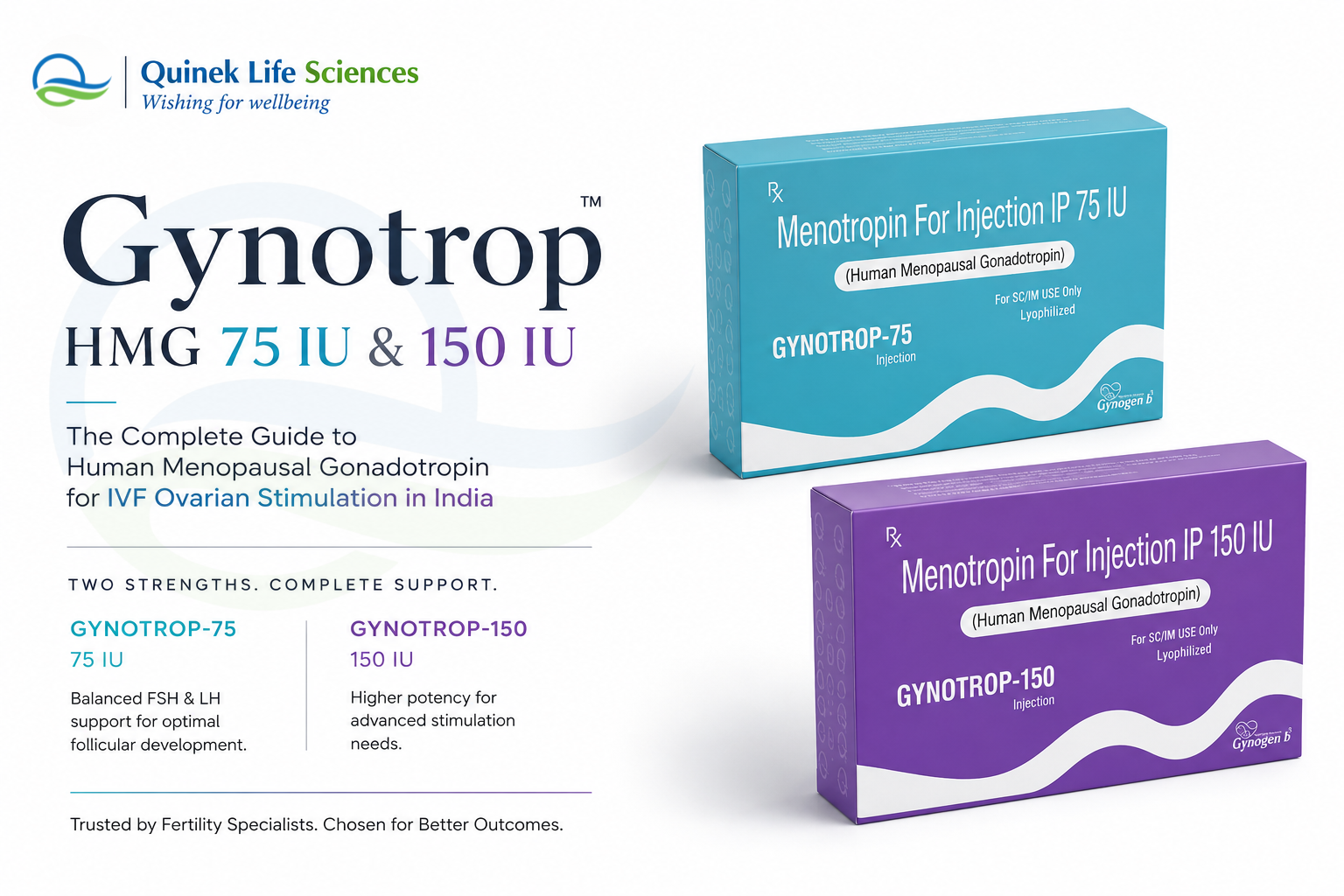
Human Menopausal Gonadotropin is the most physiologically complete ovarian stimulation medicine available — combining FSH and LH in a 1:1 ratio that mimics the natural hormonal environment of ovarian follicle development. Gynotrop, Quinek Life Sciences’ HMG formulation, is available in two strengths — 75 IU and 150 IU — to support every stimulation protocol.
What Is HMG — and Why Does It Contain Two Hormones?
Human Menopausal Gonadotropin (HMG) is a purified preparation extracted from the urine of post-menopausal women. Post-menopausal women have high circulating levels of gonadotropins — FSH (Follicle Stimulating Hormone) and LH (Luteinising Hormone) — because their ovaries have stopped responding to these hormones, prompting the pituitary to produce them in large amounts. This makes post-menopausal urine a reliable biological source of both hormones in a naturally balanced ratio.
Each vial of Gynotrop contains both FSH and LH in a 1:1 ratio — 75 IU of FSH and 75 IU of LH in the 75 IU vial, and 150 IU of FSH and 150 IU of LH in the 150 IU vial. This dual-hormone composition is what distinguishes HMG from recombinant FSH preparations — which contain only FSH.
In the natural menstrual cycle, both FSH and LH play specific and complementary roles in follicular development. FSH drives follicle growth and oestrogen production. LH supports the theca cells of the follicle, stimulates androgen synthesis (which is then converted to oestrogen by the granulosa cells under FSH action) and is critical for the final maturation of the dominant follicle. By providing both, Gynotrop mimics this natural environment more completely than FSH-only preparations — which is why HMG continues to be a preferred choice in specific patient profiles and protocols.
“HMG offers the advantage of dual hormone content — FSH and LH — providing more comprehensive and physiological gonadotropic stimulation compared to single-hormone preparations. This can result in more natural hormone profiles and potentially improved outcomes in specific patient populations.”
— Peptide Database, HMG Clinical Overview
HMG vs Recombinant FSH — Why Both Are Still Used in IVF
Both HMG and recombinant FSH (rFSH) are effective for ovarian stimulation. The question of which to use is not about which is superior overall — it is about which is more appropriate for a specific patient’s profile and protocol.
When HMG (Gynotrop) Is Preferred
Patients with low LH levels (hypogonadotropic hypogonadism) where LH supplementation is essential. Women who are poor responders where the dual FSH+LH stimulation may improve follicular recruitment. Protocols where endogenous LH has been suppressed by GnRH agonists, leaving the follicles LH-deficient. Patients where the more physiological steroidogenesis profile of HMG is clinically preferred. Budget-conscious protocols where HMG provides dual hormone stimulation at a lower cost than separate rFSH + rLH preparations.
When rFSH Is Preferred
Normal responders with adequate endogenous LH where FSH alone drives adequate follicular development. Protocols requiring precise, independent dose titration of FSH and LH. Patients with PCOS where LH is already elevated and additional LH may increase the risk of ovarian hyperstimulation. GnRH antagonist protocols in normal responders, where endogenous LH suppression is less complete and FSH alone is typically sufficient.
Clinical Indications for Gynotrop HMG
Controlled Ovarian Stimulation (COS) for IVF/ICSI
The primary indication for Gynotrop. In IVF protocols, Gynotrop is administered daily from the second or third day of the menstrual cycle, stimulating the ovaries to develop multiple follicles simultaneously. Follicular development is monitored by transvaginal ultrasound and serum oestradiol — with doses adjusted based on response. Starting doses of 150–300 IU/day (2 or 4 vials of Gynotrop 75 IU, or 1–2 vials of Gynotrop 150 IU) are typically used, depending on the patient’s age, ovarian reserve and prior response.
Ovulation Induction for IUI
In Intrauterine Insemination (IUI) cycles, lower doses of HMG (typically 75–150 IU/day — one vial of Gynotrop 75 or Gynotrop 150) are used to stimulate the development of one or two dominant follicles in women with anovulation or unexplained infertility. Careful monitoring is essential to avoid multi-follicular development and the associated risk of multiple pregnancy.
Hypogonadotropic Hypogonadism
Women whose infertility is due to low pituitary output of both FSH and LH (hypogonadotropic hypogonadism — WHO Group I anovulation) have an absolute requirement for exogenous both FSH and LH. HMG is the ideal formulation for this indication because it provides both hormones in a physiologically relevant ratio — making Gynotrop the first-line choice over FSH-only preparations in this specific patient group.
Poor Responders in IVF
Women who have responded poorly to previous FSH-only stimulation — producing fewer eggs than expected for their ovarian reserve — are often switched to or supplemented with HMG in subsequent cycles. The dual FSH+LH action of Gynotrop may improve follicular recruitment and oestradiol production in poor responders, particularly older patients where LH sensitivity of the follicles is a contributing factor.
Male Infertility — Hypogonadotropic Hypogonadism
In men with hypogonadotropic hypogonadism — where low FSH and LH result in impaired spermatogenesis — HMG is used alongside HCG to stimulate sperm production. LH (provided by HMG) stimulates testosterone production in the testes, while FSH supports the Sertoli cells that nurture developing sperm. This combined approach is one of the most effective treatments for spermatogenic failure of central origin.
Gynotrop 75 vs Gynotrop 150 — Which Strength for Which Patient?
Monitoring During Gynotrop Stimulation — What Every Clinic Needs to Do
Gonadotropin stimulation without adequate monitoring is unsafe. The risk of Ovarian Hyperstimulation Syndrome (OHSS) — ranging from mild bloating to severe, life-threatening fluid shifts — is directly related to how carefully the ovarian response is tracked and how quickly the dose is adjusted in over-responding patients.
Transvaginal Ultrasound
Monitoring begins 5–7 days after stimulation starts. Follicle number, size and growth rate are assessed. The trigger injection is typically given when the leading follicle reaches 17–18mm in diameter and at least two follicles have reached 15mm or above. In OHSS-risk patients, the protocol is adjusted if more than 15–20 follicles are developing simultaneously.
Serum Oestradiol
Measured every 2–3 days during stimulation. Rising oestradiol confirms follicular activity and guides dose adjustment. Rapidly rising oestradiol — particularly above 3,000–4,000 pg/mL in an IVF cycle — may indicate an over-response and requires immediate dose reduction or cycle modification to prevent OHSS.
Trigger Injection Timing
Once optimal follicular development is confirmed, an HCG trigger injection is administered to complete final egg maturation. Egg retrieval is scheduled precisely 34–36 hours after the trigger — a window determined by the biology of the LH surge. Gynotrop does not replace the trigger injection — HCG or GnRH agonist trigger is given separately.
Contraindications — When Gynotrop Should Not Be Used
Gynotrop HMG is contraindicated in women with: high FSH levels indicating primary ovarian failure; uncontrolled thyroid or adrenal dysfunction; pituitary tumours or other intracranial lesions; unexplained vaginal bleeding; ovarian cysts or ovarian enlargement not caused by PCOS; and in confirmed or suspected pregnancy.
Women with PCOS should be treated with extreme caution due to their high sensitivity to gonadotropin stimulation and elevated risk of OHSS. A low starting dose (Gynotrop 75 IU/day) and a step-up protocol with very close monitoring is essential in this patient group.
Quinek Life Sciences — IVF & Fertility Segment
Gynotrop 75 & Gynotrop 150 — HMG From a WHO-GMP Certified IVF Pharmaceutical Specialist
Gynotrop is Quinek Life Sciences’ Human Menopausal Gonadotropin formulation — available in both 75 IU and 150 IU strengths to support every stimulation protocol from IUI to complex IVF cycles. Manufactured at our WHO-GMP, GLP and ISO certified facilities, Gynotrop meets the quality and potency standards that fertility specialists require from every vial.
Quinek Life Sciences’ IVF and fertility segment is built on decades of reproductive medicine experience — our Founder was instrumental in introducing IVF treatment to India through the country’s third IVF programme. That heritage is reflected in every product we manufacture for the fertility space, including Gynotrop.
If you are a fertility specialist, IVF clinic or pharmaceutical distributor looking to partner with a trusted reproductive medicine pharmaceutical company — Quinek Life Sciences and Gynotrop are ready to support your practice.
When the Ovaries Need Both Signals to Respond — Gynotrop Delivers Both
Every IVF cycle is a conversation between hormones and the ovaries. In some patients, FSH alone is sufficient to drive that conversation. In others — particularly those with low LH, hypogonadotropic hypogonadism or a history of poor response — the ovaries need both signals to respond optimally. Gynotrop HMG provides those signals together, in every vial, in a physiologically balanced ratio that no single-hormone preparation can replicate.
Gynotrop 75 and Gynotrop 150 from Quinek Life Sciences — built for IVF specialists who understand that the right stimulation protocol, with the right medicine, is the foundation of every successful cycle.
Medical Disclaimer: This article is for educational purposes and healthcare professional reference only. Gynotrop HMG must be prescribed and administered under the supervision of a qualified fertility specialist. Self-administration without medical oversight is dangerous.
Sources: IVF-Worldwide — HMG Overview · Peptide Database — HMG Clinical Reference · NCBI — HMG vs rFSH in IVF · Indian Society for Assisted Reproduction · Quinek Life Sciences IVF Segment