
Gynaecology · July 2026
Uterine Fibroids Affect 40% of Indian Women. F-ibroid Brings Three Evidence-Backed Ingredients Together to Reduce Fibroid Size and Relieve Symptoms.
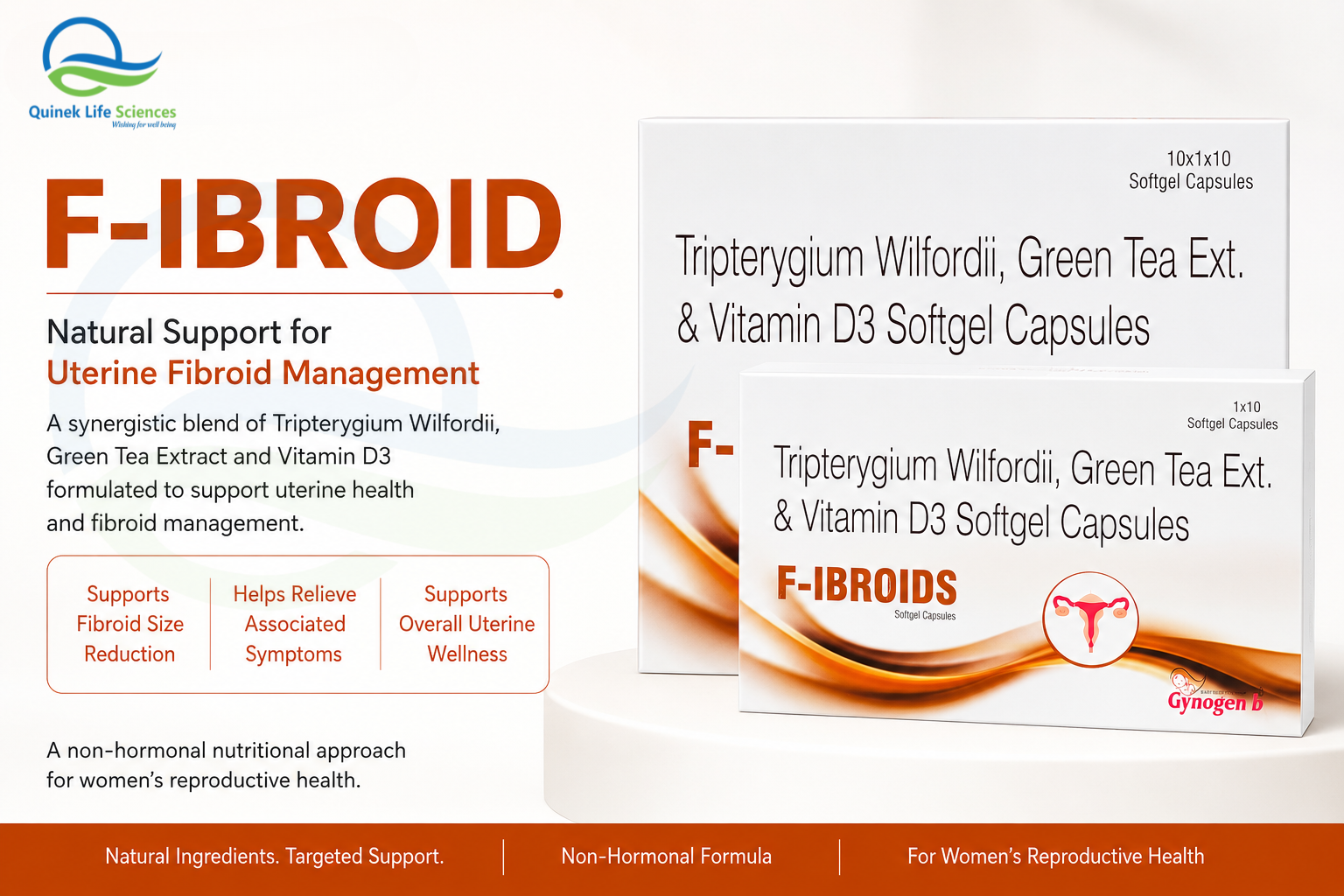
For women living with uterine fibroids, the choice has long been binary — hormonal treatment or surgery. F-ibroid from Quinek Life Sciences offers a third pathway: a targeted nutraceutical formulation combining Tripterygium Wilfordii, Green Tea Extract and Vitamin D3 — three ingredients with published clinical evidence for reducing fibroid size and improving fibroid-related symptoms without hormonal intervention.
40%
Indian women affected by uterine fibroids
37.3%
Reduction in individual fibroid size with EGCG + Vitamin D3 (clinical study)
17.8%
Overall fibroid burden reduction at patient level (90 days)
3
Active ingredients — anti-inflammatory, antioxidant, anti-proliferative
What Are Uterine Fibroids — and Why Are They So Common in India?
Uterine fibroids — also called leiomyomas or myomas — are non-cancerous growths of the smooth muscle cells of the uterus. They are the most common gynaecological condition in women of reproductive age. Studies estimate that 40% of Indian women develop fibroids at some point during their reproductive years, with prevalence rising with age. By the time a woman reaches menopause, the cumulative incidence across populations globally reaches 70–80%.
Fibroids can be single or multiple, tiny or very large, and positioned in different layers of the uterine wall — submucosal (inside the uterine cavity), intramural (within the muscle wall) or subserosal (on the outer surface). Their symptoms depend on their size, number and location — but the most commonly reported are heavy, prolonged and painful menstrual periods; pelvic pain and pressure; back pain; frequent urination; pain during intercourse; and in some cases, difficulty conceiving or recurrent miscarriage.
Fibroids are oestrogen-dependent — they grow when oestrogen levels are high (reproductive years) and typically shrink after menopause when oestrogen falls. This oestrogen sensitivity, combined with chronic low-grade inflammation and Vitamin D deficiency — both extremely common in Indian women — creates an environment where fibroid development and growth is actively promoted. Addressing these drivers is precisely where F-ibroid’s formulation is targeted.
“In a prospective clinical study of premenopausal women with uterine fibroids treated with Green Tea Extract (EGCG) and Vitamin D for 90 days — a significant reduction in fibroid mean size was observed both at the patient level (−17.8%, p=.03) and at individual fibroid level (−37.3%, p=.015). Pelvic pain and abnormal uterine bleeding also improved significantly.”
— Grandi et al., Gynecological Endocrinology (2022) — Vitamin D and Green Tea for Uterine Fibroids, Published on PubMed (PMID: 34658291)
What Is F-ibroid?
F-ibroid is Quinek Life Sciences’ targeted gynaecological supplement formulated specifically for women with uterine fibroids — particularly those seeking a non-hormonal, non-surgical approach to fibroid management. It combines three active ingredients — Tripterygium Wilfordii root extract, Green Tea Extract (standardised for EGCG) and Vitamin D3 — each addressing a distinct biological mechanism involved in fibroid development, growth and persistence.
F-ibroid is not a replacement for surgical treatment in women with very large fibroids causing severe symptoms or fertility-compromising anatomy. It is positioned as a primary management option for mild-to-moderate fibroids in women not immediately requiring surgery, as an adjunct to medical management, and as pre-surgical preparation or post-procedural support to reduce fibroid recurrence.
The Three Ingredients in F-ibroid — How Each One Works
Each ingredient targets a specific, documented mechanism in fibroid biology. Together they provide multi-pathway suppression of fibroid growth and inflammation.
Tripterygium Wilfordii Root Extract
Anti-Inflammatory · Anti-Fibrotic · Immune Modulation
Tripterygium Wilfordii — known in traditional Chinese medicine as Lei Gong Teng (Thunder God Vine) — is a well-studied botanical with potent anti-inflammatory, anti-fibrotic and immunosuppressive properties. Its primary bioactive compounds include triptolide and celastrol, which suppress the NF-kB inflammatory signalling pathway — a key driver of fibroid cell proliferation and extracellular matrix deposition.
In the context of uterine fibroids, Tripterygium Wilfordii reduces the chronic, low-grade inflammation in the uterine microenvironment that promotes fibroid growth. It inhibits fibrosis — the formation of the dense collagen-rich extracellular matrix that constitutes the bulk of fibroid tissue — and has demonstrated anti-proliferative effects on fibroid smooth muscle cells in laboratory studies. Its immune-modulating action may also address the dysregulated immune environment of the fibroid-affected uterus.
Green Tea Extract — Standardised for EGCG
Antiproliferative · Antioxidant · Fibroid Cell Apoptosis
The active polyphenol in green tea extract — Epigallocatechin Gallate (EGCG) — is one of the most extensively studied natural compounds in fibroid research. EGCG works through multiple mechanisms that collectively reduce fibroid burden. It inhibits the proliferation of fibroid smooth muscle cells and promotes their apoptosis (programmed cell death), reversing the abnormal growth pattern that defines fibroid development. It suppresses the pro-inflammatory and pro-fibrotic signalling molecules — including TGF-beta, vascular endothelial growth factor (VEGF) and matrix metalloproteinases — that sustain fibroid growth and matrix deposition.
EGCG also reduces fibroid cell sensitivity to oestrogen by downregulating oestrogen receptor expression — directly countering the hormonal drive that sustains fibroid growth. The clinical study published in Gynecological Endocrinology (2022) and the Korean single-centre study (CEOG 2025) both confirmed significant fibroid size reduction with EGCG-containing combinations over 12–16 weeks of treatment, with good tolerability and no significant adverse effects.
Vitamin D3
Fibroid Suppression · Anti-Proliferative · Matrix Remodelling
Vitamin D3 deficiency is independently associated with an increased risk of uterine fibroid development and more severe fibroid presentations. Research has established that Vitamin D3 receptors are expressed on fibroid cells — and when activated by Vitamin D3, these receptors suppress fibroid cell proliferation, reduce extracellular matrix protein production (including collagen and fibronectin that form the bulk of fibroid tissue) and inhibit the expression of matrix metalloproteinases involved in fibroid expansion.
The clinical relevance in India is significant: 70–90% of Indian women are Vitamin D3 deficient, and studies confirm that hypovitaminosis D exacerbates DNA damage in fibroid cells — accelerating their growth. Correcting Vitamin D3 deficiency with F-ibroid addresses both the direct anti-fibroid effect of Vitamin D3 and the deficiency-driven component of fibroid proliferation that is so prevalent in the Indian population.
Symptoms F-ibroid Helps Manage
Heavy Menstrual Bleeding
Submucosal and large intramural fibroids increase menstrual blood loss, often causing iron-deficiency anaemia. The anti-inflammatory and anti-proliferative action of F-ibroid’s ingredients reduces fibroid vascularity and prostaglandin-driven heavy bleeding over time — with improvements typically noticeable within 2–3 months of consistent use.
Pelvic Pain and Pressure
The clinical study confirmed significant improvement in pelvic pain scores over 90 days. Anti-inflammatory action from both Tripterygium Wilfordii and EGCG reduces the chronic inflammatory state in the fibroid-containing uterus that drives pelvic pain and cramping.
Fibroid Size Reduction
The published clinical evidence demonstrates meaningful reduction in fibroid dimensions — particularly in intramural fibroids — with the EGCG and Vitamin D3 combination over 90 days. Tripterygium Wilfordii’s anti-fibrotic action further supports regression of the extracellular matrix component of fibroid volume.
Menstrual Dysmenorrhoea
Painful periods driven by fibroid-associated prostaglandin excess and uterine contractility are addressed through the anti-inflammatory pathways of F-ibroid’s ingredients — reducing the prostaglandin load that drives both pain and excessive uterine contractions during menstruation.
Bloating and Urinary Frequency
As fibroids shrink in size, the mechanical pressure symptoms they exert on adjacent organs — bladder and bowel — naturally improve. Women with large subserosal or broad-ligament fibroids often report significant relief from pressure-related symptoms as fibroid volume reduces with treatment.
Post-Procedural Recurrence Support
Fibroids have a high recurrence rate after myomectomy. F-ibroid’s multi-mechanism approach — suppressing the inflammatory, proliferative and oestrogen-sensitising pathways — makes it appropriate as a long-term maintenance strategy after myomectomy or uterine artery embolisation to delay or prevent fibroid recurrence.
Which Patients Should Be Prescribed F-ibroid?
Women with ultrasound-confirmed fibroids of mild-to-moderate size (typically less than 5cm) who are symptomatic but not yet requiring surgical intervention. This is the primary indication — providing a non-hormonal, non-surgical management option that has clinical support from published evidence.
Women declining hormonal therapy — who want to manage fibroid symptoms without combined oral contraceptives, progestogens or GnRH analogues. F-ibroid offers a meaningful alternative pathway.
Women with fibroids and Vitamin D3 deficiency — which describes the majority of Indian women with fibroids. Correcting Vitamin D3 deficiency alongside EGCG and Tripterygium Wilfordii addresses both the nutritional and molecular drivers of fibroid persistence.
Post-myomectomy maintenance — to reduce the risk of fibroid recurrence in the months and years following surgical removal, particularly in women who are not ready for or interested in hormonal post-operative management.
Important Prescribing Notes
Tripterygium Wilfordii has known toxicity at high doses and must always be used at the prescribed therapeutic dose under physician supervision. It is not appropriate for self-medication or use outside of a monitored prescribing context. Liver function monitoring is advisable with long-term use.
Not indicated in pregnancy or in women actively trying to conceive in the immediate term, as the safety profile of Tripterygium Wilfordii in pregnancy has not been established. A reliable contraceptive method should be used during treatment with F-ibroid.
Quinek Life Sciences — Gynaecology Segment
F-ibroid — Evidence-Based Fibroid Support From a WHO-GMP Certified Gynaecology Specialist
F-ibroid is part of Quinek Life Sciences’ dedicated gynaecology range — formulated for gynaecologists who treat uterine fibroids and want a clinically supported, non-hormonal option to offer women who are not immediately requiring surgery. Manufactured at our WHO-GMP, GLP and ISO certified facilities with standardised botanical extracts and pharmaceutical-grade Vitamin D3.
If you are a gynaecologist managing fibroid patients or a pharmaceutical distributor looking to expand into the women’s health nutraceutical-pharmaceutical space, Quinek Life Sciences and F-ibroid would like to support your practice.
Surgery Is Not the Only Answer — F-ibroid Offers a Third Path
For too long, women with uterine fibroids have been told their options are hormones or surgery. Both have their place. But between diagnosis and the operating table, there is meaningful ground where a targeted, evidence-based supplement can genuinely help — reducing fibroid size, easing symptoms, delaying progression and improving quality of life.
F-ibroid from Quinek Life Sciences — Tripterygium Wilfordii, Green Tea Extract and Vitamin D3 — is built for gynaecologists who want to offer their patients that third path. Backed by published clinical evidence. Manufactured to WHO-GMP standards. Targeted at the biology that drives fibroid growth.
Medical Disclaimer: This article is for educational purposes and healthcare professional reference only. F-ibroid should be prescribed and used under the guidance of a qualified gynaecologist. It is not a substitute for surgical treatment in women with large, symptomatic or fertility-compromising fibroids. Tripterygium Wilfordii must be used under physician supervision.
Sources: Grandi et al., Gynecological Endocrinology 2022 (PMID 34658291) · CEOG — EGCG + Vitamin D3 Asian Fibroid Study 2025 · Contemporary OB/GYN — Vitamin D and Green Tea for Fibroids · NCBI — Tripterygium Wilfordii Anti-Inflammatory · Quinek Life Sciences Gynaecology Segment