
Neuropsychiatry — Epilepsy · June 2026
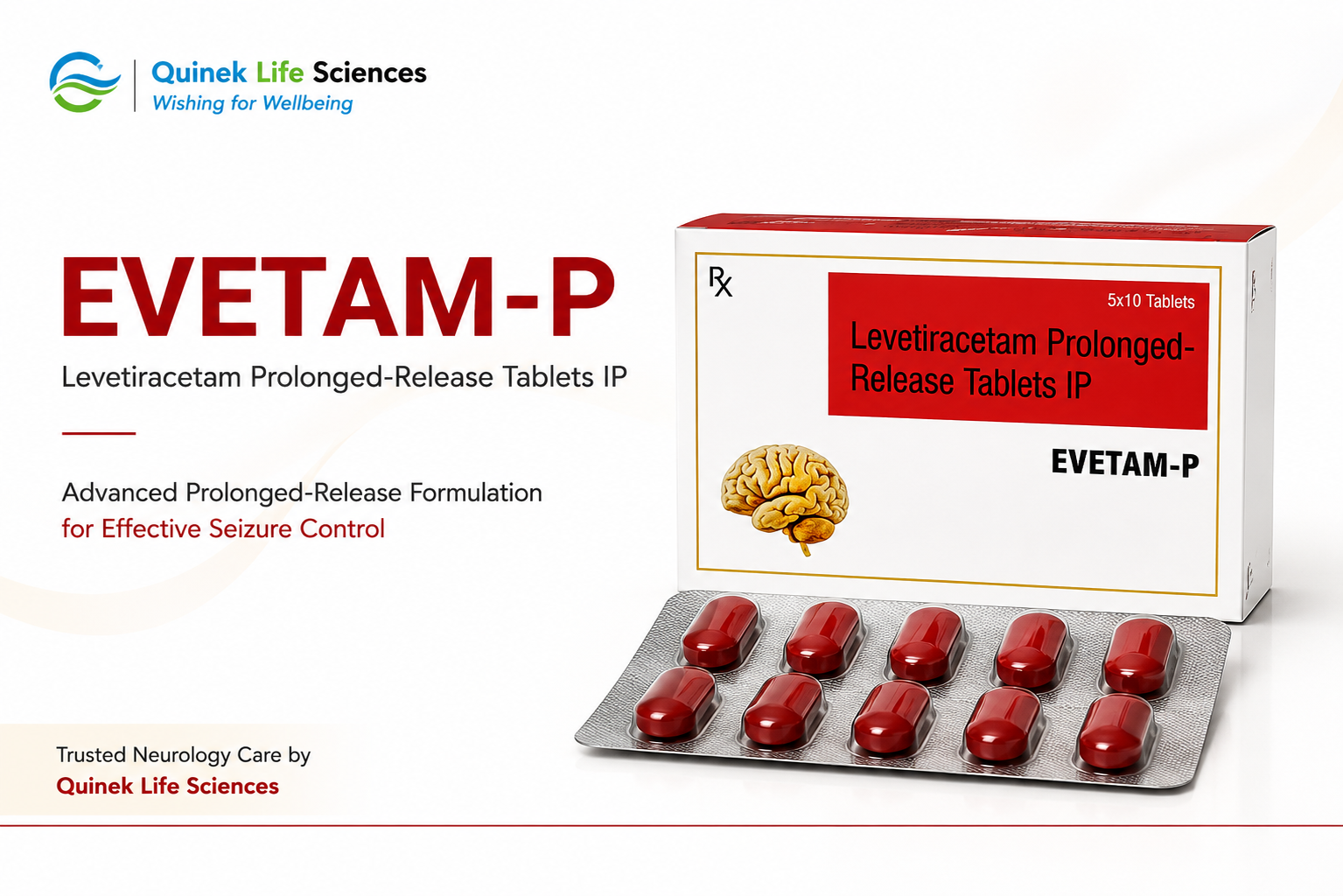
Seizure Control That Lasts Through the Day — Introducing EVETAM-P, Levetiracetam 500mg Prolonged Release by Quinek Life Sciences
Levetiracetam is one of the most widely prescribed antiepileptic medicines in India. But standard immediate-release tablets require twice-daily dosing — and dose timing becomes critical when a single missed dose can increase seizure risk. EVETAM-P’s prolonged-release formulation solves this: steadier drug levels, simplified dosing and better seizure control across the full 24-hour cycle.
10M+
Indians living with epilepsy
70%
Epilepsy patients who can be seizure-free with proper treatment
3,000mg
Maximum recommended daily dose of Levetiracetam
SV2A
Unique mechanism — synaptic vesicle protein binding
Epilepsy in India — The Scale of the Problem and Why Medicine Matters So Much
India has over 10 million people living with epilepsy — one of the largest epilepsy populations in the world. Yet studies suggest that more than 50% of people with epilepsy in India remain either untreated or inadequately treated. The consequences are severe: recurrent seizures, injuries, loss of driving and employment rights, psychological burden on patients and families, and in some cases, sudden unexpected death in epilepsy (SUDEP).
The good news is that epilepsy is manageable. In fact, approximately 70% of people with epilepsy can become seizure-free with appropriate antiepileptic drug therapy. The challenge lies not just in starting the right medicine — but in maintaining consistent blood levels around the clock to prevent breakthrough seizures.
This is precisely where EVETAM-P — Levetiracetam 500mg Prolonged Release — offers a clinical advantage over standard immediate-release formulations. It is designed to deliver consistent, sustained drug levels throughout the day and night, reducing seizure vulnerability during the troughs that can occur between immediate-release doses.
“Levetiracetam’s unique mechanism of action — binding to the synaptic vesicle protein SV2A — sets it apart from every other antiepileptic drug. It does not work through the same channels as older medicines, which means it works in patients where others have failed.”
What Is Levetiracetam — and Why Is It Different?
Levetiracetam is a second-generation antiepileptic drug that has become one of the most prescribed anticonvulsants globally — including in India — due to its unique mechanism, broad-spectrum efficacy, favourable tolerability profile and low drug interaction potential.
Unlike most older antiepileptic drugs, which work primarily by blocking sodium channels or enhancing GABA activity, Levetiracetam works through a completely distinct mechanism — binding to the Synaptic Vesicle Protein 2A (SV2A). This protein is located on the surface of synaptic vesicles in the brain and plays a critical role in regulating the release of neurotransmitters into the synapse. By modulating SV2A, Levetiracetam reduces the abnormal, excessive neuronal firing that leads to seizures — without significantly affecting normal neurological function.
The SV2A Mechanism — Why It Matters Clinically
Every antiepileptic drug works by reducing excessive brain activity — but the specific mechanism determines which seizure types it controls, how it interacts with other medicines and what side effects it produces.
Levetiracetam’s SV2A binding is unique in two important ways. First, SV2A is found throughout the brain — which gives Levetiracetam broad-spectrum efficacy across multiple seizure types. Second, because it does not significantly affect voltage-gated sodium channels or GABA receptors at therapeutic doses, it can be combined with medicines that do — without redundant mechanisms or compounding toxicity.
In addition to SV2A binding, Levetiracetam also inhibits calcium N-type channels and acts as a neuromodulator — further contributing to its broad anticonvulsant profile and its utility in both monotherapy and adjunctive therapy settings.
Why Prolonged Release Matters — EVETAM-P vs Standard Levetiracetam
Standard immediate-release Levetiracetam tablets must be taken twice daily — typically 12 hours apart. While this works well for many patients, it creates challenges in specific clinical scenarios.
The Problem With Immediate-Release
Immediate-release Levetiracetam produces peak-and-trough blood level fluctuations. The blood level rises sharply after each dose and then falls before the next dose. This trough period — particularly the early morning hours before the first dose of the day — is a window of reduced drug coverage when breakthrough seizures are most likely to occur. In patients with strict dose-timing requirements, any disruption to the schedule carries risk.
The EVETAM-P Prolonged Release Advantage
EVETAM-P’s prolonged-release matrix releases Levetiracetam gradually over an extended period — maintaining steadier plasma concentrations with reduced peak-to-trough fluctuation. This produces more consistent seizure protection throughout the 24-hour cycle, reduces the concentration-dependent side effects that occur at peak levels (particularly dizziness and somnolence), and can simplify the dosing regimen for patients who struggle with strict twice-daily timing.
What Seizure Types Does EVETAM-P Treat?
Levetiracetam has one of the broadest seizure-type coverage profiles of any modern antiepileptic drug. EVETAM-P is indicated for:
Partial-Onset Seizures
Both simple and complex partial seizures — seizures that begin in one specific area of the brain. Levetiracetam is used as monotherapy and as adjunctive therapy in adults and children. It is one of the most commonly prescribed first-line agents for focal epilepsy in India.
Myoclonic Seizures in JME
Juvenile Myoclonic Epilepsy — one of the most common generalised epilepsy syndromes in young adults in India. Levetiracetam is specifically indicated for myoclonic jerks in patients with JME aged 12 years and above. It is considered a first-line treatment option for this syndrome.
Primary Generalised Tonic-Clonic Seizures
Grand mal seizures involving the entire body — loss of consciousness, muscle stiffening and rhythmic jerking. Levetiracetam is indicated as adjunctive therapy for PGTCS in adults and children aged 6 years and above with idiopathic generalised epilepsy.
Adjunctive Therapy in Refractory Epilepsy
For patients whose seizures are not fully controlled on a single antiepileptic drug, Levetiracetam can be added as adjunctive therapy without significant pharmacokinetic interactions with most other antiepileptics — a major clinical advantage in complex polytherapy situations.
Dosing EVETAM-P — Titration and Maintenance
Levetiracetam follows a structured titration protocol designed to improve tolerability while building to a therapeutic dose. EVETAM-P’s 500mg prolonged release tablet is the core unit of this protocol.
Why Levetiracetam — Key Clinical Advantages Over Older Antiepileptics
Minimal Drug Interactions
Levetiracetam is not significantly metabolised by the CYP450 enzyme system and does not induce or inhibit liver enzymes. This means it has very few pharmacokinetic interactions with other medicines — a critical advantage in epilepsy patients who are often on multiple drugs including antiepileptics, antihypertensives and psychiatric medicines.
No Titration for Liver or Kidney Enzymes
Unlike Valproate, Carbamazepine and Phenytoin, Levetiracetam does not require monitoring of liver function, blood counts or drug levels in routine clinical use. This significantly reduces the cost and complexity of long-term epilepsy management for patients and clinicians alike.
Suitable for Women of Childbearing Age
Unlike Valproate — which carries a significant teratogenic risk and is contraindicated in women of childbearing potential in many countries — Levetiracetam has a more favourable reproductive safety profile. It is often the preferred choice for epilepsy management in young women who may become pregnant.
Renal Dosing Required
Levetiracetam is excreted renally — dose adjustment is required in patients with significant renal impairment. This is an important consideration in epilepsy patients with comorbid CKD. The prescriber should calculate GFR and adjust dosing accordingly in this patient group.
Side Effects — What to Expect and How to Manage Them
Levetiracetam is generally well tolerated. The most commonly reported side effects are:
Somnolence and Fatigue
Most common in the first few weeks of treatment, particularly during titration. Usually resolves as the body adjusts. Starting at the recommended 1000mg/day and titrating gradually minimises this. EVETAM-P’s prolonged-release formulation reduces peak concentration spikes — which can further reduce somnolence compared to immediate-release tablets.
Behavioural Changes and Irritability
A minority of patients — particularly those with pre-existing psychiatric comorbidity — may experience irritability, agitation or emotional lability. Patients and caregivers should be counselled about this possibility before starting treatment, and any significant mood changes should be reported to the prescribing neurologist promptly.
Headache and Nasopharyngitis
Listed among the very common side effects in clinical trial data — both headache and nasopharyngitis are transient and typically mild. They are more commonly reported in the early treatment period.
Never Stop Without Medical Guidance
Levetiracetam must never be discontinued abruptly. Stopping any antiepileptic drug suddenly can trigger status epilepticus — a life-threatening seizure emergency. If discontinuation is required, the dose must be tapered gradually under neurologist supervision.
What Patients and Caregivers on EVETAM-P Need to Know
Take EVETAM-P at the same times every day. Consistency in timing directly affects seizure protection — even prolonged-release formulations benefit from predictable dosing schedules.
Swallow EVETAM-P tablets whole. Do not crush, chew or break prolonged-release tablets — this destroys the extended-release mechanism and delivers the entire dose at once, eliminating the prolonged-release benefit and potentially causing concentration-related side effects.
Can be taken with or without food — but consistency matters. Taking it the same way each day reduces variability in absorption.
Report mood changes immediately. Irritability, aggression or significant mood changes should be communicated to the prescribing neurologist without delay.
Do not drive or operate machinery until you know how EVETAM-P affects you — particularly in the first few weeks of treatment when somnolence is most likely.
Quinek Life Sciences — Neuropsychiatry Segment
EVETAM-P — Levetiracetam 500mg Prolonged Release, Manufactured to WHO-GMP Standards
EVETAM-P is Quinek Life Sciences’ prolonged-release Levetiracetam formulation — manufactured at our WHO-GMP, GLP and ISO certified facilities with the batch-to-batch consistency that antiepileptic therapy demands. In epilepsy management, formulation quality directly affects plasma level stability — and plasma level stability directly affects seizure control.
Our neuropsychiatry range covers the breadth of conditions managed by psychiatrists and neurologists in India — and EVETAM-P is a core part of our neurology portfolio. As awareness of epilepsy and access to specialist care grows across India’s Tier 2 and Tier 3 cities, our commitment is to ensure that quality antiepileptic medicines reach every level of the healthcare system.
If you are a neurologist, psychiatrist or general physician managing epilepsy patients, or a distributor expanding into the neuropsychiatry space — Quinek Life Sciences and EVETAM-P are ready to support your practice.
70% of People With Epilepsy Can Be Seizure-Free. The Right Medicine Is Where It Starts.
Epilepsy is manageable. For most patients, the path to seizure freedom runs through consistent, quality pharmaceutical therapy — taken at the right dose, at the right time, without interruption. The prolonged-release formulation in EVETAM-P is designed to support exactly that — steadier drug levels, simpler dosing and consistent seizure protection across the full 24-hour cycle.
EVETAM-P — Levetiracetam 500mg Prolonged Release from Quinek Life Sciences — is manufactured with the understanding that what matters most in epilepsy is not just starting treatment, but staying seizure-free. And that requires a formulation built to deliver consistent results, every day.
Medical Disclaimer: This article is for educational purposes and healthcare professional reference only. EVETAM-P must be prescribed and monitored by a qualified neurologist or licensed physician. Never start, change or stop antiepileptic medication without medical supervision. If you or someone you know is experiencing a seizure emergency, call 112 immediately.
Sources: Epilepsy Foundation — Levetiracetam · Neurology India — LEV as Antiepileptic & Neuroprotective · Indian Epilepsy Society · CDSCO Prescribing Guidelines · Quinek Life Sciences Neuropsychiatry Segment