
10M+
Indian Men With Symptomatic BPH
50%
Men Over 50 Have BPH Symptoms
80%
Men Over 70 Affected
90%
Managed With Medicines — No Surgery Needed
There is a conversation that happens in millions of Indian households — the one that never happens. A man in his fifties or sixties wakes up three or four times a night to urinate. He notices his stream is weaker than it used to be. He rushes to the bathroom more urgently than he once did, sometimes not making it in time. He assumes it is age. He says nothing. He waits.
He waits — sometimes for years — before he mentions it to a doctor. And when he finally does, the doctor often tells him something that comes as a genuine shock: this is not just ageing. This is a treatable medical condition called Benign Prostatic Hyperplasia. And there are medicines that could have been helping him this entire time.
BPH — the non-cancerous enlargement of the prostate gland — is one of the most common conditions affecting Indian men over 45. It is also one of the most undertreated, largely because of social silence around men’s urological health, a tendency to attribute symptoms to normal ageing, and a lack of clear, accessible information about what is actually happening and what can be done.
This article is the information that should have been available earlier. It is written for men living with symptoms they have not yet named, for families trying to understand what their father or husband is experiencing, and for general practitioners and urologists who need a reliable urology pharmaceutical partner when they reach for an alpha blocker or a 5-ARI.
In This Article
- What Is BPH — And What Is the Prostate?
- The BPH Burden in India — Why This Matters
- Symptoms of Enlarged Prostate — What to Look For
- The IPSS Score — How Doctors Measure BPH Severity
- Why Does the Prostate Enlarge? Causes and Risk Factors
- How BPH Is Diagnosed
- Treatment — What Works and What the Evidence Says
- BPH Medicines — Alpha Blockers and 5-ARIs
- Frequently Asked Questions
- Living Well With BPH
- How Quinek Life Sciences Supports Urology Practice
1. What Is BPH — And What Is the Prostate?
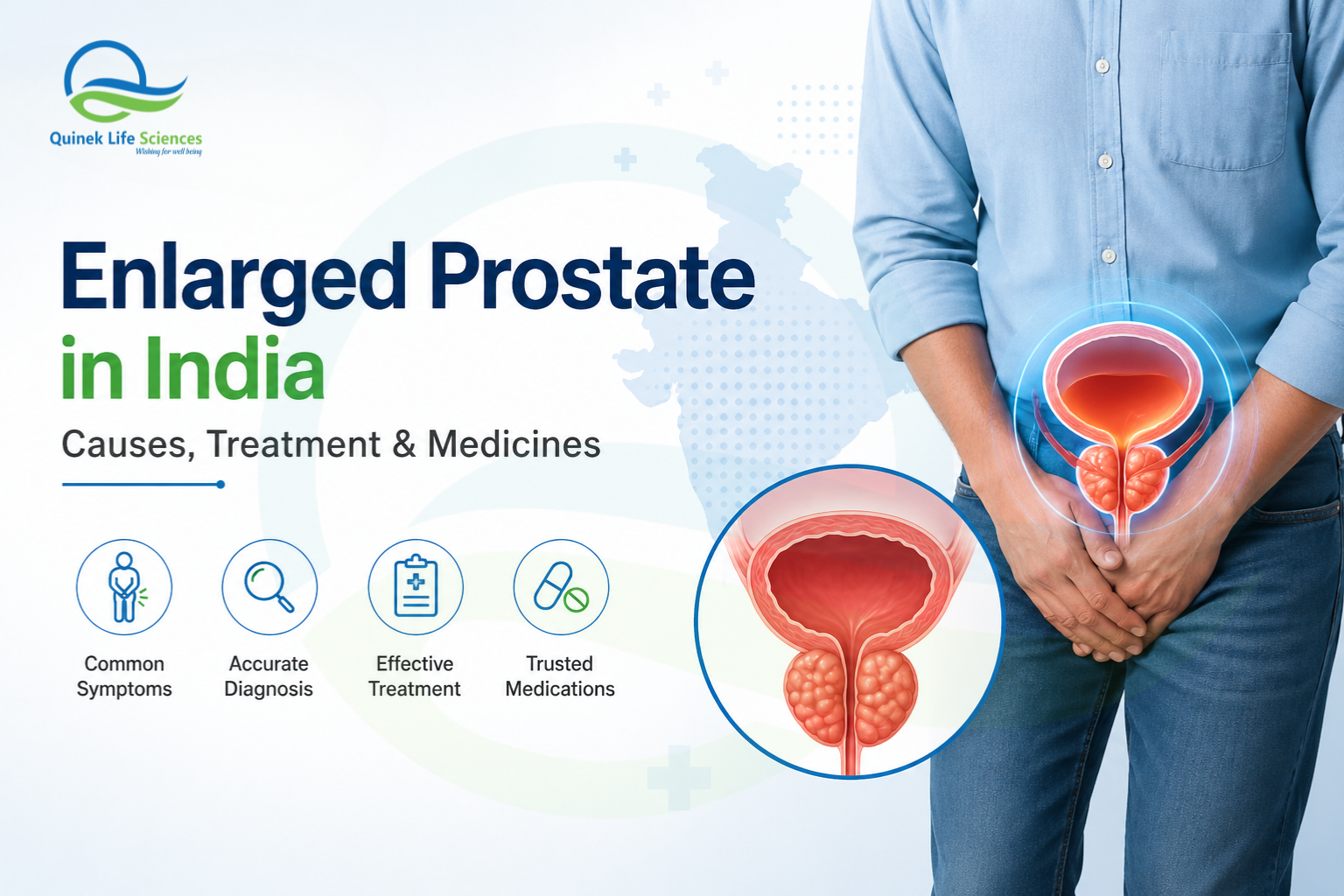
The prostate is a small, walnut-sized gland that sits just below the bladder and surrounds the urethra — the tube through which urine exits the body. In young men, the prostate weighs approximately 20 grams and functions primarily in the reproductive system, producing seminal fluid that nourishes and transports sperm.
From around age 40, the prostate begins a second phase of growth — driven by the conversion of testosterone to dihydrotestosterone (DHT) by the enzyme 5-alpha reductase. This growth is called Benign Prostatic Hyperplasia — benign because it is not cancerous, hyperplasia because it involves an increase in the number of cells. As the prostate enlarges, it squeezes the urethra — like a hand squeezing a straw — producing the urinary symptoms that define BPH.
Clinical Definition
Benign Prostatic Hyperplasia (BPH) is defined as a non-malignant enlargement of the prostate gland caused by hyperplasia of both stromal and epithelial elements. The clinical diagnosis requires the presence of lower urinary tract symptoms (LUTS) attributable to bladder outlet obstruction — prostate size alone, without symptoms, is not diagnostic. See the EAU Guidelines on Male LUTS for full diagnostic criteria.
2. The BPH Burden in India — Why This Matters
India’s male population includes an enormous and rapidly growing cohort of men above 45 — the demographic most affected by BPH. The treatment gap — between men who have symptomatic BPH and those receiving appropriate management — is wide, and the reasons are largely social and informational rather than medical.
The most important figure is the delay. Indian men live with BPH symptoms for three to five years before seeing a doctor — not because they are unaware something is wrong, but because urinary symptoms are normalised as ageing, because men are reluctant to discuss urination or reproductive anatomy, and because clear clinical information is not reaching them in time.
3. Symptoms of Enlarged Prostate — What to Look For
BPH produces two categories of urinary symptoms — obstructive (caused by physical narrowing of the urethra) and irritative (caused by the bladder’s response to obstruction). Most men have a mixture of both.
Obstructive Symptoms (Voiding Symptoms)
Hesitancy (difficulty starting)
Straining to pass urine
Intermittent stream
Feeling of incomplete emptying
Terminal dribbling
Urinary retention
Irritative Symptoms (Storage Symptoms)
Urgency
Nocturia (waking at night to urinate)
Urge incontinence
Important for Patients
Not all urinary symptoms are caused by BPH. Urinary tract infection, overactive bladder, diabetes and neurological conditions can produce similar symptoms. Any new urinary symptoms — particularly blood in urine, pain on urination or sudden inability to urinate — require prompt medical evaluation. Do not self-diagnose. See a urologist or general practitioner for proper assessment.
4. The IPSS Score — How Doctors Measure BPH Severity
The International Prostate Symptom Score (IPSS) is the standard clinical tool for assessing BPH severity. Seven questions about urinary symptoms are each scored 0 to 5. The total score (out of 35) directly guides treatment decisions.
5. Why Does the Prostate Enlarge? Causes and Risk Factors
BPH is fundamentally a hormonal and age-related process — but several factors influence how quickly it develops and how severely it affects quality of life.
The Role of DHT
The primary driver of BPH is dihydrotestosterone (DHT) — produced from testosterone by the enzyme 5-alpha reductase within prostate tissue. DHT stimulates prostate cell proliferation. This is why 5-alpha reductase inhibitors like Dutasteride — which block DHT production — are so effective at reducing prostate volume over time.
Age
Most significant risk factor. Prevalence doubles with each decade after age 40.
Family History
Men with a father or brother who had BPH develop it earlier and more severely.
Metabolic Syndrome
Obesity, type 2 diabetes, hypertension and dyslipidaemia increase BPH risk and severity independently.
Physical Inactivity
Sedentary lifestyle associated with worse LUTS. Regular moderate exercise reduces symptom severity.
6. How BPH Is Diagnosed
BPH diagnosis is primarily clinical — built on symptoms, history, physical examination and a focused set of investigations. A trained urologist or general practitioner can diagnose BPH reliably in most cases without complex investigations.
History and IPSS
A detailed symptom history combined with the IPSS questionnaire forms the foundation of diagnosis. The clinician should also ask about medication history (many drugs worsen LUTS), previous urological problems, neurological conditions and comorbidities including diabetes.
Digital Rectal Examination (DRE)
DRE allows the clinician to assess prostate size, consistency and surface texture. A smooth, symmetrically enlarged prostate is characteristic of BPH. A hard, irregular or asymmetric prostate raises concern for prostate cancer and should prompt PSA testing and urology referral.
PSA (Prostate Specific Antigen)
PSA is used to rule out malignancy, estimate prostate volume and guide treatment decisions. Men with PSA above 1.4 ng/mL are more likely to benefit from 5-ARI therapy. PSA is not prostate cancer-specific — elevated PSA also occurs in BPH and prostatitis.
Uroflowmetry and Post-Void Residual
Uroflowmetry measures peak flow rate (Qmax). Below 10 mL/s is strongly suggestive of bladder outlet obstruction. Post-void residual (PVR) above 100–150 mL on ultrasound indicates clinically significant incomplete emptying and increased risk of UTI, bladder stones and renal impairment.
7. Treatment — What Works and What the Evidence Says
The goal of BPH treatment is seizure freedom — restoration of normal urinary function and protection of long-term bladder and kidney health, with minimum medication burden. For the vast majority of men, this is fully achievable with medical management alone.
Treatment Decision Framework
Watchful waiting — Mild symptoms (IPSS 0–7), no complications, lifestyle optimisation
Alpha blocker alone — Moderate symptoms, smaller prostate (PSA <1.4), patient wants rapid relief
5-ARI alone — Large prostate (>40g or PSA >1.4), patient willing to wait 6–12 months for full effect
Combination therapy — Moderate-to-severe symptoms with large prostate (CombAT trial evidence)
Surgical referral — Failed medical management, retention, recurrent UTI, bladder stones, hydronephrosis
8. BPH Medicines — A Clinical Guide to Alpha Blockers and 5-ARIs
Pharmacological management is the cornerstone of BPH treatment. Understanding the mechanism, clinical profile and key differences between available agents allows prescribers to individualise therapy — and helps patients understand what their medicine is doing and why consistency matters.
Alpha-1 Adrenergic Blockers — Immediate Symptom Relief
Alpha-1 blockers relax smooth muscle in the prostate, bladder neck and urethra — reducing the dynamic component of obstruction. They do not shrink the prostate. Effect is rapid — symptom improvement typically occurs within 24–72 hours of the first dose.
Quinek Formulations — Silodosin
DOSI-Q4 — Silodosin 4mg
DOSI-Q8 — Silodosin 8mg
DOSI-QDT — Silodosin 8mg + Dutasteride 0.5mg (combination)
Silodosin is the most alpha-1A selective blocker available — delivering powerful prostate and bladder neck relaxation with minimal cardiovascular effects (no significant blood pressure drop). Ideal for men on antihypertensives. WHO-GMP Certified · Consistent bioavailability.
Note: Retrograde ejaculation occurs in up to 25% of patients — harmless but counsel proactively.
Quinek Formulation — Tamsulosin + Dutasteride
TAMS-RIDE — Tamsulosin 0.4mg + Dutasteride 0.5mg
Mirrors the CombAT trial regimen — superior IPSS improvement, increased peak flow and reduced acute urinary retention risk vs monotherapy over 4 years. Delivers immediate alpha blocker relief alongside progressive prostate volume reduction. WHO-GMP Certified.
Quinek Formulation — Alfuzosin + Dutasteride
ALFURIDE — Alfuzosin HCl 10mg + Dutasteride 0.5mg
Alfuzosin has the lowest rate of ejaculatory dysfunction among alpha blockers — making it the preferred choice for sexually active men concerned about ejaculatory side effects. Combined with Dutasteride for dual mechanism benefit. WHO-GMP Certified.
Medicine Selection Guide — BPH
Rapid Relief, Smaller Prostate
Silodosin monotherapy — DOSI-Q4 or DOSI-Q8
Moderate Symptoms, Large Prostate
Combination — TAMS-RIDE or ALFURIDE
Maximum Uroselectivity
Silodosin + Dutasteride combination — DOSI-QDT
Ejaculation Concern
Alfuzosin-based — ALFURIDE (lowest ejaculatory side effects)
9. Frequently Asked Questions About Enlarged Prostate
Is BPH the same as prostate cancer?
No — they are entirely different conditions. BPH is a non-cancerous enlargement caused by normal hormonal changes with ageing. Prostate cancer involves malignant transformation. Having BPH does not increase your risk of prostate cancer. However, some symptoms overlap, which is why proper evaluation — including PSA testing and DRE — is important to rule out malignancy.
Can enlarged prostate be treated without surgery?
Yes — this is the norm. Over 90% of BPH patients are managed successfully with medicines alone. Alpha blockers provide rapid symptom relief. 5-ARIs reduce prostate volume over 6–12 months. Surgery is reserved for cases that fail medical management or develop complications like urinary retention or kidney damage.
What is the difference between Silodosin, Tamsulosin and Alfuzosin?
All three are alpha-1 blockers that relax prostate and bladder neck muscles. Silodosin (DOSI-Q) is the most uroselective — highest prostate selectivity with least cardiovascular effects, but highest rate of retrograde ejaculation. Tamsulosin is moderately uroselective with an excellent evidence base. Alfuzosin has the lowest ejaculatory side effects — preferred for sexually active men. Choice depends on comorbidities and patient preference after counselling.
How long do BPH medicines take to work?
Alpha blockers produce measurable improvement within 24–72 hours and reach maximum effect in 2–4 weeks. 5-ARIs (Dutasteride) work more slowly — prostate volume reduction begins at 3–6 months and maximum effect at 12 months. This is why patients on 5-ARI therapy must be counselled about the delay, and why combination therapy is often preferred.
Can BPH lead to kidney damage?
Yes — in severe untreated cases. Chronic bladder outlet obstruction can lead to bladder damage, recurrent UTIs, bladder stones and ultimately hydronephrosis with impaired renal function. This is why untreated severe BPH is genuinely dangerous — not just a quality of life issue — and why early treatment matters.
10. Living Well With BPH — What Nobody Tells You
Lifestyle Changes That Actually Work
Regular moderate exercise — 30 minutes of walking five days a week — has been shown in multiple studies to reduce IPSS scores by 2–3 points. Weight loss in overweight men reduces prostate volume and symptom severity. Reducing evening fluid intake, limiting caffeine and alcohol, and double-voiding are practical strategies most men find genuinely helpful.
Medicines That Can Worsen BPH Symptoms
Discuss with your doctor if you take: antihistamines (older generation), decongestants containing pseudoephedrine, tricyclic antidepressants, antispasmodics or antipsychotics — they may be worsening your symptoms. Evening diuretics worsen nocturia — switching to a morning dose often helps significantly.
11. How Quinek Life Sciences Supports Urology Practice in India
Quinek Life Sciences is a WHO-GMP, GLP and ISO certified specialty pharmaceutical company with a comprehensive urology range built for Indian clinical practice. In BPH management, medicine quality is not optional — it is clinical. A patient stabilised on an alpha blocker from a sub-standard manufacturer may experience breakthrough symptoms from bioavailability variation — not treatment failure.
Our BPH portfolio covers the full spectrum of alpha blocker and 5-ARI management: DOSI-Q4 · DOSI-Q8 · DOSI-QDT · TAMS-RIDE · ALFURIDE · ORA-Q (Nitrofurantoin SR for BPH-associated UTI) · OLIF-Q10 / OLIF-Q5 (Solifenacin for storage LUTS and overactive bladder).
If you are a urologist, general practitioner or specialist looking to partner with a quality-first urology pharmaceutical company in India, we would welcome a conversation. Get in touch with our team today.
“BPH affects over 10 million Indian men. Most suffer in silence for years. The medicines exist. The evidence is clear. The only gap is awareness — and access.”
Quinek Life Sciences — WHO-GMP Certified Urology Pharmaceutical Company, India
References & Further Reading
- European Association of Urology — Guidelines on Male LUTS, 2023
- American Urological Association — BPH Guidelines, 2023
- World Health Organization — BPH Fact Sheet
- Indian Journal of Urology — Epidemiology and Management of BPH in India
- CombAT Trial — Dutasteride + Tamsulosin vs Monotherapy in BPH
- Urological Society of India — Clinical Guidelines
- Quinek Life Sciences — Urology Segment
This article is for educational and clinical reference purposes. It does not constitute medical advice for individual patients. Always consult a qualified urologist or general practitioner for diagnosis and treatment decisions. Do not start, stop or change any medicine without medical supervision.