
Urology · June 2026
Enlarged Prostate Is Disrupting Millions of Men’s Lives in India. The DOSI-Q Range Is Built to Change That.
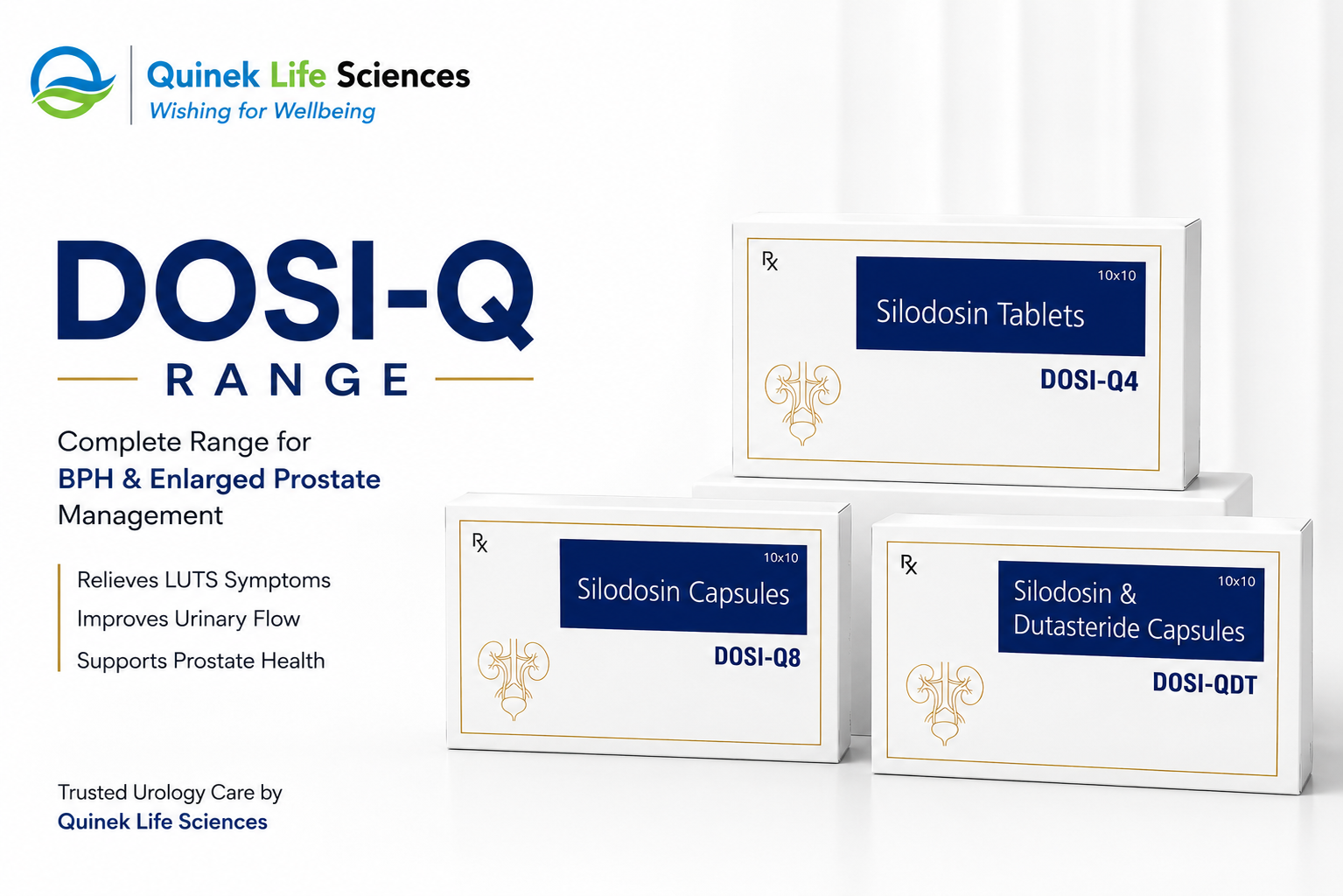
Getting up four times a night. Waiting at the washroom. Never feeling completely empty. Benign Prostatic Hyperplasia is not life-threatening — but it destroys quality of life. The DOSI-Q Range from Quinek Life Sciences — Silodosin 4mg, 8mg and the combination of Silodosin 8mg with Dutasteride 0.5mg — addresses BPH from two directions: immediate symptom relief and long-term prostate size reduction.
50%
Men over 50 affected by BPH in India
80%
Men over 80 with clinically significant BPH
67%
Indian urologists preferring Silodosin + Dutasteride for BPH with urinary retention
88.8%
TWOC success rate with Silodosin + Dutasteride combination
What Is BPH — and Why Is It Such a Problem in India?
Benign Prostatic Hyperplasia — commonly called an enlarged prostate — is one of the most prevalent urological conditions affecting men in India. It is not cancer. It is not dangerous in the immediate sense. But it is quietly, steadily and comprehensively disruptive to the daily life of every man who has it.
The prostate gland sits directly beneath the bladder and surrounds the urethra — the tube through which urine and semen exit the body. As men age, the prostate naturally grows. When it grows too large, it compresses the urethra and obstructs the flow of urine. The bladder works harder to compensate. The muscles of the bladder wall thicken. And progressively, a man finds himself unable to empty his bladder fully, waking multiple times at night to urinate, struggling to start urination and living with a persistent sense of urgency and discomfort.
BPH affects approximately 50% of Indian men over 50 and up to 80% of men over 80. It is underreported and undertreated — largely because men do not seek help until symptoms significantly impair their quality of life. The DOSI-Q Range is designed for urologists who need a reliable, evidence-backed pharmaceutical option across the full spectrum of BPH severity.
“A combination of Silodosin and Dutasteride was favoured by 67% of Indian urology experts for BPH patients with acute urinary retention — and clinical studies have shown a Trial Without Catheter success rate of 88.8% with this combination at 12 weeks.”
— International Journal of Advances in Medicine, Expert Consensus on Silodosin in Indian Clinical Settings
Understanding the Symptoms — LUTS and BPH
BPH produces a group of symptoms collectively called Lower Urinary Tract Symptoms (LUTS). These fall into two categories:
Obstructive (Voiding) Symptoms
Difficulty starting urination, weak or intermittent urinary stream, straining to urinate, prolonged urination time, feeling of incomplete bladder emptying, dribbling at the end of urination. These symptoms are caused by the enlarged prostate physically compressing the urethra.
Irritative (Storage) Symptoms
Frequent urination (daytime), nocturia (waking at night to urinate), urgency (sudden, difficult-to-control urge to urinate), urge incontinence. These are caused by the bladder’s overactive response to the obstruction — it becomes hypersensitive and contracts at smaller volumes.
Why BPH Needs Two-Pronged Treatment
BPH has two distinct pathological components — and treating only one of them produces incomplete results.
Component 1 — Dynamic
Smooth Muscle Tone
The prostate and bladder neck contain smooth muscle fibres controlled by alpha-1 adrenergic receptors. When these are activated, the muscles contract — further narrowing the urethra. Alpha-1 blockers like Silodosin relax these muscles, immediately widening the urethral opening and improving urine flow. This is the fast-acting component of BPH treatment.
Component 2 — Static
Prostate Tissue Growth
The enlarged prostate tissue itself is driven by dihydrotestosterone (DHT) — a potent androgen converted from testosterone by the enzyme 5-alpha reductase. 5-Alpha reductase inhibitors like Dutasteride block this conversion, reducing DHT levels and causing the prostate to physically shrink over months. This is the slow-acting, disease-modifying component.
The DOSI-Q Range — Three Products, Three Clinical Scenarios
Which DOSI-Q Product Is Right for Which Patient?
What Patients Need to Know About Side Effects
All medicines in the DOSI-Q Range are well tolerated in the majority of patients. The most commonly reported side effects and their management are:
Retrograde Ejaculation
The most frequently reported side effect of Silodosin — affecting approximately 22–28% of patients. Semen travels backward into the bladder during ejaculation rather than exiting. This is not harmful and reverses on discontinuation. Patients should be counselled in advance.
Orthostatic Hypotension
A drop in blood pressure on standing — reported in approximately 27% of patients on Silodosin, though usually mild. Risk is higher in patients on concurrent antihypertensives. Starting with DOSI-Q4 (4mg) in at-risk patients and taking the dose at bedtime significantly reduces this risk.
Reduced Libido (Dutasteride)
DHT reduction by Dutasteride can cause reduced libido and erectile dysfunction in a minority of patients. These effects are usually mild and transient, often resolving within the first few months of treatment even without discontinuation.
PSA Reduction (Dutasteride)
Dutasteride reduces PSA levels by approximately 50% after 6 months of treatment. This must be accounted for when interpreting PSA values for prostate cancer screening. The true PSA value is estimated by doubling the measured value in patients on Dutasteride.
Quinek Life Sciences — Urology Segment
The DOSI-Q Range — Complete BPH Management From a WHO-GMP Certified Manufacturer
The DOSI-Q Range — DOSI-Q4, DOSI-Q8 and DOSI-QDT — gives urologists a complete portfolio for BPH management across every stage of disease severity. From the first-line 4mg initiation dose to the dual-mechanism combination tablet for advanced BPH, every product is manufactured at our WHO-GMP, GLP and ISO certified facilities to the same exacting quality standards.
Quinek Life Sciences’ urology range extends beyond BPH — covering the pharmaceutical needs of urology specialists across India. If you are a urologist, a urology clinic or a pharmaceutical distributor looking for a reliable urology partner, we would like to hear from you.
BPH Is Not Something Men Should Just Live With
There is a common tendency among men to normalise urinary symptoms as just part of getting older. They are not. They are treatable symptoms of a treatable condition — and treating them early makes a real difference, both to quality of life and to the risk of serious complications like acute urinary retention and progressive bladder damage.
The DOSI-Q Range from Quinek Life Sciences — Silodosin 4mg, Silodosin 8mg and Silodosin 8mg with Dutasteride 0.5mg — gives urologists the clinical tools to manage BPH comprehensively, from first presentation to long-term disease modification. Quality-assured, specialist-targeted, and built for the demands of Indian urology practice.
Medical Disclaimer: This article is for educational purposes and healthcare professional reference only. All BPH treatment decisions must be made by a qualified urologist based on individual patient assessment, prostate size, symptom score and clinical history.
Sources: International Journal of Advances in Medicine — Silodosin Expert Consensus India · PMC — Silodosin & Dutasteride in AUR · Apollo Pharmacy Clinical Reference · Indian Journal of Pharmacology · Quinek Life Sciences Urology Segment