
Neuropsychiatry ·
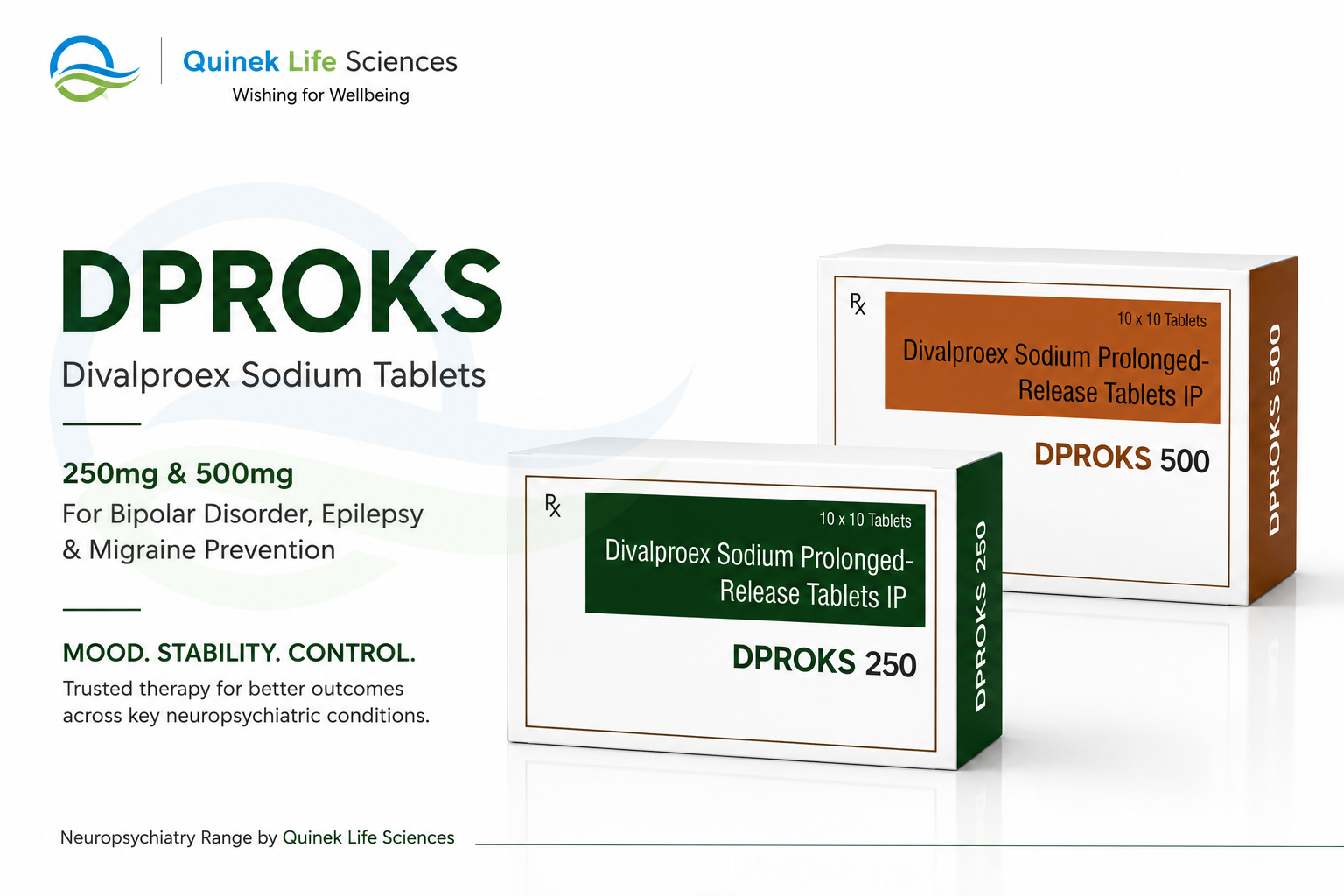
Divalproex Sodium — The Medicine That Treats Bipolar Disorder, Epilepsy and Migraines. Introducing DPROKS by Quinek Life Sciences.
Three of the most challenging neuropsychiatric conditions in India — one medicine with decades of clinical evidence behind it. DPROKS, Quinek Life Sciences’ Divalproex Sodium formulation in 250mg and 500mg, is designed for the precision demands of neuropsychiatry and neurology practice.
A Medicine That Works Across Three Major Neuropsychiatric Conditions
Some medicines are highly specific — designed for one condition, one mechanism, one outcome. Divalproex Sodium is something different. It is a compound with proven, guideline-backed efficacy across three of the most prevalent and most debilitating neuropsychiatric conditions in India: Bipolar Disorder, Epilepsy and Migraine prevention. Each use is distinct, each mechanism is understood, and each is supported by decades of clinical evidence.
Divalproex Sodium is a stable coordination compound of sodium valproate and valproic acid — a formulation designed to improve tolerability compared to valproic acid alone by enteric coating that reduces direct gastric irritation. It is the delayed-release form preferred in Indian neuropsychiatry and neurology practice for its predictable absorption profile and established efficacy.
DPROKS, Quinek Life Sciences’ Divalproex Sodium formulation, is available in two strengths — 250mg and 500mg — giving prescribers the dose flexibility required across all three indications, across a wide range of patient profiles and body weights.
“Divalproex Sodium is one of the most versatile medicines in neuropsychiatry — its ability to stabilise neuronal excitability and modulate neurotransmitter systems makes it effective across conditions that, on the surface, look very different from each other.”
How Divalproex Sodium Works — The Mechanism
Divalproex Sodium works through multiple complementary mechanisms — which is part of why it is effective across such a diverse range of neurological and psychiatric conditions.
GABA Enhancement
Divalproex increases levels of GABA (gamma-aminobutyric acid) — the brain’s primary inhibitory neurotransmitter. By increasing GABA availability and activity, it reduces excessive neuronal firing. This is central to its anticonvulsant effect and contributes to its mood-stabilising and anti-anxiety properties.
Sodium Channel Blockade
By blocking voltage-gated sodium channels in a state-dependent manner, Divalproex reduces the ability of neurons to fire repetitively at high frequency — the hallmark of seizure activity and thought to be involved in the mood cycling of Bipolar Disorder and the cortical spreading depression of migraines.
Neurotransmitter Modulation
Divalproex also influences serotonin and dopamine systems — neurotransmitters that play central roles in mood regulation, reward processing and the pathophysiology of Bipolar Disorder. This multi-target neurotransmitter action contributes to its broad clinical utility in neuropsychiatric conditions.
Indication 1 — Bipolar Disorder: Acute Mania and Long-Term Mood Stabilisation
Bipolar Disorder affects millions of Indians — yet it remains one of the most underdiagnosed psychiatric conditions in the country, largely because the manic phase is often mistaken for normal high-energy behaviour or attributed to stress. The depressive phase is similarly misidentified as unipolar depression, leading to inappropriate treatment that can actually trigger manic episodes.
Divalproex Sodium is indicated for the acute treatment of manic or mixed episodes associated with Bipolar Disorder — with or without psychotic features. It is also used as maintenance therapy to reduce the frequency and severity of future mood episodes.
Dosing in Bipolar Disorder
Acute mania: Starting dose of 750mg daily in divided doses (using DPROKS 250mg three times daily), titrated upward rapidly to achieve clinical response or a serum valproate level of 50–125 mcg/mL. Doses of 1000–2500mg/day are commonly required. DPROKS 500mg tablets are used as the dose escalates, reducing the number of tablets required and improving adherence.
Why Divalproex Over Lithium in Some Patients
Divalproex is often preferred over Lithium in patients with mixed episodes (simultaneous manic and depressive features), rapid cycling Bipolar Disorder (four or more episodes per year), comorbid substance use disorders, and in patients who have not responded adequately to Lithium. Its more forgiving therapeutic window compared to Lithium also makes monitoring somewhat less intensive.
Indication 2 — Epilepsy: Seizure Control Across Multiple Seizure Types
India has over 10 million people living with epilepsy — one of the largest epilepsy populations in the world. Despite this, the treatment gap remains enormous, with a significant proportion of patients in rural and semi-urban areas receiving no treatment or inadequate treatment.
Divalproex Sodium is indicated as monotherapy or adjunctive therapy for multiple seizure types, including:
Complex Partial Seizures
Both as monotherapy and as adjunctive therapy in patients who have not responded to first-line agents. Divalproex is effective in controlling complex partial seizures occurring in isolation or in combination with other seizure types.
Absence Seizures
Simple and complex absence seizures, whether occurring alone or in combination with other seizure types. Divalproex is considered a first-line agent for generalised absence epilepsy, particularly in childhood and adolescent presentations.
Generalised Tonic-Clonic Seizures
As adjunctive therapy in patients with multiple seizure types that include generalised tonic-clonic (grand mal) seizures. Divalproex’s broad-spectrum anticonvulsant activity makes it particularly valuable in mixed epilepsy syndromes.
Dosing in Epilepsy
Epilepsy dosing typically begins at 10–15mg/kg/day and is increased by 5–10mg/kg/week until seizures are controlled or side effects require dose adjustment. DPROKS 250mg is used in the initial titration phase, with DPROKS 500mg tablets used as maintenance doses are established. Target serum valproate levels for epilepsy control are typically 50–100 mcg/mL. Twice or three-times daily dosing is standard with delayed-release formulations.
Indication 3 — Migraine Prophylaxis
India has one of the highest migraine burdens in the world — with an estimated 150 million people suffering from migraine headaches. Migraine is not just a headache. It is a complex neurological condition involving visual aura, severe unilateral head pain, nausea and extreme sensitivity to light and sound — often lasting 4–72 hours and significantly disrupting work, social functioning and quality of life.
Divalproex Sodium is indicated for the prophylaxis (prevention) of migraine headaches in adults. It is not used to treat an acute migraine attack — it is prescribed as a daily preventive medicine to reduce the frequency and severity of future attacks.
When Migraine Prophylaxis Is Indicated
Preventive treatment is recommended when a patient experiences four or more migraine days per month, when acute treatments are failing or overused, when attacks are severely debilitating, or when acute therapy is contraindicated. Divalproex is one of only four medicines with Level A evidence for migraine prevention — the highest standard of clinical recommendation.
Dosing in Migraine Prevention
DPROKS 250mg twice daily for one week as the starting dose, increasing to 500mg twice daily (DPROKS 500mg twice daily) if needed. Full prophylactic effect typically takes 4–8 weeks to become evident. Patients should be counselled to continue the medicine for at least 3–6 months before assessing effectiveness, and should not judge it by its impact in the first few weeks.
Safety, Monitoring and Important Warnings
Contraindicated in Pregnancy
Divalproex Sodium carries a significant teratogenic risk. It must not be used in pregnancy unless there is absolutely no safer alternative for the indication. Women of childbearing potential must use effective contraception and be counselled about this risk before starting DPROKS.
Liver Function Monitoring
Divalproex can cause hepatotoxicity, particularly in the first six months of treatment. Liver function tests must be performed before starting treatment and at regular intervals, especially in the initial period. Patients should be advised to report symptoms of liver problems — jaundice, abdominal pain, unusual fatigue — immediately.
Serum Valproate Level Monitoring
Therapeutic drug monitoring helps ensure the patient is within the effective range (50–100 mcg/mL for most indications, 50–125 mcg/mL for Bipolar). It also identifies patients with levels high enough to cause toxicity — including sedation, tremor and cognitive blunting.
Weight Gain and Metabolic Effects
Weight gain is one of the most commonly reported side effects of Divalproex and can significantly affect patient adherence. Baseline weight, BMI and metabolic parameters should be recorded, and regular monitoring continued throughout treatment. Dietary counselling alongside DPROKS therapy improves long-term compliance.
Quinek Life Sciences — Neuropsychiatry Segment
DPROKS — Divalproex Sodium 250mg & 500mg — Precision Neuropsychiatry from a WHO-GMP Certified Manufacturer
DPROKS is Quinek Life Sciences’ dedicated Divalproex Sodium formulation — available in the two most clinically used strengths of 250mg and 500mg. It is manufactured at our WHO-GMP, GLP and ISO certified facilities with the same commitment to pharmaceutical quality that underpins every product across our specialty segments.
The availability of both strengths gives psychiatrists, neurologists and general physicians the dose flexibility to initiate therapy at low doses, titrate precisely to the therapeutic level, and maintain long-term treatment with minimal tablet burden. DPROKS 250mg serves the titration and lower-maintenance phase. DPROKS 500mg serves the established treatment dose — particularly in epilepsy and higher-dose bipolar management.
If you are a psychiatrist, neurologist, or general physician prescribing Divalproex, or a pharmaceutical distributor serving the neuropsychiatry segment — Quinek Life Sciences and DPROKS are ready to support your practice.
One Medicine. Three Conditions. Decades of Evidence.
Divalproex Sodium earned its place in the neuropsychiatry formulary through evidence — not marketing. For patients with Bipolar Disorder, it provides mood stability that allows them to work, maintain relationships and live fully. For patients with epilepsy, it controls seizures that would otherwise be defining, limiting events in their daily lives. For patients with chronic migraine, it reduces the frequency of attacks that have made entire weeks of every month unliveable.
DPROKS — Divalproex Sodium 250mg and 500mg from Quinek Life Sciences — brings that evidence to practice, in a formulation manufactured to the quality standards that neuropsychiatry patients, and the specialists who care for them, deserve.
Medical Disclaimer: This article is for healthcare professional and educational reference only. Divalproex Sodium must be prescribed and monitored by a qualified psychiatrist, neurologist or licensed physician. All dosing decisions must be individualised based on clinical assessment, indication and therapeutic drug monitoring. If you or someone you know is experiencing a mental health crisis, please contact iCall (9152987821) or Vandrevala Foundation (1860-2662-345).
Sources: Drugs.com Clinical Reference — Divalproex Sodium · RxList Prescribing Information · Indian Psychiatric Society Guidelines · Epilepsy Foundation · International Headache Society · Quinek Life Sciences Neuropsychiatry Segment