
Gynaecology & Fertility · July 2026
PMOS Starts With Insulin Resistance. DEE ZYR Addresses It — With Four Ingredients Whose Evidence Is Backed by Published Indian Clinical Research.
The most underappreciated driver of PMOS is not excess androgen — it is the insulin resistance that precedes and amplifies it. Myo-Inositol and D-Chiro-Inositol are the two natural insulin sensitisers with the strongest evidence in PCOS/PMOS management. DEE ZYR from Quinek Life Sciences combines both, alongside L-Methylfolate and Vitamin D3, to address the hormonal, metabolic and nutritional dimensions of PMOS simultaneously.
The Insulin Resistance Connection — Why PMOS Is a Metabolic Condition First
Most women with PMOS — now the formal name for what was previously called PCOS — understand it as a hormonal condition involving irregular periods, excess hair and acne. These are real and distressing symptoms. But they are the downstream consequence of something happening further up the metabolic chain: insulin resistance.
In insulin resistance, the body’s cells do not respond normally to insulin signalling. The pancreas compensates by producing more insulin — and these chronically elevated insulin levels stimulate the ovaries to produce excess androgens. It is this androgen excess that drives the acne, the hirsutism, the hair loss and the menstrual irregularity that define the clinical picture of PMOS. Address the insulin resistance and the androgen excess eases. Ease the androgen excess and the symptoms follow.
This is the biological logic behind the Myo-Inositol and D-Chiro-Inositol combination — the two central ingredients of DEE ZYR. Both are natural inositol isomers that function as insulin second messengers, improving the cellular response to insulin and reducing the hyperinsulinaemia that drives ovarian androgen production. A large-scale Indian clinical study involving data from 50 healthcare centres and 283 women with confirmed PCOS demonstrated significant improvements in weight, LH/FSH ratio, hirsutism, free testosterone, DHEA and insulin resistance measures with MI-DCI combination therapy.
“In 283 Indian women with confirmed PCOS treated with Myo-Inositol and D-Chiro-Inositol: 69.6% showed weight reduction, hirsutism scores significantly improved, LH/FSH ratio fell, free testosterone and DHEA levels dropped significantly, and HOMA-IR (insulin resistance marker) improved.”
— Vyas et al., Bioinformation Journal 2022 — MI-DCI in Indian Women With PCOS (50 centres, 283 patients)
The Four Ingredients in DEE ZYR — What Each One Does
DEE ZYR is not a general wellness supplement. Each of its four ingredients addresses a specific, documented aspect of PMOS pathophysiology — and together they provide comprehensive hormonal, metabolic, cellular and nutritional support.
01
Myo-Inositol 1.1g
Insulin Sensitisation · Oocyte Quality · Ovulation
Myo-Inositol (MI) is the most abundant inositol isomer in the human body and serves as the precursor to inositol-containing phospholipids that act as second messengers in the insulin signalling cascade. In PMOS, deficiency of Myo-Inositol in ovarian cells impairs this signalling, contributing to both insulin resistance and poor follicular development. Supplementation with Myo-Inositol restores ovarian insulin sensitivity, improves FSH receptor signalling and enhances oocyte energy metabolism. Clinical evidence shows that MI supplementation restores spontaneous ovulation in women with PMOS-related anovulation, reduces insulin levels, lowers free testosterone and improves oocyte quality in women undergoing IVF. The 40:1 ratio of Myo-Inositol to D-Chiro-Inositol — reflected in DEE ZYR’s 1.1g MI to 27.6mg DCI composition — is supported as the physiologically optimal ratio for ovarian function.
02
D-Chiro-Inositol 27.6mg
Androgen Reduction · Glycogen Synthesis · Peripheral Insulin Sensitivity
D-Chiro-Inositol (DCI) acts as a second messenger in the post-receptor insulin signalling pathway, specifically promoting glycogen synthesis in peripheral tissues and reducing hyperinsulinaemia by improving cellular glucose uptake. In the ovary, DCI-based second messengers stimulate aromatase activity — which converts androgens to oestrogen — while simultaneously reducing androgen production at the theca cell level. The net result is a meaningful reduction in circulating androgens, which translates clinically to reduced hirsutism, improved acne and better menstrual regularity. At 27.6mg, DCI in DEE ZYR is precisely at the 40:1 ratio with MI — the formulation supported by multiple clinical studies as optimal for balancing ovarian and peripheral insulin effects without over-suppressing follicular activity.
03
L-Methylfolate 1.0mg
Active Folate · DNA Integrity · Neural Tube Protection · MTHFR Support
L-Methylfolate is the biologically active form of folate — the form that the body can use directly, without requiring MTHFR enzyme conversion. Standard folic acid must be converted to L-Methylfolate in the body before it can participate in folate-dependent biochemical reactions, including DNA synthesis, cell division and the methylation cycle. Up to 40% of Indians carry MTHFR gene variants that impair this conversion — making standard folic acid supplementation ineffective in a substantial proportion of women. L-Methylfolate bypasses this bottleneck entirely. For women with PMOS who may be planning pregnancy, DEE ZYR’s 1.0mg of L-Methylfolate provides the active folate needed for oocyte development, reduces homocysteine (elevated in many PMOS patients) and protects against neural tube defects in early pregnancy.
04
Vitamin D3 1000 IU
Insulin Sensitivity · Ovarian Function · Hormonal Balance
Vitamin D3 deficiency is exceptionally prevalent in India — affecting an estimated 70–90% of the general population — and is disproportionately common in women with PMOS. This is not a coincidence. Vitamin D3 receptors are present on ovarian cells, and Vitamin D3 plays an active role in regulating insulin sensitivity, AMH signalling, follicular development and the conversion of androgens to oestrogen. Low Vitamin D3 independently worsens insulin resistance and is associated with more severe PMOS presentations. Supplementation with 1000 IU/day — as in DEE ZYR — corrects mild-to-moderate deficiency in most Indian women, improving both metabolic parameters and reproductive outcomes when combined with the inositol components.
What Women With PMOS Can Expect From DEE ZYR
Menstrual Regulation
As insulin sensitivity improves and androgen levels fall, the hypothalamic-pituitary-ovarian axis begins to function more normally. Many women with PMOS-related oligomenorrhoea or amenorrhoea experience restoration of more regular cycles over 3–6 months of MI-DCI treatment. This is one of the most commonly reported and valued clinical outcomes.
Improved Fertility and Ovulation
Restoration of ovulation is the most direct fertility benefit. Studies show that a high percentage of anovulatory women with PMOS begin ovulating with Myo-Inositol treatment alone. For women undergoing IVF, pre-treatment with the MI-DCI combination improves oocyte quality and maturation rates — supporting better embryo development.
Reduction in Hirsutism and Acne
As DCI reduces ovarian androgen production and Myo-Inositol corrects insulin signalling, androgen-mediated symptoms — facial hair, acne, seborrhoea — gradually improve. The Indian clinical study showed significant improvements in hirsutism scores across all severity grades, with severe hirsutism reducing to zero in the treated population.
Metabolic Improvement
HOMA-IR, fasting insulin, blood glucose and lipid profiles all show measurable improvement with MI-DCI treatment in PMOS patients. For women with PMOS and pre-diabetes or metabolic syndrome features, this metabolic benefit extends beyond reproductive health — reducing long-term cardiovascular and diabetes risk.
Weight Management Support
Nearly 70% of Indian PMOS patients in the clinical study reported weight reduction with MI-DCI treatment. Improved insulin sensitivity reduces the lipogenic effect of hyperinsulinaemia — making dietary and lifestyle efforts at weight management more effective when supported by DEE ZYR.
Pre-Conception and IVF Support
For women planning pregnancy — naturally or through IVF — DEE ZYR’s combination of MI-DCI (for oocyte quality), L-Methylfolate (for neural tube protection and DNA integrity) and Vitamin D3 (for uterine and hormonal health) provides comprehensive pre-conception nutritional and hormonal support in a single daily formulation.
Which Patients Should Be Prescribed DEE ZYR?
Women with PMOS/PCOS and insulin resistance — particularly those with elevated fasting insulin, high HOMA-IR, overweight or central obesity. This is the primary target population and where the evidence base for MI-DCI is strongest.
Women with PMOS-related anovulation trying to conceive — who are not yet at the stage of requiring Clomiphene or gonadotropin induction. DEE ZYR is an appropriate first-line intervention before pharmacological ovulation induction is initiated.
Women undergoing IVF with PMOS — where MI-DCI pre-treatment for 3 months before the stimulation cycle has been shown to improve oocyte quality and reduce OHSS risk.
Women with PMOS not wishing to conceive but seeking symptom relief — where hormonal management with combined oral contraceptives is not preferred or indicated, and a non-hormonal, metabolically targeted approach is desired.
Quinek Life Sciences — Gynaecology Segment
DEE ZYR — Four-Ingredient PMOS Support, Manufactured to WHO-GMP Standards
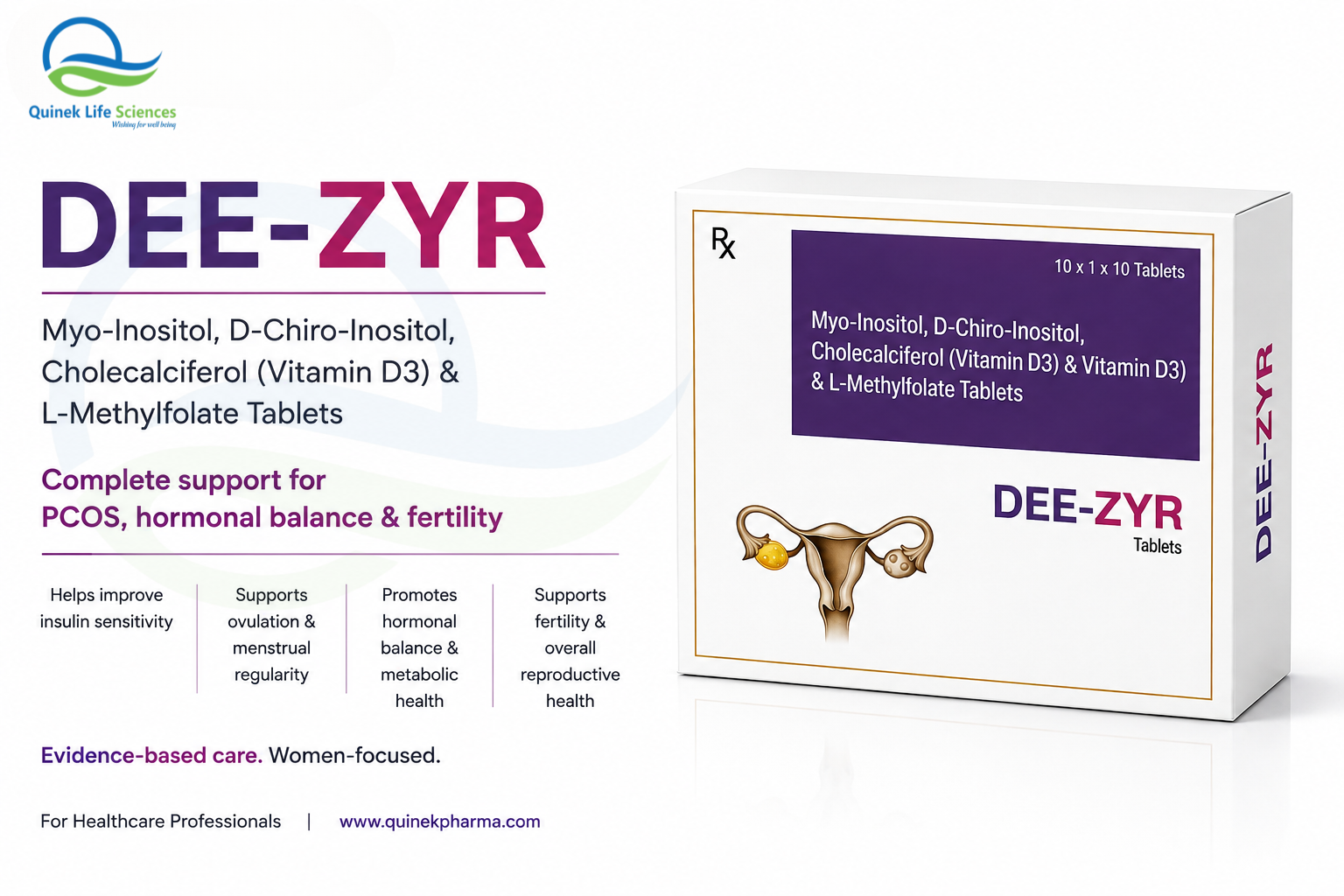
DEE ZYR is Quinek Life Sciences’ comprehensive PMOS nutraceutical-pharmaceutical formulation — combining Myo-Inositol 1.1g, D-Chiro-Inositol 27.6mg, L-Methylfolate 1.0mg and Vitamin D3 1000 IU in a single daily formulation that addresses insulin resistance, androgen excess, folate status and Vitamin D3 deficiency together. Manufactured at our WHO-GMP, GLP and ISO certified facilities.
Our gynaecology segment is built on the understanding that women’s health is multidimensional — and that effective care for conditions like PMOS requires medicines and formulations that address the full metabolic and hormonal picture, not just individual symptoms. DEE ZYR reflects that philosophy.
Treating PMOS at Its Root — Not Its Symptoms
The conversation about PMOS has been changing rapidly — from a condition defined by visible symptoms to one understood as a complex metabolic syndrome with lifelong implications. That understanding demands a treatment approach that goes beyond period regulation and acne management. It demands addressing insulin resistance, androgen excess, nutritional deficiency and reproductive health together.
DEE ZYR — Myo-Inositol 1.1g, D-Chiro-Inositol 27.6mg, L-Methylfolate 1.0mg and Vitamin D3 1000 IU from Quinek Life Sciences — is designed for gynaecologists who treat PMOS the way the evidence says it should be treated: at its metabolic root.
Medical Disclaimer: This article is for educational purposes and healthcare professional reference only. DEE ZYR should be prescribed and used under the guidance of a qualified gynaecologist or reproductive endocrinologist. Individual results may vary based on the severity of PMOS and other clinical factors.
Sources: Vyas et al., Bioinformation 2022 — MI-DCI in Indian PCOS (NCBI PMC9649498) · MDPI Biology — Myo-Inositol and Fertility 2024 · RSC Bay Area — Myo-Inositol for Fertility · Quinek Life Sciences Gynaecology Segment